Apple's iOS 18.1 widgets expose which pool companies run real systems
Apple's September 2026 update lets customers book pool service directly from Lock Screen widgets—but only if your ops stack speaks structured availability.
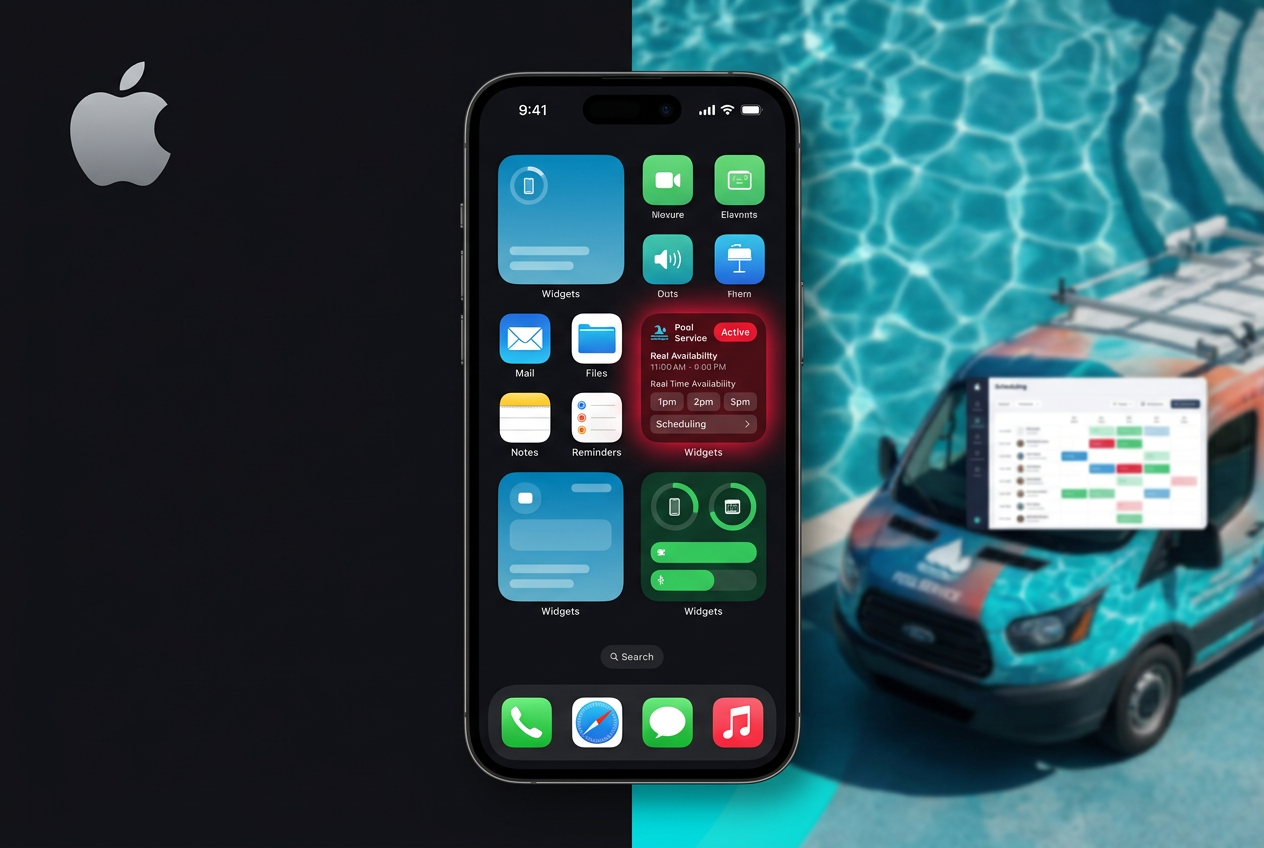
Apple released iOS 18.1 this month with a feature most pool service operators haven't noticed yet: Service & Scheduling widgets in Control Center and Lock Screen search. These widgets surface real-time booking availability for service providers who integrate via Apple's new ServiceExtension API. A customer swipes, sees your next available slot, taps, books.
For pool service companies entering fall maintenance season—the annual push for winterization, equipment checks, and off-season service plans—this is a new native front door. Not a marketing channel. A discovery layer baked into the operating system of every device your customers carry.
But there's a gate: your booking infrastructure must expose structured availability in a machine-readable format. Most pool service operators still run on text message confirmations, shared Google Calendars, or PDF invoices. Apple's API can't parse that. If your ops stack doesn't speak structured data, you're invisible to this surface.
This isn't about installing an app. It's about whether your operations infrastructure was built to export state.
What Apple actually shipped
The ServiceExtension API requires three things:
Real-time slot availability. Not a phone number or a contact form. Actual open time blocks, updated as bookings land and techs shift.
Structured service metadata. Service name, duration, prerequisites (pool type, equipment access, chemical inventory on-site), pricing tier, and tech assignment rules.
Booking confirmation flow. A backend endpoint that accepts a reservation, validates it against your scheduling engine, and returns a confirmed appointment with calendar integration.
If you have a pool service CRM or scheduling system that stores appointments in a database, surfaces a customer booking portal, and manages route optimization, you already have most of this. The question is whether your vendor has built the API bridge to Apple's spec—or whether your system is capable of exposing the hooks a middleware layer needs.
If your "scheduling system" is a shared spreadsheet, a wall calendar, or a texting habit, you can't participate. The widget layer doesn't know you exist.
Why pool service fits
Pool service companies operate on fixed-route, recurring-appointment models. Weekly chemical balance. Bi-weekly cleaning. Seasonal opens in April, closures in October. Equipment repair as needed.
This maps perfectly to widget-driven re-booking.
A customer who scheduled an opening in April can swipe into the widget in September and book a winterization without opening a browser, searching for your company name, or calling your office. The widget surfaces your next three available slots based on their service history, location, and equipment profile. They tap. It's booked. Your route optimization engine gets the payload and assigns a tech.
Compare that to the current flow: customer thinks "I should schedule my pool closing." Maybe they remember your company name. Maybe they have your number saved. Maybe they call. Maybe they leave a voicemail. Maybe your admin calls back tomorrow. Maybe the slot they wanted is gone.
The widget collapses intent-to-booking latency to seconds.
But it only works if your backend can answer three questions in real time:
- What slots are open for this customer's service type and location?
- What are the prerequisites (Do they have a safety cover? Is the equipment winterized? Is the heater gas or electric?)
- Which tech is assigned, and does this fit their route?
If those answers live in your dispatcher's head, in a notebook, or in a text thread, you can't surface them.
The infrastructure gap
Most pool service operators run on one of three infrastructure layers:
Layer one: paper and memory. Routes printed on Monday morning. Changes called in and noted by hand. Dispatch happens over the phone. Techs text when they finish. Invoices are PDFs emailed after the fact.
This works until it doesn't. No visibility. No analytics. No capacity planning. No way to expose availability to a third-party API.
Layer two: consumer tools repurposed. Shared Google Calendar for routes. QuickBooks for invoicing. A separate CRM (often not integrated) for customer contact info. Text or email confirmations.
Better than paper, but still disconnected. The calendar doesn't know your pricing. The CRM doesn't track service prerequisites. The invoice system doesn't trigger re-booking prompts. Nothing talks to anything else in a structured way.
Layer three: unified operations platform. A pool service scheduling software system purpose-built for recurring route-based appointments. Customer records include equipment specs, service history, chemical usage, access notes. Scheduling integrates route optimization. Pricing is dynamic based on service type, frequency, and customer tier. Booking confirmations auto-generate with calendar links. Techs clock in and out from a mobile app. Invoices trigger from completed jobs.
Only layer three can feed Apple's ServiceExtension API. And even then, only if the platform vendor ships the integration—or if the system exposes the right webhook and API structure for a middleware layer to bridge it.
The widget isn't the product. The widget is the interface. The product is your operations infrastructure.
What the API exposes
Apple's spec requires a schema that includes:
- Service catalog. List of bookable services with names, descriptions, durations, and pricing bands.
- Availability matrix. Time slots by service type, filtered by customer location, equipment requirements, and tech capacity.
- Customer context. Service history, equipment profile, billing status, and access instructions.
- Booking validation. Real-time check that a requested slot is still open, conflicts with no other job, and fits within tech route constraints.
This is not a static feed. It's a live query.
When a customer opens the widget, the API calls your scheduling engine and asks: "What's available for this customer in the next 14 days?" Your system queries the database, checks tech calendars, applies route logic, and returns a filtered list of slots.
If your "system" is a person who knows the schedule, this doesn't work.
If your system is a Google Calendar, it can't filter by customer equipment or apply route constraints.
If your system is a standalone booking page with manually entered availability, it's not real-time and can't validate conflicts.
The API assumes you have a scheduling engine that owns state, enforces rules, and exposes structured data.
Fall maintenance as proof
Pool service companies are entering their second major seasonal spike right now. The first is spring openings—March through May, depending on geography. The second is fall maintenance and winterization—September through November.
This is when customers who haven't thought about their pool in three months suddenly realize they need to schedule a closing, drain equipment, balance chemistry for winter, and possibly repair a heater or pump before next season.
Historically, this creates a surge of inbound calls. Companies that answer fast and confirm bookings win. Companies with full voicemail boxes or admin overhead lose jobs to competitors.
The widget changes this dynamic.
A customer who booked their opening with you in April gets a proactive Lock Screen prompt in mid-September: "Schedule your pool winterization with [Your Company]." They see three available slots. They pick one. It's confirmed.
You didn't run an ad. You didn't send an email. You didn't wait for them to call. The system re-engaged them at the moment of intent, using infrastructure you already built for spring.
But only if your spring booking flow was connected to a real scheduling engine. If April's "booking" was a phone call that someone wrote on a calendar, there's no data for the widget to surface in September.
Recurring revenue compounds when the operations layer remembers context and automates re-engagement. The widget is just a new interface to that layer.
What operators should build
If you're running on paper or disconnected consumer tools, this is the forcing function.
You need a pool service CRM and scheduling system that:
- Stores customer records with service history and equipment specs.
- Manages recurring appointments and one-time bookings in a unified calendar.
- Exposes real-time availability via API or webhook.
- Handles route optimization and tech assignment automatically.
- Confirms bookings with structured data (iCal, Google Calendar, SMS, email).
- Tracks job completion and triggers follow-up workflows.
This isn't new advice. These capabilities have been table stakes for scaling a route-based service business for years. What's new is that Apple just made them visible to customers.
If you can't surface availability in real time, you're not just operationally inefficient—you're now invisible in a native discovery layer that your competitors may occupy.
The gap between "we use a calendar" and "we have a scheduling engine" used to be internal. Now it's external. Customers will see which pool companies show up in the widget and which don't.
The middleware play
Not every pool company operations platform will ship an Apple ServiceExtension integration immediately. Some vendors move slowly. Some focus on other priorities. Some don't have the engineering bandwidth.
This creates an opportunity for middleware.
If your scheduling system has an API—even a basic one—you can build or buy a bridge layer that translates your data schema into Apple's spec. That middleware queries your database, structures the response, and feeds the widget.
Zapier won't cut it. This requires a live API with sub-second response time and conflict validation logic.
But if your platform exposes booking state, customer records, and service metadata in any structured format, a middleware layer can connect it.
The key is that your operations infrastructure must be the source of truth. The widget isn't a standalone product. It's a view into your scheduling engine.
Why this compounds
Most marketing advice for service businesses focuses on acquisition: run ads, build a website, get reviews, post on social. All of that generates leads.
But leads aren't revenue. Leads convert to revenue when they book. And one-time bookings convert to recurring revenue when customers re-book.
The widget doesn't just generate leads. It collapses the entire funnel:
- Discovery. Customer sees your service in a native OS surface.
- Intent. They're already looking to book (otherwise they wouldn't open the widget).
- Conversion. They see real-time availability and confirm in two taps.
- Re-engagement. The system reminds them to re-book based on service history.
This only works if your infrastructure supports it. And once it's built, it compounds.
Every seasonal customer you book this fall becomes a re-booking candidate next spring. Every spring opening becomes a fall winterization. Every equipment repair generates a follow-up maintenance appointment.
The widget is just the interface. The compounding happens in the operations layer.
What doesn't work
You can't fake this with a static landing page.
You can't manually update availability twice a day and call it "real-time."
You can't build a booking form that sends you an email and hope someone confirms it fast enough.
Apple's API expects a live scheduling engine. It queries your system, your system responds with filtered availability, and the booking is validated and confirmed in one round trip.
If there's a human in the loop, the latency breaks the experience. If your calendar isn't the source of truth, the API will surface slots that are already taken. If your customer records don't include service context, the widget can't filter availability correctly.
The quality bar is high because the interface is fast. Customers expect the widget to work like every other iOS feature: instant, accurate, no friction.
If your infrastructure can't deliver that, you're better off not integrating at all. A broken widget experience is worse than no widget.
The real forcing function
This isn't about Apple.
Apple didn't invent the need for structured operations infrastructure. They just made it visible.
Pool service companies that scale profitably all converge on the same architecture eventually:
- Unified customer records.
- Recurring service scheduling with route optimization.
- Real-time availability and automated confirmation.
- Mobile tools for techs in the field.
- Analytics and capacity planning.
These aren't features. They're the foundation of a business that can grow revenue without growing operational overhead proportionally.
The widget is simply a new interface to that foundation. If you've built it, the integration is straightforward. If you haven't, the widget is irrelevant—and you probably have bigger problems.
The companies that will dominate fall maintenance bookings this year are the ones that built the scheduling engine two years ago. The companies scrambling to answer voicemails and manually confirm appointments will lose slots to competitors who automated that flow.
And next spring, when the opening season surge hits, the gap will be even wider.
Systems surface in interfaces
Apple's widget isn't a marketing tool. It's a systems visibility layer.
Customers have always preferred service providers who make booking easy, confirm fast, and remember context. The widget just makes that preference explicit. It separates the companies running real operations infrastructure from the ones winging it.
For pool service operators, this is both an opportunity and a deadline.
The opportunity: if your booking stack is already built on structured data and real-time availability, you can occupy a high-intent native surface that most competitors can't access.
The deadline: if you're still running on text messages and shared calendars, you're now visibly absent from a place customers expect to find you.
Fall maintenance season is here. The operators who show up in the widget will book more winterizations with less overhead. The ones who don't will keep answering phone calls and hoping their voicemail box doesn't fill up.
The widget doesn't create competitive advantage. It exposes the advantage you already built—or didn't.
Build the scheduling engine. The interfaces will follow.