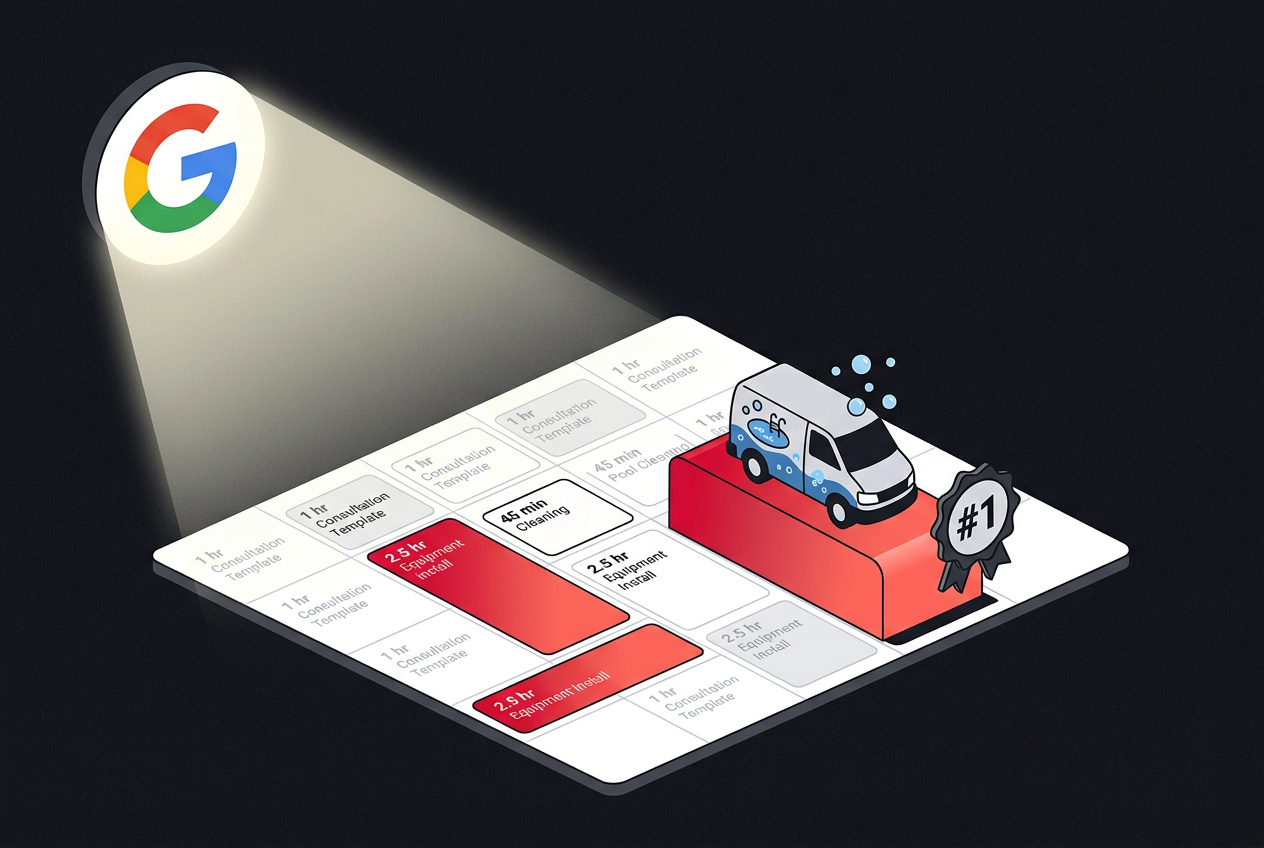
Google Now Ranks Your Calendar: How Appointment Duration Became a Local SEO Signal
Google's new appointment duration signal rewards operators who feed real job-length data into their booking layer—and punishes template time-blocking.
In late September 2026, Google Business Profile quietly added appointment duration as a ranking signal in local pack results for pool service companies. Operators scheduling jobs in generic 15-minute blocks are now being outranked by competitors whose GBP data reflects realistic 60–90 minute service windows.
This is not a cosmetic update. It is Google indexing the operational cadence of your business and using it to determine search visibility.
The change exposes a foundational gap in how most appointment-based service operators think about scheduling. Your calendar is no longer just an internal tool. It is now a ranking factor that talks directly to Google, and the businesses that instrument their scheduling stack to feed accurate job-duration data back into their booking layer are gaining measurable acquisition advantage.
What Changed
Google Business Profile has always captured appointment availability through integrations with Reserve with Google and third-party scheduling platforms. Until now, that data was used primarily for booking UX—letting searchers see open slots and request appointments without leaving the search result.
The September update adds a new dimension. Google now surfaces typical appointment duration as a quality signal in local pack rankings. For pool service companies specifically, operators whose GBP profiles show service appointments averaging 60–90 minutes are ranking higher than those with 15–30 minute default blocks, even when the latter have more reviews or closer proximity to the search origin.
The signal appears to weight realistic job duration as a proxy for service depth. A pool maintenance appointment that takes 75 minutes signals a more comprehensive service offering than one blocked at 15 minutes, regardless of what the website copy claims.
This matters because local pack position directly determines lead volume. The difference between position one and position three in the local pack is a 40–60% drop in click-through rate. For a pool service operator running 200 maintenance accounts and targeting $120k in seasonal deep-clean upsells, a two-position ranking loss can suppress $30k–$50k in annual acquisition-driven revenue.
Google is no longer indexing just your content and citations. It is indexing your operations.
Why Pool Service First
Pool service sits at the intersection of recurring maintenance and high-margin seasonal work, making appointment duration a direct proxy for revenue per slot. A weekly maintenance visit might be 60 minutes, but a green-to-clean algae remediation job runs 120–180 minutes, and a filter teardown with acid wash can stretch to 240 minutes depending on pool size and equipment age.
Operators who treat all appointments as interchangeable 30-minute blocks are signaling to Google that they run a commodity service model. Those who capture actual job types—maintenance, chemical balance correction, equipment repair, seasonal opening, winterization—and map them to realistic time windows are signaling operational maturity.
Google's local ranking algorithm has always favored businesses that demonstrate category authority. For years, that meant review velocity, keyword-optimized GBP descriptions, and geo-tagged service areas. Now it includes whether your scheduling data reflects the actual work you do.
The update rolled out for pool service first, likely because the vertical has high seasonal search volume, clear appointment-type segmentation, and widespread adoption of scheduling integrations that feed structured data into GBP. Expect the signal to expand to other appointment-based verticals—med spas, pet grooming, garage door service, lawn care—within the next 6–12 months.
If you operate in any vertical where job duration varies by service type, the clock is already running.
Template Scheduling Is Dead
Most scheduling software ships with default time-block templates: 15 minutes, 30 minutes, 60 minutes. Operators pick one, apply it across all appointment types, and move on. This worked when your calendar was an internal coordination tool. It fails when your calendar structure feeds a ranking algorithm.
A mobile pet groomer who blocks every appointment at 30 minutes—whether it's a nail trim for a Chihuahua or a full groom with deshedding treatment for a Golden Retriever—is now telling Google that all services are equivalent. A groomer who tracks actual duration by breed, coat type, and service package is feeding Google a richer operational signal.
The same applies to remodelers. A design consultation might run 45 minutes. A site measure for a kitchen remodel might take 90 minutes. A final walkthrough before permit submission could be 30 minutes. If your calendar shows every client meeting as a generic 60-minute block, you are compressing operational nuance into a flat signal that does not represent the depth of your process.
This is not about gaming the algorithm. It is about instrumenting your scheduling stack so it reflects the actual work.
Job Duration as Revenue Signal
Appointment duration is not just an operational metric. It is a revenue architecture decision.
A pool service operator running 12 maintenance routes per week at 60 minutes per stop can serve 96 accounts assuming eight stops per day. The same operator running 45-minute stops can serve 128 accounts. But the operator running 75-minute stops—because they include skimmer basket inspection, tile brushing, and equipment diagnostics in every visit—can serve only 76 accounts while commanding 20–30% higher monthly recurring fees.
Google's algorithm is now indexing which model you run.
If you block maintenance visits at 45 minutes but your actual average is 72 minutes because half your stops run long due to equipment issues or customer conversations, your GBP data is lying to Google. Worse, your internal scheduling is lying to your dispatch team, creating chronic route delays that compress margins and burn out technicians.
The businesses that win this update are the ones that already track job duration by service type and feed that data back into their booking layer. They know a standard maintenance visit averages 65 minutes, a green pool remediation averages 140 minutes, and a filter cleaning averages 95 minutes. Their scheduling software reflects those averages, their calendar availability adapts accordingly, and their GBP profile surfaces a realistic operational footprint.
That footprint now drives rankings.
What Operators Should Build
The fix is not to manually inflate appointment durations in your GBP settings. Google's algorithm will detect the gap between stated duration and actual booking behavior over time, and businesses that game the signal will eventually be penalized.
The fix is to instrument your scheduling stack so job duration is tracked, analyzed, and fed forward into capacity planning.
Step one: Audit actual job duration by service type over the past 90 days. Pull dispatch data, technician timesheets, or GPS timestamps from your field service software. Segment by service category—maintenance, repair, seasonal, upsell. Calculate the mean and median duration for each category.
If you do not have this data, start capturing it now. Add a "job start" and "job complete" timestamp to your technician workflow. If your team uses a mobile app for work orders, this should be a two-tap process. If they use paper, switch.
Step two: Map service types to realistic time blocks in your scheduling software. A pool maintenance visit is not the same as a pump replacement. A standard groom is not the same as a double-coat deshedding session. A routine pest control service is not the same as a rodent exclusion job.
If your scheduling software does not support service-specific duration settings, replace it. Any platform built for appointment-based service businesses in 2026 should allow you to define service catalogs with default durations that auto-populate when a job is booked.
Step three: Connect your scheduling software to your GBP profile via an integration that surfaces appointment availability and duration data. Reserve with Google is the native option, but most modern scheduling platforms—Jobber, Housecall Pro, ServiceTitan, FieldRoutes—offer GBP integrations that push structured booking data into your profile.
Verify that the integration is feeding service-specific duration data, not just generic availability. If your GBP profile shows all appointments as 30-minute slots regardless of service type, the integration is not passing the right data payload.
Step four: Monitor the feedback loop. Once your GBP profile reflects realistic appointment durations, track local pack ranking position for your core service keywords over 30–60 days. Use a local SEO tool like BrightLocal or LocalFalcon to measure rank by geo-grid across your service area.
If you see ranking improvements without corresponding changes to review count or citation consistency, appointment duration is likely contributing to the lift. If rankings remain flat, audit whether your GBP data is actually updating—many integrations lag by 7–14 days.
Step five: Use job duration data to optimize capacity. If your average maintenance visit runs 70 minutes but you are booking routes at 60-minute intervals, you are creating systemic delays that erode margin and destroy technician morale. If your average runs 55 minutes but you are blocking 75-minute windows, you are leaving 25% of your route capacity unused.
Accurate duration tracking lets you pack routes tighter without overloading teams. For a pool service operator running six technicians on 12 routes, compressing scheduling waste from 20 minutes per day per tech to 5 minutes adds 90 minutes of billable capacity per day across the team—enough for one additional maintenance stop or a small repair upsell.
That is $18k–$24k in recovered annual revenue per technician, before accounting for the acquisition lift from better local rankings.
Why This Extends Beyond Pool Service
Pool service is the canary. The logic applies to every vertical where job duration varies by service type and appointment scheduling feeds into customer acquisition.
A residential cleaning company that books all jobs as two-hour blocks is compressing the operational difference between a maintenance clean for a 1,200-square-foot apartment and a deep clean for a 3,500-square-foot home. When Google starts indexing appointment duration for cleaning companies, the operators who track job size, service tier, and actual duration will outrank those who use template time blocks.
A med spa that schedules all appointments as 60-minute slots is masking the difference between a 30-minute Botox session and a 90-minute combination facial with microneedling. When Google rolls this signal out to health and wellness verticals, the spas that feed service-specific duration data into their GBP profiles will gain visibility over those that do not.
A garage door service company that treats every call as a 45-minute service window is ignoring the reality that a spring replacement takes 30 minutes while a full panel replacement with track realignment takes 150 minutes. When this ranking factor hits home service verticals, the operators who instrument job-type segmentation will rank higher.
The principle is universal: your calendar structure is now part of your acquisition infrastructure.
Operations as Acquisition Lever
For the past decade, local SEO has been treated as a marketing function. Operators outsourced it to agencies that optimized GBP descriptions, built citations, and managed review requests. Operations stayed in its lane—routing, dispatch, labor utilization, material costs.
The appointment duration update collapses that boundary. Your scheduling cadence now directly influences search visibility, which means your operations team owns a piece of the acquisition funnel whether they realize it or not.
This is not a burden. It is an advantage.
Marketing agencies cannot instrument your job duration tracking. They cannot rewrite your service catalog to reflect operational reality. They cannot integrate your dispatch software with your booking layer. Only your operations team can do that, and the businesses that do it first will compound the advantage over time.
Google's algorithm rewards operational maturity because operational maturity correlates with service quality, and service quality correlates with user satisfaction. A business that tracks job duration by service type is more likely to staff appropriately, price accurately, and deliver consistent customer experiences. Google wants to rank businesses that deliver consistent customer experiences.
The appointment duration signal is Google indexing the exhaust from your operations engine and using it to predict service quality. If your engine runs on template time blocks and reactive scheduling, the signal is weak. If your engine runs on instrumented job tracking and capacity planning, the signal is strong.
What This Means for Revenue Infrastructure
Revenue infrastructure is the system that connects acquisition, conversion, and operations into a single feedback loop. Most appointment-based service businesses run these as three separate stacks: marketing owns lead gen, sales owns booking, operations owns delivery.
The appointment duration update forces integration. Your scheduling software is no longer just an operations tool—it is an acquisition input. Your job duration data is no longer just a labor efficiency metric—it is a ranking factor. Your calendar structure is no longer just an internal coordination layer—it is a customer-facing signal that Google indexes and searchers infer.
Businesses that treat these layers as separate will leak margin and lose rankings. Businesses that instrument them as one system will gain both.
A pool service operator who tracks job duration, maps it to service-specific pricing, feeds it into route optimization, and surfaces it through GBP has built a closed-loop system where operational improvements compound into acquisition gains. A 10% improvement in route efficiency—achieved by tightening duration estimates and reducing scheduling waste—does not just save labor hours. It also frees capacity for more jobs, which increases service velocity, which feeds a stronger signal into GBP, which drives more inbound leads, which fills the freed capacity without increasing acquisition cost.
That is how infrastructure compounds. You do not optimize one metric. You build a system where improving one metric improves three others.
The Era of Instrumented Operations
Google's appointment duration signal is not an isolated change. It is part of a broader shift toward indexing operational signals that have historically been invisible to search algorithms.
Google already indexes business hours, response time to customer inquiries, and reservation availability in real time. It ranks businesses based on how quickly they reply to messages sent through GBP. It surfaces delivery estimates for restaurants based on live order volume. It penalizes businesses whose stated hours do not match actual open/close behavior tracked via location data.
The algorithm is moving from indexing what you say to indexing what you do.
For appointment-based service businesses, this means your operations stack is now part of your SEO stack. The businesses that instrument job duration, track service type, optimize capacity, and connect scheduling data to their GBP profiles will outrank businesses that treat these as separate concerns.
This is not a technical SEO tactic. It is a shift in how acquisition and operations intersect. If you are still thinking of local SEO as a keyword and citation game, you are already behind.
Building the System
The good news is that most operators already have the raw materials. If you run field service software, dispatch tools, or a scheduling platform built for appointment-based businesses, you are already capturing job duration data—even if you are not analyzing it.
The work is not in collecting the data. The work is in structuring it, feeding it forward into your booking layer, and connecting that layer to your GBP profile so the signal flows through to Google.
This is infrastructure work, not campaign work. You build it once, refine it over 60–90 days, and then it runs as a compounding system. Every job you complete feeds data into your duration model. Every duration refinement improves scheduling accuracy. Every scheduling improvement tightens route efficiency. Every efficiency gain frees capacity. Every freed slot gets filled by a lead that found you because your GBP profile signals operational maturity.
The businesses that build this system in Q4 2026 will enter 2027 with a structural acquisition advantage that competitors cannot reverse by buying more ads or posting more content. They will rank higher because they operate better, and they will operate better because they instrumented the feedback loop between operations and acquisition.
Your calendar is now a ranking factor. The question is whether you are going to treat it like one.