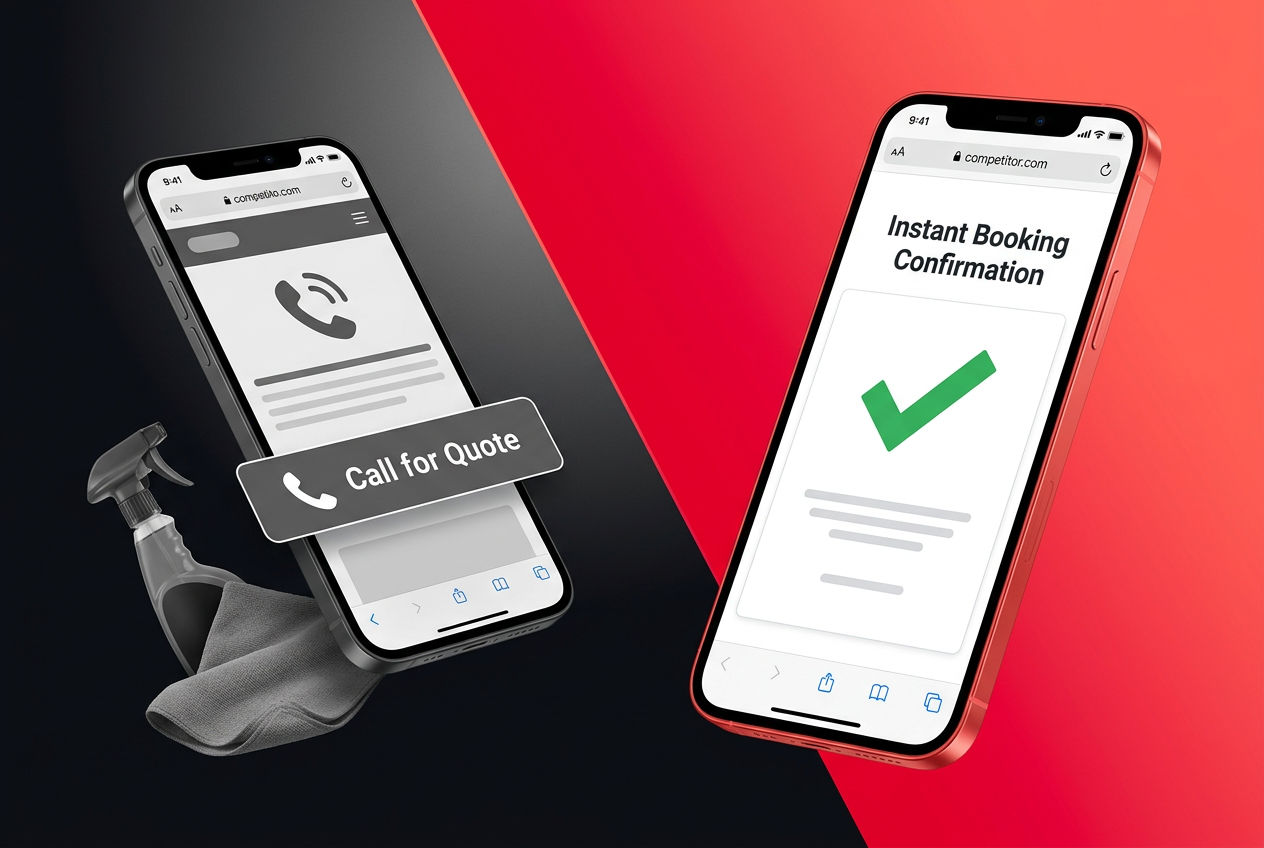
Why Call for a Quote Is Killing Your Detailing Business
Auto detailing shops that force prospects to call for quotes are losing 60-70% of mobile traffic to competitors with one-click booking.
September 2026 marks an inflection point for auto detailing shops. Customers searching "mobile detailing near me" from a grocery store parking lot expect to book and pay before they finish loading their trunk. Shops still running on "call for a quote" lose 60-70% of those prospects before the phone rings.
This isn't a customer service problem. It's an infrastructure gap.
The detailing vertical is joining med spas, pet groomers, and cleaning companies in a category where real-time booking capability determines capture rate more than reviews, pricing, or brand. The operators building revenue infrastructure today are compounding while competitors wonder why their Google Business Profile views don't convert.
The Friction Tax
A prospect finds your detailing shop on Google at 7:42 PM on a Tuesday. They want an exterior wash and interior detail for a midsize SUV. Your listing says "call for a quote."
They close the browser and book with the shop three listings down that shows instant availability, displays a $189 package, and confirms the appointment in 90 seconds.
You never knew they existed.
This scenario repeats 40-80 times per month for a typical mobile detailing operation in a metro market. The shops still treating online channels as lead generation funnels—capture a name, call them back, quote over the phone, then schedule—are hemorrhaging margin to competitors who collapsed that six-step process into one.
The math is clear. A detailing shop running traditional phone intake converts 25-35% of inbound interest into booked appointments. Operators with real-time booking systems convert 55-70%. For a business generating 200 monthly inquiries, that's the difference between 60 jobs and 120 jobs with identical traffic.
The gap isn't sales technique. It's infrastructure.
What Changed in 2026
Three trends converged this year to make instant booking the baseline expectation in auto detailing.
Google Business Profile evolved from directory to storefront. The "Book" button integrated with scheduling platforms is now live for service appointments across categories. Detailing shops that can surface real-time availability and package pricing directly in search results capture prospects before they comparison shop. Shops without this integration don't appear in the consideration set.
Mobile traffic crossed 80% in local service searches. Desktop users tolerate friction. Mobile users abandon. When a customer is sitting in their car deciding whether to book a detail, every tap between intent and confirmation bleeds conversion. Call for a quote requires five actions: tap phone number, wait for dial, leave voicemail or navigate phone tree, wait for callback, schedule. One-click booking requires one.
Payment expectation shifted from job completion to booking confirmation. Customers now expect to pay a deposit or full amount when they book, the same way they book a restaurant or a hotel. This isn't just convenience—it signals legitimacy and eliminates no-shows. Detailing shops that can't accept payment at booking lose trust and eat 15-25% no-show rates.
These aren't isolated feature requests. Together they define a new revenue infrastructure standard. Shops without real-time availability, instant pricing, and integrated payments are functionally invisible to the mobile-first customer.
The Conversion Breakdown
Walk through the workflow for both models.
Traditional phone-based intake:
A customer finds your shop on Instagram, sees a before-and-after post, taps the link in bio. They land on a website with a contact form or phone number. If they call, they get voicemail 70% of the time—you're under a hood or driving between jobs. They leave a message with their vehicle type and requested service.
You call back three hours later. They don't answer. You leave a voicemail. They text back at 9 PM asking for pricing. You respond the next morning with a quote and ask about their availability. They reply the following afternoon. You're now 36 hours into a conversation that hasn't confirmed a single appointment.
By the time you circle back, 40% of prospects have booked elsewhere or lost interest. The ones who remain are price shopping, not buying.
Infrastructure-first workflow:
The same customer taps the Instagram link. They land on a booking interface embedded in your site. They select "Full Interior + Exterior Detail" from a menu. The system asks three qualifier questions: vehicle size, condition level, add-ons. It displays real-time availability across your mobile units for the next 14 days and shows the price: $219 for a standard SUV.
They pick Thursday at 2 PM, enter their address, and pay a $75 deposit via card or digital wallet. Confirmation hits their phone in 15 seconds with appointment details and a calendar invite. You get a notification with job specs, location, and guaranteed payment.
Total time: 90 seconds. Conversion rate: 65%. No-show risk: under 5%.
The difference isn't customer effort. It's system design.
Infrastructure, Not Features
Most detailing shops approach online booking as a feature layer on top of existing operations. They add a Calendly link or a form that feeds into their CRM. This creates a Frankenstein workflow: half-manual quoting patched onto half-automated scheduling with no payment integration.
The result is worse than doing nothing. Customers start a digital process, hit a gap, and bail.
Real infrastructure solves three problems simultaneously.
Instant pricing based on dynamic inputs. A detailing business has variable pricing: vehicle size, service package, condition surcharges, add-ons like ceramic coating or pet hair removal. The system must translate customer inputs into accurate quotes without human intervention. This requires logic trees, not static menus. When a customer selects "Large SUV + Heavy Pet Hair + Interior Shampoo," the system calculates $287 and presents it with confidence.
Real-time availability across distributed resources. Mobile detailing shops run multiple units. Each has different geographic zones, equipment configurations, and schedules. A booking system must surface available slots that match the requested service, location, and crew capability. If Unit 2 is booked solid but Unit 1 has a Thursday opening in the customer's ZIP code, the system shows Thursday. If no units can reach that area this week, it offers next week or suggests the closest shop location.
Payment capture at booking. Deposits eliminate no-shows and validate intent. Full payment up front reduces job-day friction and accelerates cash flow. Either model requires integrated payment processing tied directly to the booking confirmation. The system charges the card, logs the transaction, and triggers downstream workflows—calendar events, crew assignments, reminder sequences—without manual handoff.
These three layers form a unified revenue engine. Miss one and the system degrades into a lead form with extra steps.
Operations Layer
Booking infrastructure doesn't stop at confirmation. The real leverage comes from what happens after the customer books.
Automated job preparation. When a customer books a full detail on a large SUV with heavy staining, the system assigns the job to the crew with the right equipment and adds 30 minutes to the time block. It generates a prep checklist: extra extraction tools, upholstery cleaner, stain treatment supplies. The crew sees this before they leave the shop.
Dynamic routing. A mobile detailing operation books six jobs across a metro area on a single day. Manual scheduling clusters jobs geographically but doesn't optimize drive time or account for traffic windows. Integrated systems calculate optimal routing, slot new bookings into existing routes, and adjust automatically when a customer reschedules. This turns chaotic dispatching into predictable capacity.
Customer communication sequences. Booking triggers a confirmation message. Two days before the appointment, the system sends a reminder with crew ETA and prep instructions (clear the driveway, remove valuables). Two hours before arrival, the customer gets a live tracking link. After the job, the system requests a review and offers a discount on the next booking. None of this requires staff time.
This operational layer is where booking infrastructure becomes revenue infrastructure. The same system that captured the lead now manages job execution, crew efficiency, and repeat customer development. Shops without this integration hire coordinators to manually bridge the gap. Shops with it scale without adding overhead.
Pricing Transparency as Moat
The old "call for a quote" model gave detailing shops control. They could qualify the customer, upsell during the conversation, and adjust pricing based on perceived willingness to pay. That control had value when customers had limited comparison options.
It has zero value in September 2026.
Customers expect transparent pricing before they engage. Hiding prices behind a phone call signals either inflexibility or inflated cost. Competitors who publish pricing—even ranges—win the trust battle before the conversation starts.
But transparency doesn't mean static menus. Smart pricing infrastructure uses conditional logic to educate customers and guide them toward accurate quotes.
A prospect selecting "Interior Detail" sees a price range: $120–$220 depending on vehicle size and condition. The system asks: "How large is your vehicle?" They select "Midsize SUV." New range: $150–$190. Next question: "Any heavy staining, pet hair, or odor issues?" They select "Light pet hair." Final price: $170.
The customer feels informed, not interrogated. The shop avoids underquoting a job that turns out to need extra labor. Both sides win.
Contrast this with the competitor who lists "Interior Detail: Starting at $99." The customer books, expecting $99. The tech arrives, sees a dog-hair-covered Tahoe that hasn't been cleaned in two years, and quotes $240 on site. The customer feels baited. The review mentions "hidden fees." The shop earns $240 once and loses ten future customers.
Transparent conditional pricing builds trust and sets accurate expectations. It's a retention engine disguised as a booking tool.
No-Show Economics
A detailing shop running phone-based scheduling with no deposit typically sees 15-25% no-show rates. For a mobile operation, that's catastrophic. A no-show doesn't just cost the job revenue—it costs drive time, fuel, opportunity cost on the next blocked slot, and crew morale.
Calculate the damage. A mobile detailing business books 120 jobs per month at an average ticket of $180. A 20% no-show rate means 24 lost jobs and $4,320 in monthly revenue. Annually: $51,840.
Now add the operational cost. Each no-show burns an average of 45 minutes in drive time and staging. That's 18 hours per month—half a crew week—spent generating zero revenue.
Booking systems with integrated deposits cut no-show rates to 5-8%. A $50 deposit on a $180 job changes customer behavior. It's not about the money—it's about commitment. Customers who pay upfront protect that time slot. They reschedule instead of ghosting.
The same shop drops from 24 monthly no-shows to 7. Revenue recapture: $3,060 per month, $36,720 annually. Crew time recapture: 12.75 hours monthly. That's capacity for 8-10 additional jobs without hiring.
This is how infrastructure compounds. The booking system doesn't just convert more leads—it makes the leads it converts more profitable.
What to Build Now
Auto detailing shops have two options in September 2026: build revenue infrastructure or become a referral source for competitors who did.
The operators who win this transition focus on three build priorities.
Real-time booking with conditional pricing. Choose a platform that supports service menus, vehicle-type segmentation, add-on logic, and instant quoting. Avoid tools that require manual quote approval or callback workflows. If the system can't calculate a price and confirm a booking without human intervention, it's not infrastructure—it's a lead form.
Payment integration at booking. Deposit or full payment must be captured when the customer confirms. This requires merchant account integration, PCI-compliant processing, and automated receipt generation. Bonus: systems that store payment methods for one-tap rebooking.
Operations sync across scheduling, dispatch, and customer communication. The booking system must push confirmed jobs into crew calendars, trigger prep workflows, optimize routing for mobile units, and manage pre-appointment reminders and post-job follow-ups. If you're manually copying booking details into a separate dispatch tool, you've built a data entry job, not a system.
These aren't vendor features to evaluate someday. They're the minimum viable infrastructure to compete in a vertical where mobile-first customers expect instant answers.
Compounding Effects
Revenue infrastructure doesn't just solve today's conversion problem. It creates feedback loops that separate operators from competitors over time.
A detailing shop with real-time booking captures more leads per dollar of marketing spend. Higher capture rates mean lower customer acquisition cost. Lower CAC means the business can outbid competitors on Google Local Services Ads and Facebook while maintaining margin.
The same system reduces no-shows, which increases crew utilization. Higher utilization means the shop can service more customers with the same labor cost. Better unit economics create pricing flexibility—the operator can run promotions to fill gaps without eroding baseline margin.
Integrated customer communication and payment storage turn one-time buyers into repeat customers. A client who booked a full detail in April gets an automated message in September offering a pre-winter interior refresh at 15% off. One tap rebooks using stored payment details. Repeat customer rate climbs from 18% to 42%. Lifetime value doubles.
None of these advantages come from working harder. They emerge from system design.
The detailing shops still running on phone tag and manual quoting will survive for a while. They'll blame Google, complain about price-shopping customers, and wonder why their 4.8-star rating doesn't generate more business.
The shops building infrastructure will scale predictably, reduce operational overhead, and compound revenue without adding coordinators or customer service reps.
Infrastructure isn't a growth hack. It's the difference between running a booking service and engineering a revenue system.
Systems Thinking
The shift happening in auto detailing right now isn't unique to the vertical. It's the same pattern playing out in med spas, pet grooming, lawn care, and every other appointment-based service business where mobile customers expect instant answers.
The old model—generate a lead, call them back, quote manually, schedule by phone—worked when customers tolerated friction and competition was local. That world ended.
The new model collapses acquisition, conversion, and operations into one integrated system. Real-time availability, instant pricing, and integrated payments aren't customer experience features. They're the revenue infrastructure that determines whether a prospect becomes a customer or a lost opportunity you never knew existed.
Detailing shops that build this infrastructure in September 2026 don't just win more jobs today. They create compounding advantages that separate them from competitors over quarters and years: lower CAC, higher utilization, better retention, predictable capacity.
The operators who treat booking as a feature will spend the next two years wondering why their traffic doesn't convert.
The operators who treat it as infrastructure will spend that time scaling.