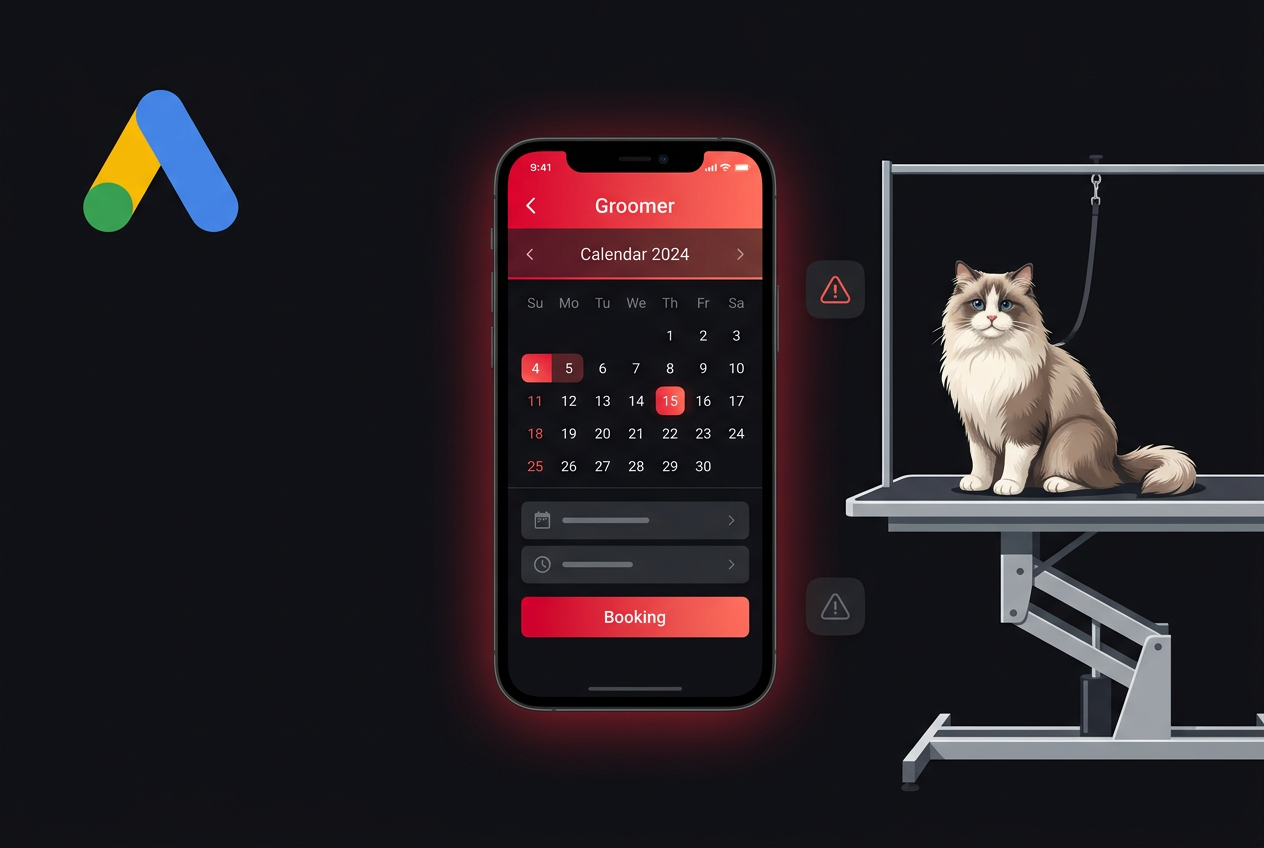
Google Ads Now Requires Real-Time Booking for Pet Groomers
Google quietly mandated booking extensions with live appointment feeds for pet grooming advertisers in early September 2026, penalizing shops without real-time calendar infrastructure.
In the first week of September 2026, Google rolled out mandatory booking extensions for local service advertisers in pet grooming. The change was quiet—no blog post, no webinar, just an email to advertisers and a policy update buried in Help Center documentation.
The mechanics are simple. If you run Google Ads or Google Local Services Ads for pet grooming, you now need to provide a real-time appointment availability feed. If your calendar doesn't expose live booking slots through a supported integration, your impression share drops. Google doesn't publish the exact penalty, but early reports from grooming shops show 30-50% declines in visibility within two weeks of non-compliance.
This isn't a feature request. It's infrastructure as a gatekeeper.
Why Google Moved
Google has been pushing booking extensions across verticals since 2019, but adoption was optional and uneven. Advertisers could add a "Book Now" button that linked to a contact form or a static scheduling page. Conversion tracking was loose. The user experience was inconsistent.
Pet grooming became the test case for mandatory enforcement because the economics are clear. High local search volume. Short consideration windows. Repeat purchase cycles. Mobile-heavy traffic. The vertical mirrors what Google wants to replicate everywhere appointment-based services exist.
The shift also aligns with how Google now thinks about local search intent. When someone searches "dog grooming near me" on mobile, Google wants to close the loop in-session. Not send the user to a website. Not ask them to call. Book the appointment inside the search result or the map listing, confirm it, and keep them in the Google ecosystem.
For that to work, Google needs live data. They need to know which groomers have availability Tuesday at 2pm versus Thursday at 10am. They need inventory visibility, not marketing pages.
That requires infrastructure most grooming shops don't have.
What Compliance Requires
Google's documentation outlines three acceptable paths for grooming shops to maintain full impression share:
- Direct API integration between your scheduling software and Google's Reserve with Google platform.
- Third-party booking platform that already integrates with Reserve with Google and syncs your calendar in real time.
- Manual calendar sync through Google Business Profile, updated at least twice daily with current availability.
Option three is a trap. Manual updates don't scale, and "twice daily" doesn't meet the real-time threshold Google enforces algorithmically. If you block out a slot at 11am and someone tries to book it at noon through a stale feed, Google flags your account for sync errors. Three flagged bookings in 30 days triggers a review. Sustained issues result in permanent removal from booking extensions.
That leaves options one and two, both of which require your scheduling system to expose live calendar data through an API.
Most dog grooming scheduling software wasn't built for this. The tools groomers use—Square Appointments, Schedulicity, Gingr, ProPet—were designed for internal scheduling, not external inventory distribution. Some have Reserve with Google integrations now. Many don't. And even when the integration exists, it often requires manual setup, recurring subscription fees, and ongoing monitoring to prevent sync failures.
The infrastructure gap is real.
The Operational Risk
Exposing live appointment availability to Google sounds simple until you map the edge cases.
A mobile groomer has two vans, four groomers, and staggered service areas across three zip codes. Availability depends on drive time, not just calendar slots. A booking in one territory affects travel windows in the next. Google's feed expects binary availability—open or closed—but the operational reality is conditional.
A storefront groomer runs bath-and-brush appointments at 30 minutes, full grooms at 90 minutes, and specialty services at 120 minutes. The same time slot can accommodate three bath appointments or one full groom. Google's booking extension doesn't understand service-level inventory. It sees "2pm" as available or unavailable, regardless of service type.
A groomer with two locations uses one Google Business Profile per address. Each location has separate staff, separate equipment, and separate availability. If the scheduling system doesn't segment inventory by location in the API feed, Google shows availability at Location A when the only open slot is at Location B. The customer books, shows up at the wrong place, and blames the groomer.
These aren't hypothetical problems. They're the default state for most grooming operations, and Google's feed architecture doesn't accommodate them without middleware.
Infrastructure Requirements
To comply with Google's mandate without breaking your scheduling workflow, your revenue infrastructure needs four capabilities:
Real-time calendar sync. Your scheduling system must push availability updates to Google within 60 seconds of any change—new booking, cancellation, block-off, staff absence. Batch syncs and nightly exports don't meet the threshold.
Service-level inventory logic. The system must translate your internal service catalog (30-minute bath, 90-minute groom, add-on nail trim) into availability windows that match Google's schema. If you offer three services with different durations, the feed needs to calculate which slots can accommodate which bookings without double-booking your staff or equipment.
Location and resource segmentation. If you have multiple locations, mobile units, or specialized groomers (e.g., one groomer handles anxious dogs, another handles large breeds), your infrastructure must route availability and bookings to the correct resource. Google's feed allows location segmentation, but your scheduling system has to enforce it.
Error monitoring and reconciliation. When a sync fails—API timeout, schema mismatch, missed webhook—you need automated alerts and a reconciliation process that corrects the drift before Google flags your account. Manual checks don't scale.
Most grooming shops don't have this infrastructure because they've never needed it. Scheduling was an internal tool. Lead generation happened separately—Google Ads sent traffic to a landing page, the landing page collected a phone number, the groomer called back and booked manually.
That model is ending.
The Acquisition-Operations Merge
Google's policy shift in pet grooming is a preview of what's coming for every appointment-based service vertical. HVAC, pest control, cleaning, lawn care, med spas, dental—anywhere local search drives appointment requests, Google will eventually require real-time booking infrastructure as a condition of paid visibility.
The wedge is mobile. When 70% of local service searches happen on mobile and 60% of those searches lead to a phone call or visit within 24 hours, the friction between search and booking becomes the choke point. Google's business model depends on closing that gap.
For operators, this creates a new forcing function. Revenue infrastructure—your scheduling system, booking workflows, calendar logic, lead routing—is no longer just an operational concern. It's now a prerequisite for acquisition.
You can't separate the two anymore.
A groomer who invests in Google Ads but runs scheduling on pen and paper can't comply. A groomer who uses scheduling software without API access can't comply. A groomer whose booking flow depends on phone calls and manual confirmation can't comply.
The infrastructure becomes the price of entry.
What to Build Now
If you're a pet groomer running paid acquisition today, here's the build sequence:
Audit your scheduling system. Confirm whether your current software supports Reserve with Google or a comparable real-time booking API. If it doesn't, you need to migrate or build middleware.
Map your inventory model. Document how your calendar actually works—service types, durations, staff assignments, location rules, block-off logic. Write it down. This becomes the spec for your booking feed.
Implement real-time sync. Connect your scheduling system to Google through an integration partner or direct API. Test the sync with multiple booking and cancellation scenarios. Monitor sync latency and error rates daily for the first 30 days.
Build reconciliation workflows. Set up automated alerts for sync failures, double-bookings, or availability mismatches. Create a daily checklist to compare Google's view of your calendar against your internal view.
Extend to other channels. Once you have real-time booking infrastructure for Google, replicate it for Meta lead ads, Yelp, your website, and SMS campaigns. The same feed powers all channels.
This isn't a one-time project. It's permanent infrastructure.
The Compound Effect
Groomers who build real-time booking infrastructure to comply with Google's mandate unlock a secondary benefit: they can now distribute appointment inventory across every acquisition channel simultaneously.
A Google Ad, a Meta lead form, a Yelp listing, an email campaign, and a website visit all pull from the same live calendar. No phone tag. No manual follow-up. No lag between inquiry and booking.
Conversion rates increase because friction drops. Cost per acquisition drops because more leads convert. Operational overhead drops because fewer leads require manual handling.
The infrastructure built to satisfy Google's requirement becomes the foundation for a unified acquisition and operations system.
That's the leverage point.
What This Means Long-Term
Google's mandatory booking extensions in pet grooming signal a broader shift. Paid acquisition platforms are no longer content to generate leads—they want to close the transaction.
For service businesses, this means the line between marketing technology and operations technology is disappearing. Your CRM, your scheduling software, your payment processor, and your acquisition channels need to function as a single system.
Businesses that treat these as separate tools—duct-taped together with Zapier workflows and manual handoffs—will face rising acquisition costs and declining impression share as platforms penalize infrastructure gaps.
Businesses that build integrated revenue infrastructure—real-time booking, unified inventory, automated lead routing, closed-loop attribution—will compound efficiency across acquisition, conversion, and operations simultaneously.
Google's policy change in pet grooming is a forcing function. But the operators who respond by building systems instead of patching workflows will exit this moment with a structural advantage that extends far beyond compliance.
The question isn't whether to build this infrastructure. The question is whether you build it reactively, under penalty pressure, or proactively, as a compound system that drives revenue and reduces operational overhead at the same time.
Google just made the decision urgent. The opportunity was already there.