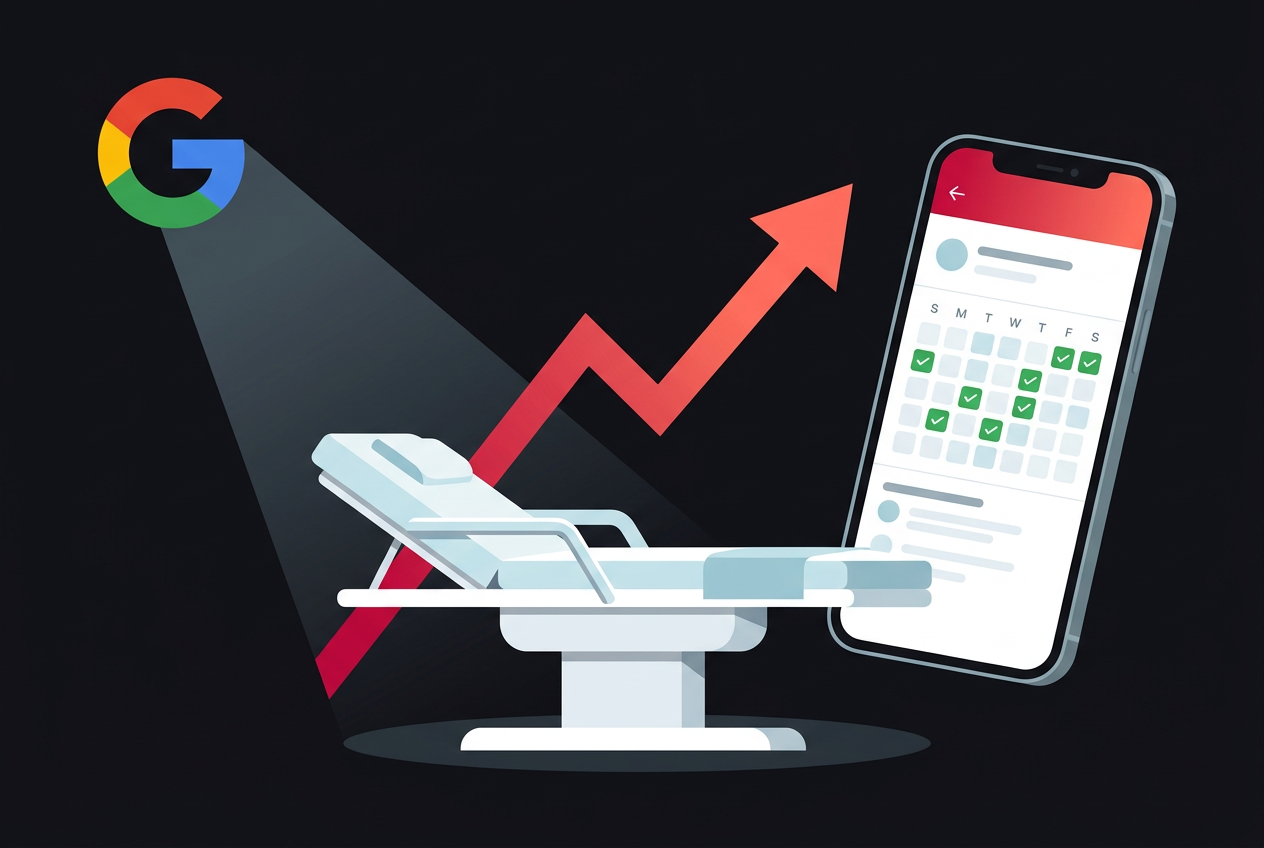
Google Now Ranks Med Spas by Booking Conversion Rate
Google's Q3 2026 algorithm update rewards med spas that convert profile clicks into confirmed appointments, penalizing phone-only and form-based booking.
Google changed the rules for local visibility in Q3 2026. The platform now measures how many people who click your med spa's Business Profile actually book a confirmed appointment. High conversion rates push your ranking up. Low rates or unmeasured funnels push you down.
Practices relying on "contact us" forms or phone-only booking are seeing 15–30% ranking drops in competitive markets. The operators holding or gaining position are the ones who can prove to Google that profile traffic converts into booked appointments at scale.
This is not a marketing update. It is an operations update disguised as SEO.
The New Signal
Google Business Profile now tracks a metric it calls "booking conversion rate" for med spas and aesthetics practices. The platform measures the percentage of users who interact with your profile—clicking the booking button, tapping to call, visiting your website—and later complete a confirmed appointment.
The keyword is confirmed. A form submission does not count. A phone call that goes to voicemail does not count. A text thread that never closes does not count.
Google wants proof that the interaction produced a scheduled appointment with date, time, and customer details locked in. The signal feeds directly into local pack rankings, map visibility, and organic positioning for location-based searches.
The update rolled out to med spas and aesthetics practices first, beginning in August 2026. Google has not announced which verticals are next, but the infrastructure requirements tell you where this goes: any appointment-based service business will eventually be ranked on conversion proof, not just review count and keyword optimization.
The change rewards practices that instrument their entire booking funnel. If you cannot measure the path from profile click to confirmed appointment, you cannot optimize it. If you cannot optimize it, your competitors will outrank you.
Why Med Spas First
Google chose med spas as the testing ground for booking conversion signals because the vertical has clear appointment intent, high transaction value, and a crowded local search landscape.
When someone searches "botox near me" or "laser hair removal [city name]", they are ready to book. The query is not informational. It is transactional. Google knows this, and now it penalizes profiles that fail to close the transaction.
Med spas also have fragmented booking infrastructure. Some use online scheduling. Some use phone-only intake. Some route traffic to a contact form and follow up manually. The variance in conversion rates is wide, which makes the ranking signal useful for differentiation.
High-intent traffic with inconsistent conversion infrastructure creates an opportunity for Google to reward the operators who build systems that work.
The aesthetics vertical has another characteristic that makes it ideal for this update: repeat transactions. A patient who books a Botox appointment in September will likely book again in December, March, and June. Google can track not just first-time bookings but also retention and lifetime engagement, which means the ranking signal compounds over time.
Practices that convert one-time searchers into repeat patients will rank higher than practices that treat every booking as a cold lead.
What Drops Your Ranking
Three booking patterns are correlated with ranking drops since the update went live.
Phone-only booking with no confirmation loop. If your profile directs users to call and your front desk answers some calls but not others, Google sees low conversion. If the call connects but the patient does not book immediately, Google sees no confirmed appointment. If the patient says "I'll think about it" and you do not follow up with a scheduling link, the interaction dies unmeasured.
Phone calls are not the problem. Unconfirmed phone calls are the problem.
Contact forms that route to email or CRM without real-time scheduling. A user fills out a form on your website. The form submits. Your team sees it the next day and replies with available times. The user does not respond. Google sees a profile click that produced no appointment.
Even if your team follows up and eventually books the patient, the delay breaks the conversion signal. Google measures speed and certainty. A form that requires back-and-forth does not produce either.
Website booking flows that require manual confirmation. Some scheduling tools let patients request a time but hold the appointment as "pending" until the practice confirms availability. From Google's perspective, the appointment is not confirmed until both parties agree. If 40% of requested times are unavailable and require rescheduling, your conversion rate is capped at 60% before you even account for no-shows or cancellations.
The common thread: any booking path that adds friction, delays confirmation, or requires human follow-up will lower your measured conversion rate and hurt your ranking.
What Operators Are Building
The practices that are holding or gaining local visibility after the update share a common infrastructure pattern. They instrument the entire funnel from profile click to confirmed appointment, and they eliminate manual handoffs.
Direct scheduling from the Google Business Profile. Instead of sending users to a contact form or generic website, the profile's booking button routes directly to a real-time scheduling interface. Available times are pulled from the practice's calendar. The patient selects a service, picks a time, and confirms. The appointment is instantly written to the calendar and the patient receives automated confirmation.
No human touches the booking. No delay. No uncertainty.
The scheduling interface is not bolted onto the website as an afterthought. It is the primary conversion path, and the profile's booking button is the front door.
Automated confirmation and reminder flows. Conversion does not stop when the patient clicks "book now". A confirmed appointment requires that the patient shows up. Practices with high booking conversion rates send SMS and email confirmations immediately after booking, with calendar links and pre-appointment instructions.
They follow up with a reminder 48 hours before the appointment, a reminder 24 hours before, and a final reminder the morning of. Each message includes a one-click reschedule link and a one-click cancel link. This keeps the appointment in the patient's calendar and reduces no-shows, which Google also tracks as part of conversion quality.
No-shows hurt your ranking. Automated reminders reduce no-shows. Therefore, automated reminders protect your ranking.
Single-flow intake for new and returning patients. Some med spas split their booking process: new patients fill out a long intake form and schedule via phone, while returning patients use online scheduling. This creates two conversion rates, and Google measures the blended average.
The practices that rank well use the same booking flow for everyone. New patients complete intake after they book, not before. The scheduling interface collects the minimum information needed to hold the appointment—name, contact, service, time—and everything else happens in the pre-appointment workflow.
This reduces friction for new patients and increases the percentage of profile clicks that convert into locked appointments.
Instrumentation that tracks every step. The operators who are winning after this update do not guess whether their booking funnel works. They measure it.
They track how many users click the booking button on their Google Business Profile. They track how many of those users land on the scheduling page. They track how many select a service, how many pick a time, and how many complete confirmation. They track no-show rates and reschedule rates.
They know their conversion rate from profile click to confirmed appointment because they built the infrastructure to measure it. When Google penalizes unmeasured funnels, these operators have data. When competitors lose rankings, these operators know why they did not.
The Compound Effect
This update does not reward short-term optimization. It rewards systems that compound over time.
A practice that books 60% of profile clicks in September will rank higher in October. Higher rankings produce more profile impressions. More impressions produce more clicks. More clicks produce more bookings. More bookings produce more reviews, more repeat patients, and more referrals.
The conversion rate becomes a flywheel. The practice that converts well gets more traffic. The traffic converts well, so rankings climb. The rankings produce more traffic, which converts well.
The inverse is also true. A practice with a 20% conversion rate loses visibility. Fewer people see the profile. Fewer people book. The practice interprets this as "Google changed the algorithm and we got unlucky" and does nothing. The ranking continues to slide.
Six months from now, the gap between instrumented and uninstrumented practices will be structural. The practices that built conversion infrastructure in Q3 2026 will have compounding visibility. The practices that waited will have compounding obscurity.
Why This Extends Beyond Med Spas
Google will roll this ranking signal to other appointment-based verticals because the incentive structure works for the platform. Google wants users to complete transactions without leaving the Google ecosystem. A booking funnel that requires phone calls or email exchanges pulls users away from Google's interface. A booking funnel that confirms appointments in real time keeps users inside Google's property and creates measurable conversion data that Google controls.
The update is not about helping service businesses. It is about giving Google more control over the booking transaction.
But the result is the same: operators who instrument conversion will outrank operators who do not.
Pest control companies, lawn care providers, cleaning services, roofing contractors, mobile groomers, and remodelers will face the same ranking logic. The businesses that can prove they convert profile traffic into confirmed jobs will dominate local search. The businesses that treat booking as a manual coordination problem will lose visibility.
The timeline is unknown, but the direction is certain. Google will measure conversion wherever conversion can be measured. The verticals that rely on appointment-based revenue will be ranked by their ability to convert attention into booked work.
What to Build Now
If your med spa or aesthetics practice still routes profile traffic to a contact form, you have three months before the ranking loss becomes structural. If you rely on phone-only booking without automated confirmation, you are already losing ground.
Build a scheduling interface that confirms appointments in real time. Connect it directly to your Google Business Profile. Eliminate every manual step between profile click and confirmed appointment.
Instrument the funnel so you know your conversion rate from impression to booking. Measure drop-off at every stage. Identify where users abandon the flow and remove the friction.
Automate confirmation and reminders. Reduce no-shows. Treat the appointment as confirmed only when the patient shows up, because Google treats it the same way.
Stop thinking of online booking as a convenience feature. It is now a ranking input. The practices that convert well will compound visibility. The practices that do not will disappear from local search.
Infrastructure as Ranking
Google's booking conversion signal makes explicit what has been implicit for years: the platforms reward operators who build infrastructure, not operators who optimize content.
You cannot blog your way to higher rankings if your booking funnel leaks 60% of traffic. You cannot buy your way to visibility if confirmed appointments do not follow profile clicks. You cannot hack local SEO if the underlying system does not convert.
The update forces med spas to treat marketing and operations as the same system. The practice that can convert a profile impression into a confirmed Botox appointment in under two minutes will outrank the practice with better branding, more reviews, and a bigger ad budget.
Revenue infrastructure is no longer a back-office concern. It is the front line of competitive positioning.
The operators who understand this will build systems that measure, confirm, and convert at every touchpoint. The operators who do not will watch their rankings slide and blame the algorithm.
Google did not change the rules to punish anyone. Google changed the rules to reward the businesses that work.