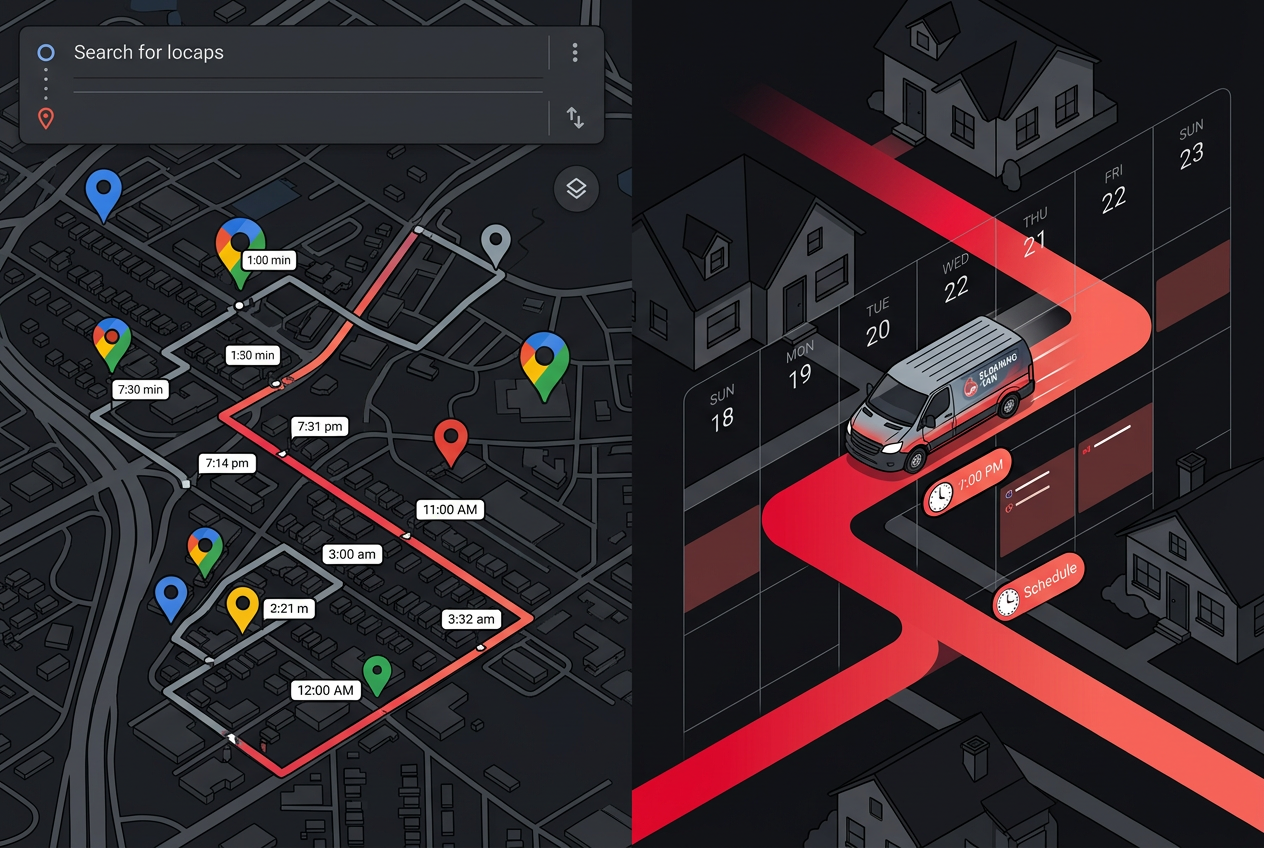
Google Now Exposes Your Cleaning Company's Scheduling Discipline
Google's new service completion attribute surfaces operational discipline in map pack results, rewarding residential cleaners who run predictable routes and exposing those who don't.
Google rolled out a new attribute for residential cleaning companies in early October 2026: service completion time. It appears in the knowledge panel and map pack. It tells searchers how long your jobs typically take.
You do not control it manually.
Google pulls the data from booking integrations and parses review mentions. If your operations are tight—consistent time blocks, predictable crew performance, accurate job close timestamps—you get a clean number. "Standard clean: 2–3 hours." If your scheduling is a mess, Google surfaces that too. "Varies widely" or inflated averages that scare off price-conscious searchers.
This is not a vanity metric. It is a storefront signal derived from operational cadence.
The businesses that win are the ones who have instrumented their workflows. The ones still running on spreadsheets and gut-feel routing just lost the ability to hide inefficiency.
What Google Is Doing
The service completion time attribute is part of Google's broader push to surface trust signals that correlate with conversion. They want to show searchers not just who provides a service, but how reliably they deliver it.
For residential cleaning companies, duration is a proxy for predictability. A homeowner searching "maid service near me" wants to know if they need to block out two hours or five. If your profile says "3–4 hours" and a competitor's says "varies," you win the click.
Google is not waiting for businesses to self-report. They are instrumenting this from:
- Booking system integrations. If you use a cleaning company booking system that passes appointment start, arrival, and completion timestamps to Google via schema markup or API, that data feeds the attribute.
- Review mentions. Phrases like "they were in and out in two hours" or "took way longer than expected" get parsed and weighted.
- Behavioral signals. If users who click your profile bounce quickly or fail to convert, Google infers a mismatch between expectation and reality.
The attribute updates continuously. It is not static. Every job you log, every review you earn, every timestamp your system records—it all compounds into the signal Google displays.
Why Scheduling Discipline Became Acquisition
Most residential cleaning companies think of scheduling as back-office logistics. You build a route, assign a crew, hope they finish on time, and move to the next job.
That mental model just broke.
Scheduling is now front-office infrastructure. The tightness of your dispatch cadence, the accuracy of your time blocks, the consistency of your crew performance—these are no longer internal metrics. They are public, searchable, and weighted in local ranking and conversion.
Consider two cleaning companies in the same market:
Company A runs on a residential cleaning scheduling software platform. Every job has a defined scope: square footage, number of bathrooms, add-ons. The system calculates duration based on historical data, assigns the crew, and tracks actual start and finish times. When the crew closes the job in the field app, the timestamp syncs. Reviews mention "always on time" and "finished exactly when they said." Google surfaces "Standard clean: 2.5–3 hours" in the knowledge panel.
Company B schedules jobs in a spreadsheet. The owner estimates time based on gut feel. Crews run late because the previous job took longer than expected, or they arrive early and wait. Customers leave reviews like "great work but took forever" or "was supposed to be two hours, ended up being four." Google surfaces "Varies widely" or no attribute at all.
Company A converts searchers at a higher rate. Company B wonders why their cost per lead keeps climbing.
This is infrastructure as competitive moat.
The Mechanics of Clean Data
Getting a favorable service completion time attribute is not about gaming Google. It is about running operationally tight systems that produce clean data as a byproduct.
Start with job definition. Every service you offer needs a scope and a time estimate. A standard clean for a 1,500-square-foot home with two bathrooms is different from a deep clean for a 3,000-square-foot home with four bathrooms. If you quote both as "a cleaning," your time blocks will be inconsistent and your attribute will reflect that.
Break services into templated job types. Define the scope, the crew size, and the expected duration. Track actual performance against the estimate. If a two-person crew consistently finishes standard cleans in 2.8 hours but your system schedules 2 hours, you are creating variance. Adjust the template.
Use a house cleaning operations software platform that timestamps every stage: booking, dispatch, crew arrival, job start, job completion. The more granular your data, the more accurate your attribute. Google rewards precision.
Sync that data to your Google Business Profile. Most modern cleaning company booking systems support schema markup or direct API connections. If your platform does not, you are flying blind. Google will pull from reviews and behavioral signals alone, and those are noisier.
Close the loop with customers. After every job, send a review prompt. Make it easy. Include a direct link. The reviews that mention time—"they finished in three hours exactly as promised"—feed the attribute and reinforce the signal.
Where Variance Kills You
Service completion time is an average, but Google also flags variance. If your jobs range from 90 minutes to five hours with no pattern, Google will not display a clean number. They will show "varies widely" or omit the attribute entirely.
Variance comes from three places: scope creep, crew inconsistency, and routing inefficiency.
Scope creep happens when you sell a standard clean but the customer expects a deep clean. You show up, the crew realizes the job is bigger than quoted, and they either rush (and deliver poor quality) or stay late (and blow the schedule). The solution is not better crews. It is better scoping at booking. Use a maid service scheduling system that forces the customer to define square footage, room count, and add-ons before confirming the appointment. If the scope changes on-site, log it as a change order and update the time block in real time.
Crew inconsistency happens when performance varies by team. One crew finishes standard cleans in 2.5 hours. Another takes 4 hours. Both are logged as the same job type, so your average is meaningless and your variance is high. The solution is training and performance tracking. Instrument time-per-task at the subtask level: how long does it take to clean a bathroom, vacuum a room, wipe down a kitchen? Identify outliers and coach to the standard. If a crew cannot hit the benchmark after coaching, reassign them or adjust their job types.
Routing inefficiency happens when your schedule is a Jenga tower. You book jobs back-to-back with no buffer, so one delay cascades into six. Or you route crews geographically inefficient paths, so drive time inflates total job duration. The solution is intelligent dispatch. Use routing algorithms that cluster jobs by geography and crew capacity. Build buffer time between appointments. Track actual drive time and adjust future routes accordingly.
The businesses that eliminate variance do not do it with heroic effort. They do it with systems that make variance visible and correctable.
What to Build Now
If you are a residential cleaning company and you do not have a platform that instruments scheduling, dispatch, and job close, you are losing ground every day Google refines this attribute.
Start with booking. Every appointment needs structured data: service type, square footage, room count, crew size, estimated duration. If customers book online, the form should force these inputs. If they book by phone, your intake script should capture them and your system should log them.
Move to dispatch. Every job needs a defined time block, a crew assignment, and a route. The system should calculate drive time between jobs and enforce buffers. If a crew is running late, the system should alert the next customer and adjust the schedule dynamically.
Instrument the field. Crews need a mobile app that timestamps arrival, start, and completion. They should be able to log scope changes, add-ons, and delays in real time. The app should sync to your central scheduling platform so your office has live visibility into the day's cadence.
Close the loop with reviews. After every job, trigger an automated review request. Make it a text message with a direct link to your Google Business Profile. The faster you collect reviews that mention time and quality, the faster your attribute stabilizes.
Connect everything to Google. Use schema markup or API integrations to pass appointment and completion data to your Business Profile. If your platform does not support this, switch platforms. The ROI is not in saved hours. It is in conversion rate and cost per acquisition.
Why This Compounds
Service completion time is one attribute. Google will add more.
They are building a model where operational excellence becomes discoverable. The businesses that instrument workflows, eliminate variance, and produce clean data will dominate local search. The ones that run on spreadsheets and tribal knowledge will get commoditized.
This is not a marketing problem. It is an infrastructure problem.
You cannot hire your way out of it. You cannot ad-spend your way out of it. You have to build systems that make discipline the default.
The residential cleaning companies that win in 2027 and beyond will not be the ones with the best branding. They will be the ones whose operations are tight enough to become their brand.
Google just made execution visible. The question is whether your execution can withstand scrutiny.
Systems Thinking
The service completion time attribute is a reminder that acquisition and operations are not separate functions. They are two views of the same system.
When you tighten scheduling, you reduce variance. When you reduce variance, you produce clean data. When you produce clean data, Google surfaces trust signals. When Google surfaces trust signals, your conversion rate climbs. When your conversion rate climbs, your cost per lead drops. When your cost per lead drops, you can afford to pay crews better, invest in training, and raise prices.
The flywheel runs on infrastructure.
Most residential cleaning companies are still treating scheduling as a cost center. They use free tools, manual processes, and gut-feel decisions. They wonder why their Google ranking is stagnant and their close rate is mediocre.
The companies that treat scheduling as revenue infrastructure are building compounding advantages. They are instrumenting every timestamp, every crew movement, every job scope. They are using that data to refine estimates, optimize routes, and reduce variance. As a byproduct, they are generating the signals Google rewards.
This is not a six-month project. It is a foundational shift in how you run the business.
But the businesses that make the shift now will own their markets. The ones that wait will spend the next two years trying to explain why their "varies widely" label is not a reflection of their quality.
Google does not care about your explanations. They care about your data.
Build systems that produce the data that wins.