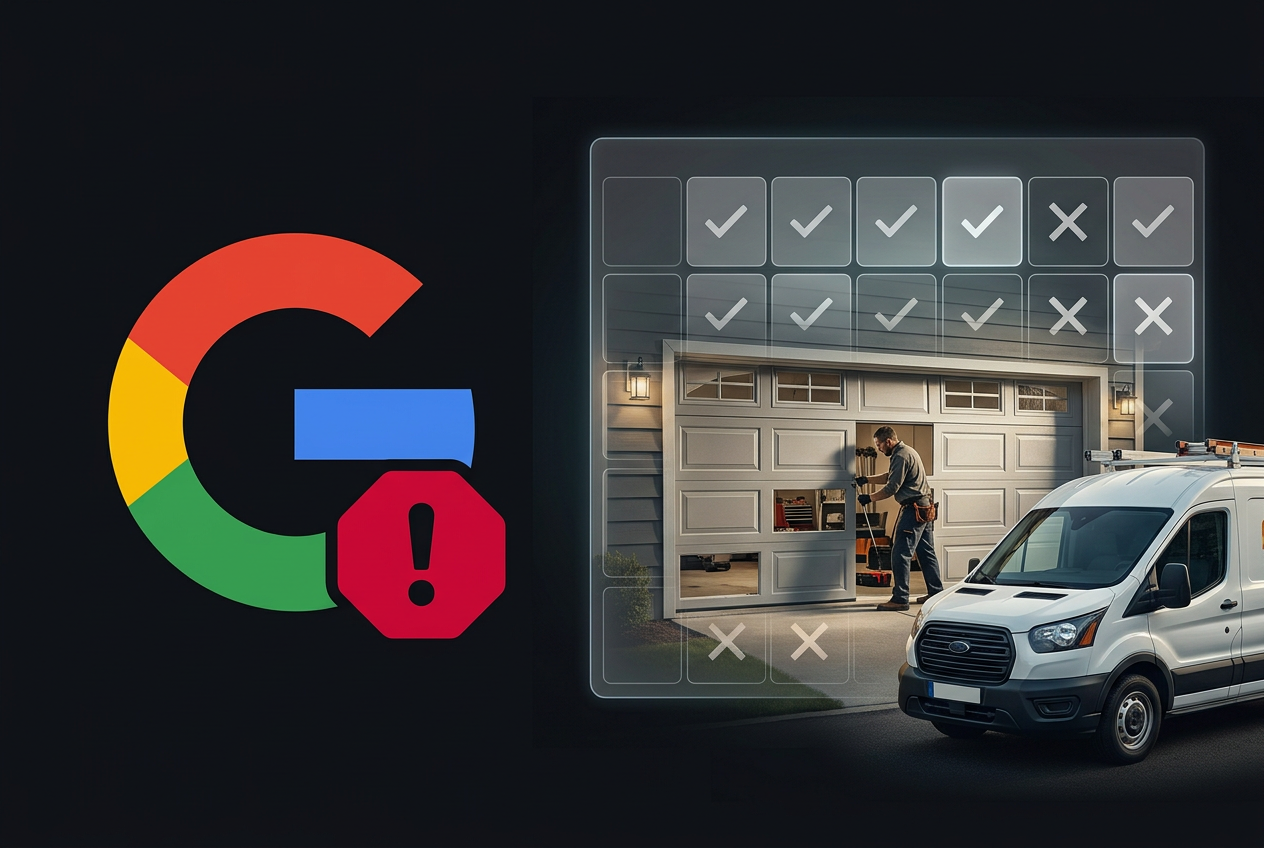
Google's Completion Rate Metric Punishes Good Garage Door Service
Google's new Business Profile completion metric flags multi-visit garage door jobs as incomplete, penalizing companies that schedule staged installs and proactive callbacks.
Google rolled out a visible "job completion rate" metric to Business Profiles for garage door service companies in October 2026. The signal is designed to surface reliability by tracking whether jobs close cleanly on the first visit. But the implementation is crude, and it's punishing operators who do the right thing.
If you schedule a follow-up visit within 30 days of the original job—whether it's a planned second trip for a staged installation, a warranty callback, or a proactive maintenance check—Google flags the job as incomplete. Your completion score drops. Your profile loses trust signals in local search.
This hits garage door service operations harder than most trades because the work naturally splits into emergency dispatch and multi-visit projects. A broken spring gets fixed in one trip. A full door replacement with custom trim often requires an initial install and a finish visit once the frame settles. Google's metric doesn't distinguish between the two.
The operators getting dinged are the ones offering proactive post-job stewardship. The ones benefiting are cutting corners or avoiding callbacks entirely.
How the Metric Works
Google pulls job data from three sources: appointment scheduling integrations, review timestamps, and Business Profile messaging activity. When a customer books through your profile or a linked scheduling tool, Google creates a job record with a start date. If you schedule a second appointment tied to the same customer within 30 days, the system assumes the first job wasn't completed.
The completion rate appears as a percentage badge on your Business Profile. It's visible to customers browsing local search results and maps. A rate below 85% triggers a yellow flag. Below 70%, your profile gets pushed down in local pack rankings.
Google's intent is reasonable: surface companies that show up, do the work, and close the loop. The problem is the metric treats every follow-up as a failure.
A garage door company in Boise runs a staged installation model for custom carriage doors. Initial install takes four hours. Trim and hardware go on seven days later once the door settles into the frame. Two visits, both planned from the start, both included in the original quote.
Google sees two appointments for the same customer. Flags the job as incomplete. The company's completion rate drops from 94% to 81% over eight weeks.
Another operator in Fort Worth offers a 30-day post-install check for all opener replacements. It's a value-add, not a fix. Customers appreciate it. Google counts every callback as an incomplete job. Completion rate: 68%. Profile flagged.
This isn't a bug. It's a fundamental misunderstanding of how garage door service operations run.
Why Multi-Visit Jobs Exist
Garage door work splits into three categories: emergency dispatch, single-visit repairs, and planned projects. Each has different timelines and follow-up patterns.
Emergency dispatch is straightforward. Spring breaks, door won't close, opener dies. Technician arrives, diagnoses, fixes on-site. One trip, one invoice, done. These jobs should score 100% completion under Google's metric.
Single-visit repairs include most tune-ups, sensor replacements, and track adjustments. Occasionally you need to order a part and return, but most close in one trip.
Planned projects are where the metric breaks down. Full door replacements, custom installs, commercial overhead doors—these often require multiple visits by design, not because something went wrong.
A residential door replacement typically goes like this:
- Visit one: measure, quote, order door.
- Visit two: remove old door, install new door and tracks.
- Visit three (optional): install trim, paint touch-up, final adjustment after frame settles.
Visit three happens 7–10 days after visit two. It's not a callback. It's part of the scope. But Google's system doesn't know that.
Commercial jobs are worse. A three-bay shop install might span two weeks: rough-in on day one, door install on day five, opener wiring and final programming on day twelve. Three separate appointments, same project. Google sees three "incomplete" jobs.
The metric also punishes warranty callbacks. If you replace a spring under warranty within 30 days, Google logs it as a failure to complete the original repair. Even if the spring failed due to a manufacturing defect, not workmanship.
Proactive maintenance falls into the same trap. Offer a complimentary 30-day safety check after a new opener install, and your completion rate takes a hit.
The operators who avoid these penalties are the ones who skip follow-ups, don't offer staged installs, and ignore post-job stewardship.
The Data Google Doesn't See
Google pulls appointment data from scheduling integrations like Jobber, Housecall Pro, and ServiceTitan. But it doesn't pull job notes, scope descriptions, or project metadata. It sees dates and customer IDs, not context.
If your CRM labels a job as "Day 1 of 2" or "Warranty follow-up," Google doesn't parse that. If your invoice shows two line items—"Install" and "Trim-out"—the system doesn't connect them.
Google also doesn't pull completion data from your internal records. If you mark a job as "Complete—follow-up scheduled," the system ignores it. The only signal it trusts is the absence of a second appointment.
This creates a perverse incentive: batch all your work into a single visit, even if it means rushing or skipping quality steps.
A garage door company in Phoenix used to schedule a final adjustment visit 14 days after every opener replacement. It reduced nuisance callbacks and improved customer satisfaction scores. After the October update, they stopped offering it. Completion rate climbed back to 89%. Customer complaints increased 22%.
Another operator in Charlotte restructured custom door installs to force trim-out on the same day as the install, even if the frame hadn't settled. Door alignment issues spiked. But their Google completion rate stayed above 90%.
This is systems collision: Google's ranking signal is optimizing for the wrong outcome.
How to Protect Your Profile
You can't ignore Google's completion rate—it's visible to customers and affects local pack rankings. But you don't have to abandon multi-visit jobs or proactive callbacks.
The solution is to restructure how you log appointments and communicate scope to customers.
Consolidate Multi-Visit Jobs Into One Appointment Block
If a project requires two visits, schedule them as a single appointment with a long duration rather than two separate bookings. In your CRM, create one job record with internal notes that break out the visit schedule.
Example: A custom door install requires an install day and a trim-out visit seven days later. Instead of scheduling two appointments, book the project as a single "Custom Door Install—2 Visits" appointment starting on day one. Add internal task reminders for the second visit, but don't create a second customer-facing appointment.
Google sees one job, one completion. Your techs still know when to return.
This only works if your scheduling system allows long-duration or multi-day appointments. Most modern CRMs do. If yours doesn't, you're flying blind in a metric-driven ranking environment.
Separate Warranty Work From Original Jobs
When a customer calls with a warranty issue, don't tie the callback to the original job record. Create a new job with a distinct service type: "Warranty Service—Spring Replacement" instead of linking it back to the original "Spring Replacement" job.
Google's system uses customer ID and appointment proximity to flag incomplete jobs. If the second appointment is logged as a completely separate job type—especially if it's categorized under warranty or maintenance rather than repair—it's less likely to trigger the completion penalty.
Some CRMs auto-link warranty callbacks to the originating job for internal tracking. Disable that feature for external-facing appointment records.
Push Follow-Ups Past the 30-Day Window
If you offer proactive maintenance checks or post-install adjustments, schedule them for 31+ days after the original job. Google's completion metric only tracks follow-ups within 30 days.
A 30-day safety check becomes a 35-day check. A two-week trim-out visit becomes a five-week visit.
This is a compromise. Ideally, you'd schedule follow-ups based on what the job needs, not what Google's algorithm penalizes. But if the alternative is losing local pack visibility, the trade-off makes sense.
For jobs that require a second visit sooner than 30 days—like commercial installs with permit inspections—use the consolidated appointment strategy above.
Communicate Scope in Booking Confirmations
Google also pulls review timestamps and customer messaging activity. If a customer leaves a review praising your "two-visit install process" three days after the first visit, Google may interpret that as premature feedback on an incomplete job.
Train customers to understand that multi-visit jobs are complete when the full scope closes, not after each individual visit. Include scope timelines in booking confirmations and post-visit emails.
Example confirmation email:
"Your custom carriage door install is scheduled for October 15. The installation will be completed in two visits: door install on October 15, and trim/final adjustment on October 22. Both visits are included in your quoted price. You'll receive a completion confirmation after the October 22 visit."
This sets the expectation that one job = two visits. If the customer leaves a review, they're more likely to reference the full project timeline rather than flagging the first visit as incomplete.
Track Your Completion Rate Weekly
Google updates Business Profile metrics every 7–10 days. If your completion rate starts dropping, you need to know immediately so you can trace it back to specific jobs or scheduling patterns.
Most CRMs don't surface Google's completion data inside your dashboard. You have to check your Business Profile manually or use a local SEO monitoring tool that scrapes profile metrics.
Set a weekly alert. If your rate drops below 85%, audit the last 30 days of jobs. Look for:
- Multi-visit projects logged as separate appointments.
- Warranty callbacks tied to original job records.
- Proactive follow-ups scheduled inside the 30-day window.
Fix the pattern going forward. You can't retroactively change how Google scored past jobs, but you can prevent the rate from sliding further.
The Bigger Problem
Google's completion rate metric is a crude proxy for reliability. It assumes that one appointment = one job, and any deviation signals incomplete work or poor service. That assumption works for some trades. It breaks for garage door service operations.
The metric doesn't account for:
- Staged installs required by permit timelines or material availability.
- Manufacturer-recommended post-install adjustments.
- Proactive maintenance that prevents future callbacks.
- Warranty work that's separate from the original service quality.
It rewards companies that avoid follow-ups and penalizes companies that build post-job stewardship into their operations.
This isn't unique to garage door work. Any trade that runs multi-visit projects or proactive callbacks will hit the same problem. Remodelers doing demo and build-out in separate phases. Painters scheduling prep and finish coats days apart. Landscapers installing hardscape in stages.
Google is trying to solve for flaky operators who no-show or leave jobs half-done. The signal is directionally correct. The implementation punishes the wrong companies.
Systems Absorb Metrics
Your job records, scheduling logic, and customer communication must absorb the fact that Google now surfaces completion rate as a visible, ranking-affecting metric. You can't ignore it. You can't wish it away.
But you also can't let a poorly designed algorithm dictate how you scope and deliver work.
The solution is to separate internal operations from external signals. Internally, you still track every visit, every callback, every warranty follow-up as distinct tasks. Your techs need that granularity. Your ops team needs it for scheduling and capacity planning.
Externally—in the appointment records that flow to Google through your CRM integrations—you consolidate, re-categorize, and time-shift to protect your completion score without sacrificing service quality.
This is the tax of operating in a metric-driven local search environment. The companies that engineer around it maintain rankings and customer trust. The ones that don't pay the price in visibility, even if their work is flawless.
Google's completion rate isn't measuring quality. It's measuring compliance with a narrow definition of "done." Build your systems to satisfy both.