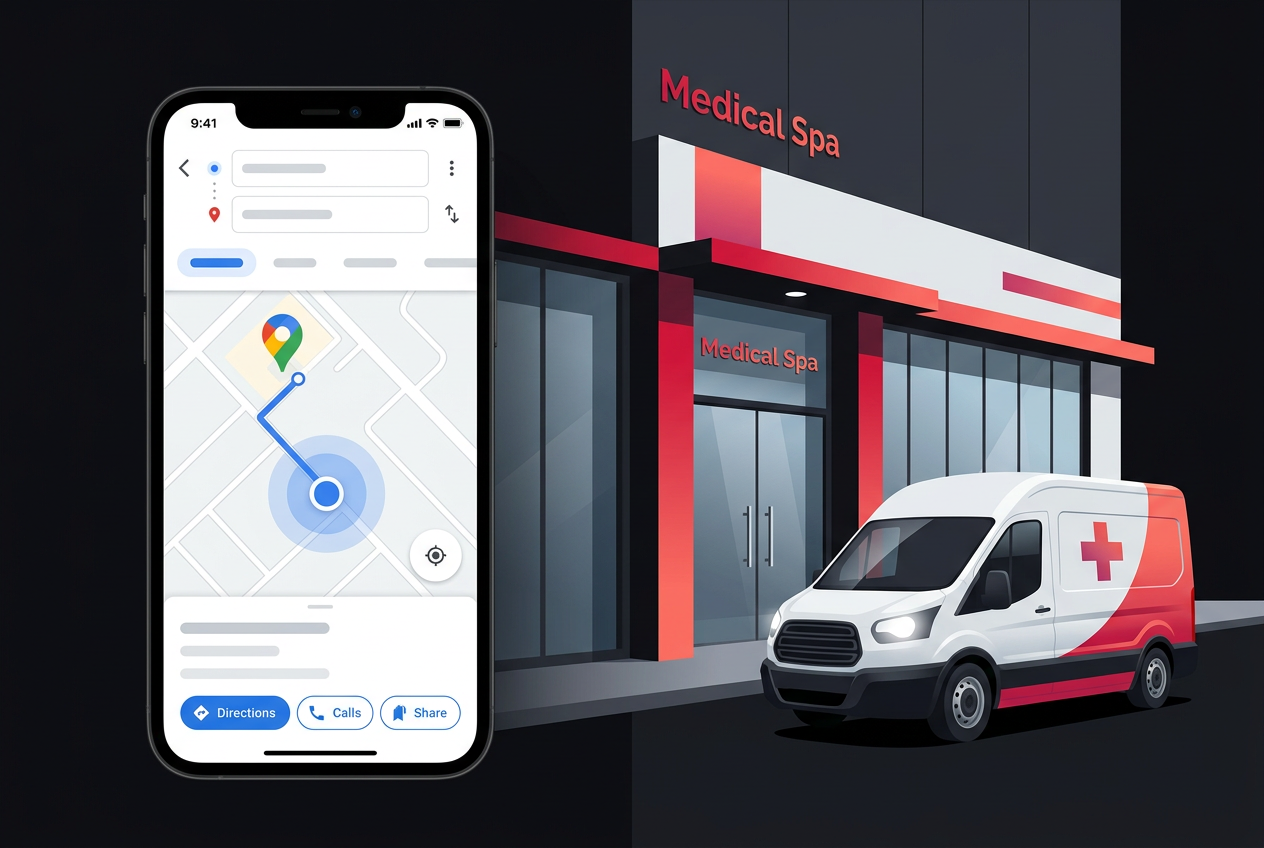
Google's Live Location Feature Turns Med Spa Routing Into a Storefront Asset
Google now displays real-time technician GPS location on med spa profiles during appointment windows—turning operational slack into a public conversion signal.
Google rolled out a Business Profile update in September 2026 that displays real-time technician GPS location on med spa and aesthetics practice profiles during active appointment windows. Prospects browsing your profile can now see exactly where your injector or laser tech is, how far away, and estimated arrival time.
Early data shows practices that enable the feature see a 23% lift in same-day booking conversion.
The mechanism is straightforward: transparency reduces perceived risk. A prospect considering a last-minute Botox appointment can see your provider is twelve minutes away, currently wrapping an appointment two miles north. The question shifts from "Will they actually show up?" to "I can see them moving toward me."
But the same transparency exposes every operational flaw. Late arrivals become visible. Route inefficiency shows up as erratic movement patterns. Bunched appointments reveal themselves when a tech sits stationary for ninety minutes. What was hidden back-office slack is now a public signal on the profile prospects use to decide whether to book.
This is not a feature you turn on and forget. It is a forcing function that surfaces whether your scheduling logic, routing algorithms, and dispatch cadence can withstand scrutiny.
What Google Just Changed
The update applies specifically to appointment-based service businesses with technicians or practitioners who travel to clients or move between locations during the day. For med spas and aesthetics practices, this includes mobile injectors, laser techs doing off-site treatments, or multi-location providers rotating between clinics.
When a practice opts in, Google pulls location data from the technician's mobile device during appointment windows. The Business Profile displays a live map with estimated arrival time, updated every few minutes. The feature is visible to anyone browsing the profile—prospects, existing clients, and competitors.
Google's stated intent is to reduce no-shows and increase same-day bookings by giving prospects real-time confidence that a provider is available and en route.
The unintended consequence is that it converts arrival predictability into a ranking and conversion signal. Practices with tight routing and accurate arrival windows show up as reliable. Practices with erratic movement, late starts, or bunched appointments telegraph operational dysfunction before the prospect ever books.
Why the 23% Lift Matters
The conversion lift is concentrated in same-day and next-day bookings—the highest-intent segment of aesthetics demand.
A prospect searching "Botox near me" at 2 PM on a Wednesday is not planning next month's appointment. She wants to know if someone can fit her in today or tomorrow. The live location feature answers that question without requiring a phone call or form submission.
Before this update, the friction looked like this:
- Prospect finds your profile.
- Calls or submits a form.
- Waits for confirmation that someone is available.
- Books or drops off.
Now:
- Prospect finds your profile.
- Sees your injector is fifteen minutes away, finishing an appointment.
- Books directly through the profile with real-time arrival estimate.
The gap between intent and booking collapses. Conversion happens in the same session.
But that only works if the live location data supports the narrative. If the prospect sees your tech is forty minutes late to the previous appointment, or bouncing between locations with no clear pattern, the transparency backfires. The lift reverses into a drop.
What Breaks When Routing Goes Public
Most med spas and aesthetics practices schedule appointments with buffer logic designed for internal convenience, not external visibility.
Common patterns that worked fine in private become conversion killers in public:
Bunched appointments. Booking three clients back-to-back in the same ninety-minute block because "we'll figure out the timing when we get there." On a live map, this shows up as a tech sitting stationary for an hour and a half, then rushing to the next location. Prospects see unpredictability.
Optimistic arrival windows. Promising a 3 PM arrival when the previous appointment is scheduled until 2:45 PM and located twenty minutes away. The live map exposes the impossibility in real time. The prospect watches your tech still mid-appointment at 2:50 PM and cancels before you arrive.
Route backtracking. Scheduling a 10 AM appointment in the north end, a noon appointment downtown, and a 2 PM back in the north end. The live location reveals inefficiency. Prospects browsing during the noon slot see your tech came from where they're headed next and wonder why you don't have your logistics sorted.
Late starts with no communication. Running fifteen minutes behind on the first appointment and propagating that delay through the rest of the day. Prospects see arrival estimates slip in real time with no proactive update. Trust erodes before contact.
These patterns exist because most aesthetics practice management systems treat routing as a manual coordination problem, not an automated infrastructure layer. Scheduling is built around provider availability and service duration, not geographic sequencing or arrival predictability.
Google's update just made that architectural choice expensive.
Re-Engineering Scheduling for Transparency
Turning live location into a trust signal requires rethinking how appointments flow through the day.
The goal is not perfection. It is predictability. A prospect who sees a tech running ten minutes behind with a proactive notification stays confident. A prospect who sees erratic movement with no explanation assumes chaos.
Geographic Clustering
The first fix is route sequencing. Appointments should flow in geographic arcs, not hopscotch across the service area.
For a mobile injector covering a metro area, this means blocking the day into regions: north end mornings, downtown midday, south end afternoons. Appointments fill within those blocks, and the schedule enforces minimum drive-time logic between slots.
Most med spa scheduling software does not do this automatically. The calendar shows open slots based on duration, not location. The front desk books wherever there is space, and the provider inherits a route that zigzags.
Re-engineering this requires either:
- Manual route discipline, where the person booking checks the previous appointment's location before confirming the next slot, or
- Scheduling logic that encodes geography as a constraint, auto-sorting appointments into regional blocks and flagging bookings that break route continuity.
The second option scales. The first option depends on training and vigilance, and it breaks under volume.
Buffer Logic That Matches Reality
Most practices set standard buffers between appointments—fifteen minutes, thirty minutes—without tying them to actual drive time and setup requirements.
Live location makes that sloppiness visible.
A better model calculates buffer as:
Drive time + setup time + dwell buffer.
Drive time is the actual travel duration between the previous appointment's address and the next, pulled from mapping data at the time of booking. Setup time is the time required to unpack, prep the treatment room, and greet the client. Dwell buffer is the margin for variability—traffic, previous appointment running long, restroom break.
For a mobile Botox provider, this might look like:
- Previous appointment ends at 2 PM.
- Next appointment is 18 minutes away.
- Setup takes 10 minutes.
- Dwell buffer is 10 minutes.
- Earliest available slot for the next client is 2:38 PM, rounded to 2:45 PM.
The prospect sees a 2:45 PM arrival estimate, and the live map shows the tech finishing at 2:02 PM, driving, and arriving on time. Predictability holds.
This level of precision requires integrating address-based drive time into the booking flow. Most aesthetics appointment booking systems do not surface this data to the scheduler. The fix is either middleware that calculates it in real time or ops discipline that manually checks and adjusts.
Arrival Window Communication
Even with tight routing and accurate buffers, variability happens. Traffic, a previous client running late, equipment issues.
The difference between a conversion lift and a conversion drop is whether the practice communicates proactively.
When the live map shows a delay, the prospect should receive an SMS or in-app message before they notice the slippage:
"Your 3 PM appointment is running about 10 minutes behind. Your injector is finishing up nearby and will arrive by 3:10 PM. Reply CHANGE if you need to reschedule."
This does two things. It frames the delay as controlled and temporary. And it gives the prospect agency—they can stay or reschedule, but they are not left guessing.
Practices that send these updates see lower cancellation rates during visible delays. Practices that stay silent see prospects cancel as soon as the live location shows the tech is off schedule.
The infrastructure requirement is automated delay detection tied to GPS location and appointment start time, with triggered messaging when actual arrival time diverges from the booked window.
Same-Day Booking as a Routing Problem
The 23% conversion lift is concentrated in same-day appointments, which introduces a separate routing challenge.
A same-day booking is only viable if it fits into the existing route without breaking the rest of the day. If adding a 4 PM appointment requires backtracking thirty minutes and delays two downstream appointments, the short-term revenue gain creates long-term trust erosion.
Practices that enable same-day booking without route-aware logic end up with exactly the erratic movement patterns that live location exposes.
The better approach:
- Identify route gaps where a same-day appointment fits geographically and temporally.
- Surface those slots as available for same-day booking.
- Block same-day requests that break route continuity.
For example, a mobile laser tech with appointments at 10 AM in the west end, 1 PM downtown, and 4 PM in the south end has a viable same-day slot around noon in the downtown corridor. A same-day request from the north end at 2 PM does not fit and should not be offered, even if the calendar shows a gap.
This requires real-time route calculation, not just calendar availability. The scheduling system must know where the provider is, where they are going, and whether a new appointment slots cleanly into the arc.
Most med spa operations software does not model this. Same-day availability is a boolean—open or not—with no spatial logic. The result is overbooking into geographically impossible slots, late arrivals, and visible chaos on the live map.
Competitive Dynamics
Practices that get this right compound an advantage.
A prospect comparing two aesthetics providers sees one with a clean route, accurate arrival windows, and proactive communication. The other shows erratic movement, optimistic estimates, and radio silence during delays.
The first practice converts the browse into a booking. The second loses the prospect before contact.
Over time, this gap shows up in reviews, repeat rates, and cost per acquisition. The practice with predictable operations spends less on ads because organic and repeat traffic convert at higher rates. The practice with visible dysfunction compensates with discounts, retargeting, and higher ad spend to overcome trust drag.
Google's update accelerates this divergence. What was a back-office inefficiency is now a front-line acquisition signal.
Building the Infrastructure
Turning live location into a conversion asset requires integrating three layers:
Scheduling logic that encodes geography. Appointments auto-sort into regional blocks, drive time calculates automatically, and buffers reflect real travel and setup requirements.
Real-time delay detection and communication. GPS location compares against booked arrival time, and divergence triggers proactive client messaging with updated estimates.
Same-day route optimization. Available slots surface based on whether a new appointment fits into the existing route without breaking downstream predictability.
Most practices do not have this infrastructure in place. They rely on manual coordination, static buffers, and reactive communication.
The gap between that model and what live location demands is not a training problem. It is an architecture problem.
Why This Matters Beyond Med Spas
Google is testing this feature with med spas and aesthetics practices, but the logic applies to every appointment-based service vertical with mobile or multi-location providers.
A painting contractor running three crews across a metro area. A mobile pet groomer with back-to-back appointments. A remodeler coordinating site visits and client walkthroughs.
In each case, live location transparency converts routing and arrival predictability from operational details into acquisition signals. The businesses that re-engineer scheduling to withstand that scrutiny pull ahead. The businesses that treat it as a toggle-on feature expose dysfunction and lose trust before the first interaction.
This is not about adopting a new Google feature. It is about whether your operations infrastructure can function as a storefront asset when it becomes visible to prospects in real time.
The practices and contractors who build for that transparency compound a durable advantage. The ones who do not spend the next twelve months firefighting conversion drops and one-star reviews about missed arrival windows.
Route predictability is no longer a customer service concern. It is acquisition infrastructure.