Google LSA Now Penalizes Landscapers Who Run Lean Crews
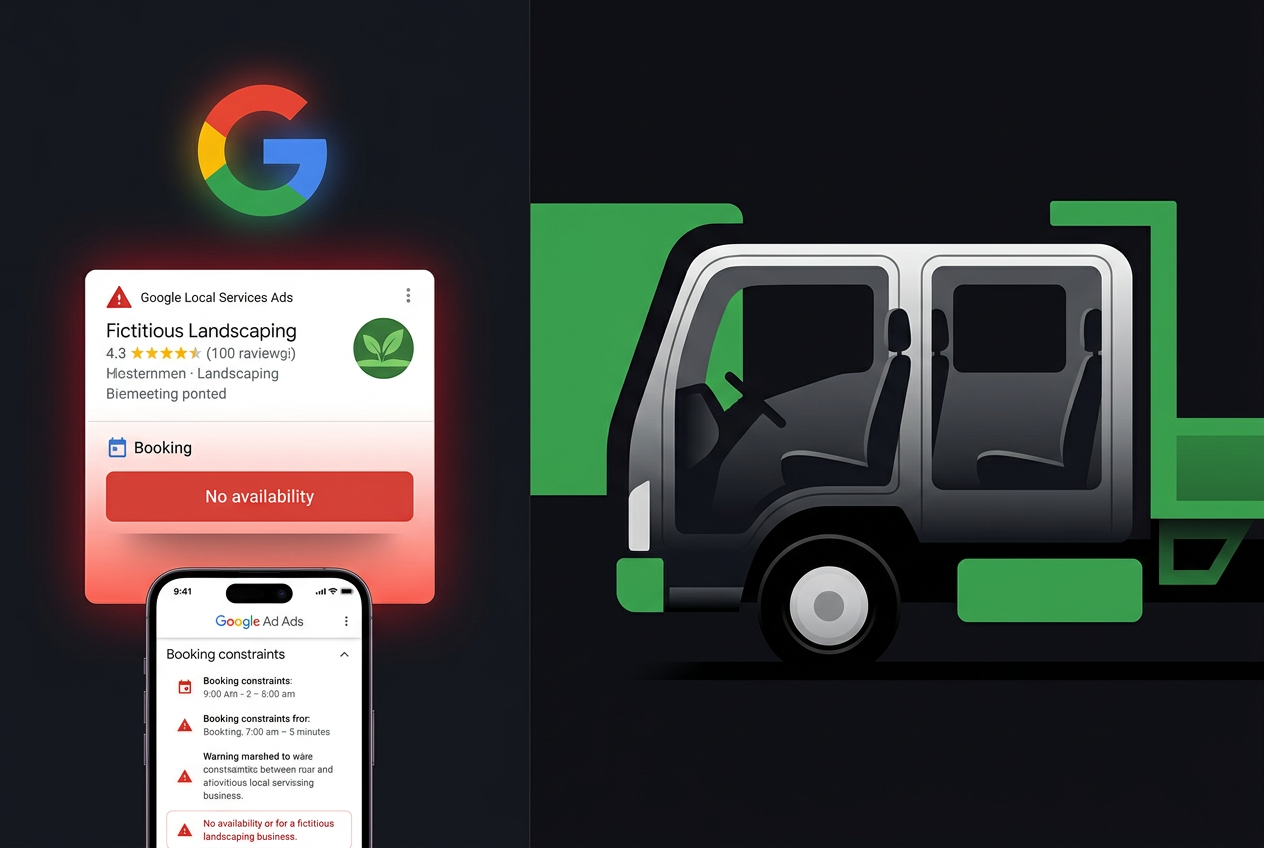
Google's October 2026 LSA update surfaces real-time crew availability in ad units—if you show no capacity in 72 hours, your ad stops serving entirely.
Google rolled out a significant update to Local Services Ads in October 2026. LSA ad units now display real-time scheduling data pulled directly from your calendar system. For landscaping and lawn care operators, this means your ad prominently shows "Next available slot" based on live crew capacity. If your schedule shows zero openings in the next 72 hours, your ad stops serving. You keep paying for Premium placement, but Google stops showing your listing.
This is not a bug. It is a deliberate mechanism to prioritize advertisers who can fulfill demand immediately.
The timing creates immediate friction. October is peak fall cleanup season for most landscaping businesses in temperate zones. Demand surges, margins are strong, and crews run at or near capacity. In previous years, a full schedule was a sign of operational health. Now it is an acquisition penalty. The businesses that optimized for lean crew utilization—minimizing labor cost while maximizing margin per job—are the first to lose impression share during their highest-value weeks.
This update transforms crew scheduling from an internal operational dial into a live gate for paid acquisition. The cost is not just lost impressions. It is compressed revenue concentration, higher customer acquisition cost during shoulder periods, and strategic misalignment between how you staff and how Google decides to show your business.
The Mechanism
Google's LSA platform now requires integration with scheduling software that exposes appointment availability via API. The ad unit queries this data in real time and surfaces the next open slot to the searcher. If no slot exists within 72 hours, the system interprets this as "unable to serve new customers" and suppresses the ad.
This is not a manual toggle. You cannot override it by increasing your bid or upgrading to a higher tier. The logic is binary: capacity exists or it does not.
For a landscaping company running three crews during October, the math is straightforward. Each crew completes an average of two jobs per day. That is six jobs daily. If your average job books four days out and you operate five days per week, you have 30 slots filled in your forward calendar at any given time. When demand spikes—say, after the first hard frost or a windstorm drops leaves early—your calendar fills past the 72-hour threshold. Your LSA goes dark.
Premium placement, which costs 20-30% more than standard LSA, offers no protection. You are still paying the platform fee, but Google stops routing search traffic to your business.
The suppression is not permanent. As soon as a slot opens within the 72-hour window—due to a cancellation, a crew finishing ahead of schedule, or a new availability block added—your ad resumes serving. But during high-demand windows, that gap may not materialize for days. In a two-week peak cleanup period, you could lose 40-60% of your impression share with no corresponding reduction in your LSA budget.
Why Lean Scheduling Breaks
Most landscaping operators manage crew utilization as a margin lever. Labor is the largest variable cost in the business. Running crews at 85-95% capacity during peak season maximizes profit per job and minimizes downtime. This is sound operational discipline in a world where acquisition and scheduling are separate systems.
Google's update collapses that separation. Crew utilization is now directly coupled to impression share. A business running at 90% capacity loses acquisition access. A competitor running at 70% capacity—with deliberate buffer slots—continues to capture inbound leads.
This creates a strategic bind. You can preserve margin by running tight schedules, but you pay an acquisition tax. Or you can preserve impression share by holding buffer capacity, but you pay a labor cost for unutilized crew time.
The trade-off is not symmetrical. High-margin weeks in October compress an outsized share of annual revenue for most landscaping businesses. Losing impression share during these windows does not just shift revenue to November. It evaporates. Homeowners book fall cleanups in a narrow decision window, typically 48-72 hours before the first freeze or when leaf drop becomes visibly unmanageable. If your ad is not serving when they search, they book with a competitor. That revenue does not reappear later in the season.
The businesses that suffer most are those that deliberately optimized for operational efficiency. They hired exactly the crew count needed to serve forecasted demand. They minimized overhead. They avoided carrying extra labor capacity "just in case." These practices produced the highest EBITDA margins in the category—until October 2026.
Now those same practices create a structural acquisition disadvantage during the most valuable weeks of the year.
The Capacity Illusion
One immediate response is to artificially inflate availability by creating placeholder slots in your scheduling system. If Google's LSA algorithm only checks for the presence of an open slot within 72 hours, you could theoretically leave buffer appointments open, keep your ad serving, and then fill those slots with inbound leads.
This works for approximately one week.
The problem is that LSA is not just checking availability. It is checking fulfillment. Google's Local Services Ads platform tracks conversion rates, cancellation rates, and booking lag. If you consistently show availability but then push customers beyond the displayed window or cancel appointments to accommodate demand, your Quality Score degrades. Lower Quality Score increases your cost per lead and eventually suppresses your ad regardless of availability.
Google is not measuring whether you say you have capacity. It is measuring whether customers successfully book and complete service within the stated window. The system is designed to surface providers who can fulfill immediately, not providers who game the availability display.
This eliminates the simplest workaround and forces operators to address the actual constraint: real crew capacity must exist within the 72-hour window for the ad to serve sustainably.
What Changes Now
Landscaping businesses must redesign how they manage scheduling, crew allocation, and acquisition spend to operate under this new constraint. The system that worked in 2025—optimize crew utilization, run LSA campaigns during peak demand, accept that your calendar fills quickly—no longer functions.
Three specific areas require structural change.
Dynamic Slot Release
Instead of filling your schedule in strict chronological order, you need to hold a rolling reserve of near-term capacity that releases dynamically based on demand signals.
A landscaping company running three crews might allocate 80% of each crew's capacity to standard booking flow, with 20% held in reserve and released only when lead volume drops below a threshold or when the forward calendar crosses the 72-hour boundary. This creates a buffer that keeps your LSA ad serving even during high-demand periods.
The reserve is not unutilized time. It is capacity deliberately held back from the standard booking interface and released through a secondary logic layer. When an inbound LSA lead arrives and your standard schedule is full, the system checks the reserve pool and releases a slot if margin and routing logic justify it.
This requires your scheduling system to support tiered availability—slots visible to some channels but not others—and to automatically promote reserve slots to general availability based on real-time conditions.
Crew Dispatch Flexibility
Traditional landscaping scheduling assigns jobs to crews based on geography and skill match, optimizing for drive time and labor efficiency. Under LSA's capacity constraint, dispatch logic must also optimize for calendar shape—ensuring that at least one crew always has near-term availability.
A remodeler managing multiple project crews might assign long-duration jobs (deck builds, hardscaping) to Crew A and short-duration jobs (cleanups, mulching, small plantings) to Crew B. Crew B's shorter job cycle naturally creates more frequent availability windows, keeping the LSA ad active even when total utilization is high.
This is not about reducing utilization. It is about distributing utilization across crews in a way that maintains a continuous availability signal. One crew running at 95% capacity with jobs stacked end-to-end creates the same impression suppression as three crews at 95%. But three crews at 85%, 90%, and 95%—with staggered job completion—keeps the ad serving because someone always has near-term capacity.
Dispatch flexibility also means dynamically re-routing jobs when capacity windows threaten to close. If Crew B finishes a job four hours early and Crew A is booked solid for the next 96 hours, you re-assign an inbound lead originally routed to Crew A over to Crew B to preserve the availability signal.
This level of real-time crew coordination requires dispatch software that tracks job duration predictions, updates availability as jobs complete, and reroutes incoming leads based on current calendar state—not static crew assignments made at the start of the week.
Seasonal Spend Inversion
In the previous LSA environment, landscaping businesses concentrated ad spend during peak demand windows. October and November drove the highest search volume, the highest close rates, and the best margin jobs. You increased your LSA budget during these weeks because return on ad spend was highest.
Google's capacity gate inverts this logic. Peak demand now creates periods of involuntary ad suppression. You are still paying for placement, but the platform limits your impressions because your calendar is full. Your effective cost per lead increases even though your bid and budget remain constant.
The new optimal spend curve shifts budget forward into shoulder periods—late August, early September—when search volume is lower but your calendar still has room. You capture leads earlier, book them into the peak window, and avoid the suppression penalty when October demand surges.
This requires revenue infrastructure that can accept early bookings without creating long lead times that degrade close rates. A lead generated in early September for a mid-October cleanup must be nurtured, confirmed, and converted at the same rate as a lead generated 48 hours before service. That means automated reminders, pre-service communication sequences, and dynamic rebooking logic if weather or schedule shifts force changes.
It also means managing cash flow differently. In a same-week booking model, revenue and labor cost align within the same week. In an early-booking model, you carry forward liability—booked jobs that have not yet been fulfilled—and must ensure your operational tempo in October actually matches the commitments made in September.
The Operational Layer
These changes do not happen in your LSA dashboard. They happen in the scheduling, dispatch, and customer communication systems that feed data into LSA.
A landscaping business cannot manually manage tiered slot availability, real-time crew re-routing, and early-booking nurture sequences. The operational tempo is too fast and the cost of error—a suppressed ad during a high-value week—is too high. This must be automated infrastructure.
That infrastructure has three components.
Scheduling logic that exposes availability selectively. Your calendar must differentiate between "booked," "held in reserve," and "available to LSA." It must automatically release reserve slots when certain conditions are met and suppress availability to other channels when LSA demand is strong.
Dispatch coordination that optimizes for calendar shape, not just drive time. When an inbound lead arrives, the system must evaluate which crew assignment preserves near-term availability across the business, not just which crew is geographically closest. It must track job duration in real time and update availability as jobs complete early or run long.
Lead nurture and rebooking automation that converts early leads at the same rate as late leads. If you shift spend into shoulder periods and book jobs weeks in advance, you need a communication layer that keeps those customers engaged, confirms the appointment as the date approaches, and handles rescheduling without manual intervention.
These are not features you add to a generic CRM. They are purpose-built for appointment-based service businesses operating under capacity constraints imposed by acquisition platforms.
Why This Compounds
The strategic advantage does not come from solving the immediate problem—keeping your LSA ad live during October 2026. The advantage comes from building infrastructure that decouples crew utilization from acquisition access.
A landscaping company that implements dynamic slot release, flexible dispatch, and seasonal spend inversion does not just avoid Google's suppression penalty. It gains the ability to run leaner operations and maintain acquisition velocity during peak periods. Competitors who do not build this infrastructure face a binary choice: sacrifice margin to hold buffer capacity, or sacrifice impression share during high-value weeks.
You avoid the choice entirely.
This infrastructure also extends beyond LSA. The same scheduling logic that holds reserve capacity for Google can prioritize repeat customers, allocate premium slots to high-ticket jobs, or dynamically adjust pricing based on forward calendar density. The dispatch coordination that optimizes for calendar shape also reduces drive time, improves crew utilization, and shortens the lag between lead capture and service delivery.
Revenue infrastructure built to solve one acquisition constraint ends up solving a dozen operational constraints. That is what compounds.
The New Baseline
Google's October 2026 LSA update is not a temporary experiment. It is a signal of where acquisition platforms are moving. Paid channels increasingly favor advertisers who can prove immediate fulfillment capacity, not just willingness to pay for placement. The cost of running lean operations—once purely a labor margin calculation—now includes an acquisition tax.
For landscaping businesses managing seasonal demand, this changes the build priority. Scheduling systems, dispatch coordination, and lead nurture automation are no longer operational nice-to-haves. They are structural requirements to maintain acquisition access during the weeks that matter most.
The businesses that build this infrastructure in Q4 2026 enter spring 2027 with a compounding advantage. The ones that do not will spend the next peak season managing the tension between margin and impression share, one manual schedule adjustment at a time.
You already know which path scales.