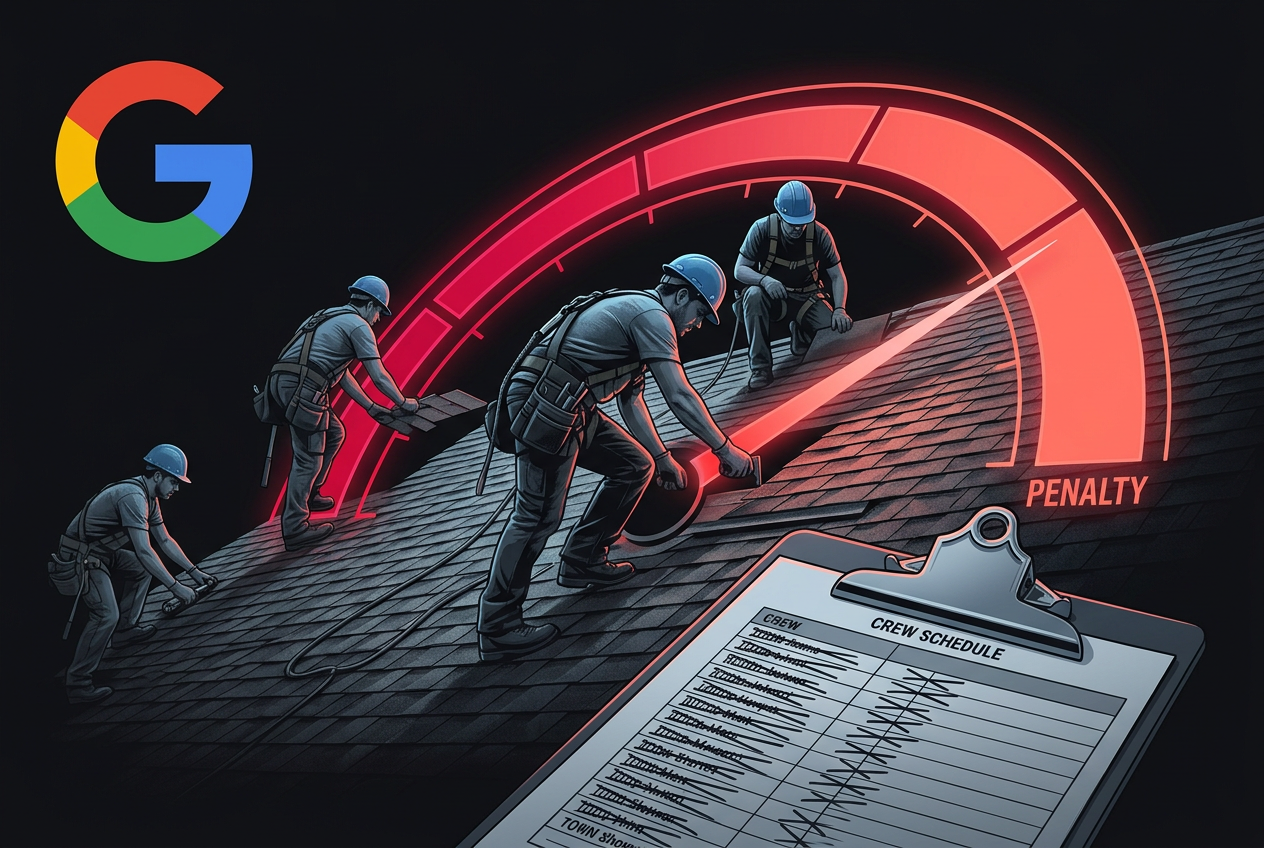
Google's LSA Crew Utilization Rule Punishes Good Roofing Operations
Google now surfaces real-time crew capacity in Local Services Ads for roofers, penalizing contractors who staff for safety margins and quality control.
Google flipped a switch on October 7, 2026, and roofing contractors woke up to a new problem: homeowners searching for roofers in Local Services Ads can now see which companies are running below 70% crew capacity. Google frames this as an "availability signal." The market reads it as desperation.
The update surfaces internal utilization data that most roofing contractors don't even track properly. Worse, it penalizes the operational discipline that separates good shops from volume mills—safety margins, quality control buffers, seasonal crew adjustments, and the decision not to overbook when weather or permitting creates risk.
Contractors who maintain 60% utilization to preserve crew safety and project quality now pay higher cost-per-lead in LSA auctions. Shops that run crews at 85% and accept the callbacks, the rework, and the safety incidents get visibility and lower bid costs.
This is not a marketing problem. It's an operations infrastructure problem dressed up as an ad platform update.
The Utilization Trap
Google defines crew utilization as the percentage of available crew-hours that are assigned to billable project work within a rolling seven-day window. A roofing contractor with three crews, each working five eight-hour days, has 120 available crew-hours per week. If 95 of those hours are assigned to jobs, utilization is 79%.
Google's LSA algorithm now factors this number into ad placement and cost-per-lead. Contractors above 70% utilization are considered "busy" and deprioritized in search results. Contractors below 70% are flagged as "available" and receive preferential placement.
The mechanic sounds reasonable until you understand how roofing operations actually work.
A responsible roofing contractor does not run crews at 90% utilization. They staff for weather delays, permit hold-ups, material delivery windows, and the reality that a three-day tear-off can stretch to five if it rains or the inspector reschedules. They leave buffer time for callbacks, for a flashing detail that needs a second visit, for the commercial project that gets bumped because the property manager changes the start date.
They also staff for safety. A crew running at 85% utilization all summer is a crew that skips the mid-day break, rushes the tear-off, and takes shortcuts on fall protection. Fatigue and time pressure are the two largest contributors to roofing injuries.
Google's algorithm does not account for any of this. It reads low utilization as availability and rewards it. It reads high utilization as demand and penalizes it.
The result is a reverse auction where contractors compete to appear less busy, even if that means overbooking crews, under-staffing for safety, or gaming the system by inflating crew counts in Google's Business Profile.
How the Data Gets to Google
Google is not guessing. The utilization data comes from one of three places.
Direct integration. If you use scheduling software that integrates with Google Local Services Ads—and most major platforms have added this connection in the past 18 months—Google pulls crew assignments, job start and end times, and resource allocation directly from your dispatch calendar. You agreed to this data share when you connected your LSA account to your scheduling tool.
Manual reporting. If you don't use integrated software, Google prompts you to manually report crew count and job assignments through the LSA dashboard. Most contractors ignore this. Google interprets silence as low utilization and assigns a default score, which is usually worse than reporting honestly.
Inferred utilization. Google cross-references your LSA lead volume, your response time, and your booking rate to estimate how busy you are. If you're declining leads, delaying responses, or booking jobs three weeks out, Google infers high utilization and adjusts your placement accordingly.
The contractors getting hit hardest by the October update are the ones running tight operations with real scheduling discipline. They know their crew capacity. They track utilization internally. And they've connected their scheduling software to LSA because it automates lead routing and follow-up.
They are being punished for operational transparency.
The False Choice
The update forces roofing contractors into a decision tree that should not exist.
Option one: Overbook crews. Schedule jobs at 85% utilization or higher to maintain LSA placement. Accept the downstream consequences—rushed tear-offs, callback volume, safety incidents, crew burnout, and the occasional project that gets bumped because you ran out of time. This works until it doesn't. A single fall injury or a viral one-star review costs more than six months of LSA leads.
Option two: Inflate crew counts. Report four crews to Google when you actually run three. Lower your apparent utilization without changing operations. This works until Google cross-checks your crew count against your lead acceptance rate, your job completion data, or a manual audit. Google has started flagging contractors for "inaccurate business information" and suspending LSA accounts. The penalty is a 90-day ban and a manual reinstatement process that takes weeks.
Option three: Accept higher bid costs. Run your crews at 60% utilization, staff for safety and quality, and pay 20-30% more per LSA lead because Google deprioritizes you in search results. This is the operationally correct choice, but it only works if your close rate and lifetime customer value are high enough to absorb the higher acquisition cost. Most roofing contractors operate on thin enough margins that a 25% increase in cost-per-lead breaks the unit economics of LSA entirely.
Option four: Build the infrastructure to prove utilization accurately and allocate crew capacity in real time. This is the only option that does not trade operational integrity for visibility.
What the System Requires
If Google is going to surface crew utilization as a ranking signal, the only defensible response is to track utilization accurately and manage it dynamically. That requires infrastructure most roofing contractors do not have.
Real-time crew assignment
You need a scheduling system that assigns specific crew members to specific jobs with specific start and end times. Not a paper calendar. Not a whiteboard. Not a shared Google Doc. A dispatch system that treats crew capacity as a constrained resource and allocates it accordingly.
Every job gets a crew assignment, a start date, an estimated duration, and a status. When a job moves from "scheduled" to "in progress" to "complete," the system updates crew availability in real time. When a job gets delayed or rescheduled, the system recalculates utilization and surfaces the gap.
This is table stakes for proving utilization to Google. If your scheduling tool cannot produce a report that shows crew-hours assigned versus crew-hours available for any seven-day window, you are guessing.
Buffer allocation
Good scheduling software lets you define buffer time as a first-class resource. A roofing contractor might allocate 15% of crew capacity to weather delays, 10% to callbacks and punch-list work, and 5% to safety margin. Those buffers show up in the schedule as blocked time, not as "available" hours.
When Google pulls utilization data, it sees 70% scheduled work plus 30% intentional buffer. The algorithm reads this as "busy but not overbooked," which is the utilization band that minimizes LSA cost-per-lead without triggering the "low availability" penalty.
Buffer allocation also protects you from the operational failure modes that kill roofing contractors. You do not end up triple-booking the same crew because a job ran long. You do not skip the post-job inspection because the next tear-off is already starting. You do not send a crew to a site without verifying that the dumpster arrived and the permit is posted.
Dynamic rescheduling
The difference between 60% utilization and 75% utilization is often a single rescheduled job. A three-day roof that gets pushed back two days because of rain creates a two-day gap in the schedule. If your scheduling system can automatically surface that gap, route inbound LSA leads to fill it, and adjust crew assignments without manual intervention, you recover the utilization points that Google penalizes.
This is not about overbooking. It's about adaptive capacity allocation. When a job delays, the system flags the gap and offers it to the next inbound lead. When a job finishes early, the system checks for queued work and advances the start date. Utilization stays in the 70-80% band without requiring the operator to manually shuffle the calendar every morning.
LSA integration with dispatch
If your scheduling software integrates with Google Local Services Ads, the utilization data flows automatically. Google sees your dispatch calendar, calculates utilization, and adjusts your placement and bid cost accordingly. You do not have to manually report crew counts or guess at availability.
But integration is a double-edged sword. If your scheduling data is messy—jobs marked "scheduled" that actually finished two weeks ago, crews assigned to placeholder jobs that never close, estimated durations that bear no relationship to actual cycle time—Google reads that mess as operational chaos and penalizes you.
LSA integration requires dispatch hygiene. Jobs must be marked complete when they finish. Crews must be unassigned from canceled jobs. Estimated durations must reflect reality, not wishful thinking. The scheduling system must be the source of truth for who is doing what, when.
Most roofing contractors are not there yet.
The Unit Economics Shift
Google's utilization rule changes the math on LSA lead acquisition. Prior to October 7, a roofing contractor could budget $50-80 per lead depending on market and job type. Close rate of 30% meant a cost-per-job of $165-265. Average job value of $8,000-15,000 meant customer acquisition cost sat at 1.5-3% of revenue.
Post-update, contractors running below 70% utilization report cost-per-lead increases of 20-35%. A lead that cost $60 in September now costs $75-80. Cost-per-job climbs to $250-330. CAC as a percentage of revenue rises to 2.5-4%, which is above the margin threshold for most residential roofing work unless the contractor can push price or improve close rate.
The contractors maintaining flat LSA costs are the ones running crews at 75-85% utilization. They are either scheduling tighter than they should, or they have the infrastructure to dynamically allocate crew capacity and prove accurate utilization to Google.
The gap between those two groups is not marketing skill. It's operations infrastructure.
Why This Matters Beyond LSA
Google's crew utilization rule is a forcing function for a capability that roofing contractors should have built anyway. Real-time crew scheduling, buffer allocation, dynamic rescheduling, and dispatch hygiene are not LSA features. They are foundational operational systems that determine whether a roofing contractor can scale past three crews without collapsing under coordination overhead.
The shops that survive this update are the ones that already track utilization, manage crew capacity as a constrained resource, and use scheduling software as the system of record for dispatch. LSA integration is a data export, not a new capability.
The shops that get hit are the ones running operations on institutional knowledge, paper calendars, and daily stand-up meetings. Google just made that operating model 25% more expensive.
The correct response is not to game the algorithm. It's to build the infrastructure that makes the algorithm irrelevant.
Building the System
A roofing contractor who wants to prove crew utilization accurately and maintain LSA placement without overbooking needs four layers.
Layer one: Crew scheduling with resource constraints. Every crew is a resource with a defined capacity. Every job consumes crew-hours. The scheduling system allocates crew-hours to jobs and blocks time for buffer, callbacks, and safety margin. When a crew hits 80% utilization, the system stops accepting new assignments for that crew in that window.
Layer two: Real-time status tracking. When a crew starts a job, the system marks it "in progress." When they finish, it marks it "complete." When a job delays, the system updates the end date and recalculates downstream assignments. Crew availability reflects current reality, not last week's plan.
Layer three: Buffer allocation as policy. The system reserves 20-30% of crew capacity for weather, callbacks, and safety margin. That reserved time shows up in the schedule as blocked, not as "available." Google sees 75% utilization, but the contractor is running at a sustainable operational pace.
Layer four: LSA integration with dispatch data. The scheduling system exports crew assignments, job timelines, and utilization metrics to Google. The data is clean, current, and accurate. Google reads it, calculates utilization, and adjusts placement and bid cost accordingly. The contractor does not have to manually report or guess.
This is not a software feature. It's an operational discipline encoded into a system.
The Real Cost
Google's utilization rule exposes the hidden cost of weak scheduling infrastructure. A roofing contractor who cannot prove crew utilization accurately now pays a 25% tax on every LSA lead. Over a year, that's $15,000-30,000 in incremental acquisition cost for a three-crew shop running 200 leads annually.
That tax funds the contractors who built dispatch infrastructure. They get lower cost-per-lead, better placement, and the operational leverage to scale without overbooking crews or sacrificing safety.
The gap compounds. The shops with strong infrastructure acquire customers more cheaply, which funds better crew retention, which reduces scheduling chaos, which improves utilization tracking, which lowers LSA costs further.
The shops without infrastructure pay more per lead, which pressures margins, which forces overbooking, which increases callbacks and safety incidents, which damages reputation and customer lifetime value, which makes LSA the only acquisition channel that still works, which increases dependence on a platform that is actively penalizing them.
This is not a Google problem. Google is surfacing a structural weakness that was already there.
Systems Beat Hacks
The roofing contractors asking "how do I game Google's utilization algorithm" are asking the wrong question. The correct question is "how do I track and manage crew capacity accurately enough that the algorithm reflects operational reality."
That question has one answer: build scheduling and dispatch infrastructure that treats crew utilization as a first-class operational metric. Track it in real time. Allocate buffer capacity as policy. Integrate dispatch data with LSA so Google sees what you actually do, not what you report in a dashboard.
The shops that do this win twice. They get better LSA placement and lower cost-per-lead. And they get the operational leverage to scale past three crews without coordination overhead consuming all the margin.
The shops that don't do this pay a tax that grows every quarter. Google will continue surfacing operational metrics—response time, callback rate, project cycle time, customer retention—and using them as ranking signals. Every new metric punishes operational weakness and rewards infrastructure.
You can staff for safety, manage crew capacity responsibly, and still maintain LSA visibility. But only if you build the system that proves it.