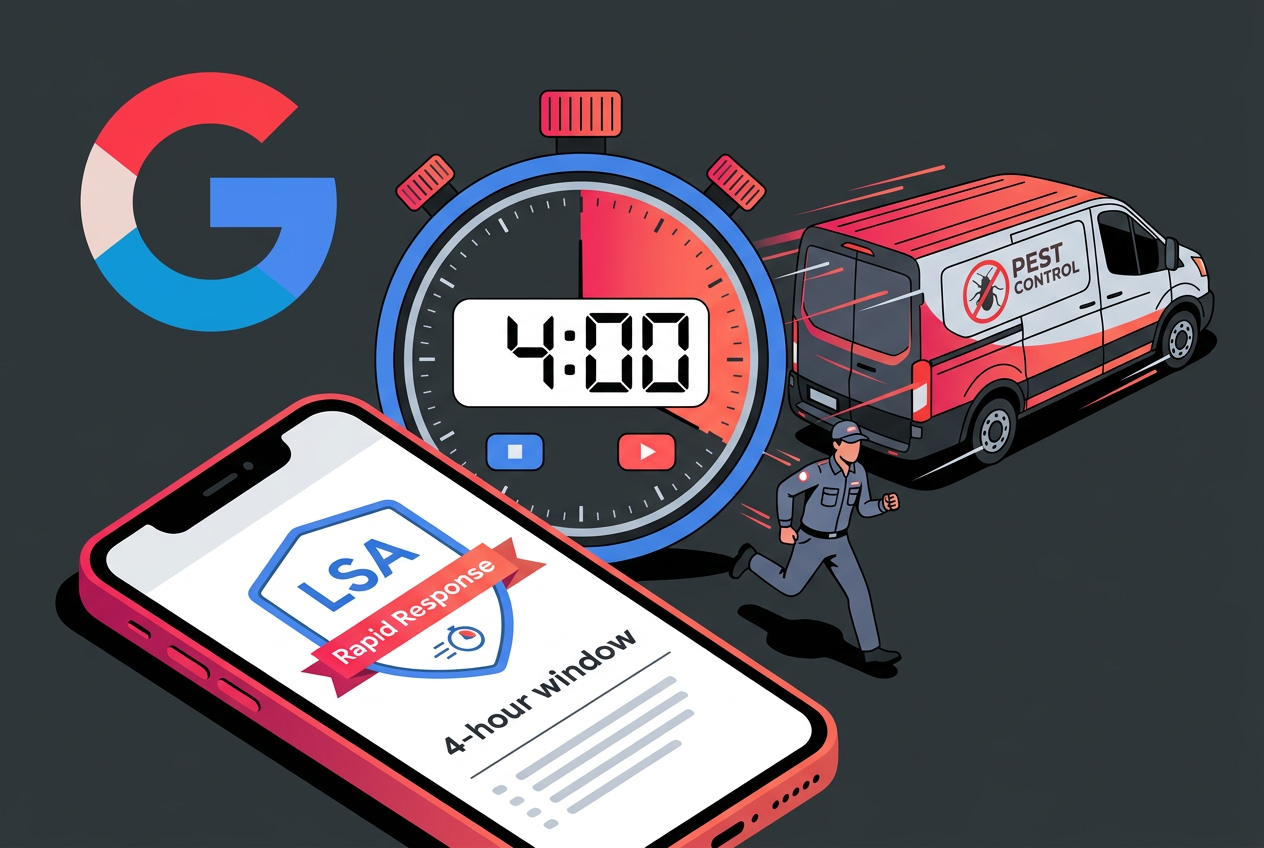
Google's LSA Rapid Response Badge Makes Dispatch Speed a Direct Acquisition Cost
Google now prioritizes pest control LSA providers who dispatch within four hours—turning scheduling infrastructure into the primary driver of lead volume.
In September 2026, Google changed the acquisition game for pest control operators. Local Services Ads now surface a "Rapid Response" badge for providers who can dispatch within four hours and confirm arrival windows via SMS. The badge appears directly on LSA cards, above the fold, visible before a prospect ever clicks through.
Early data from competitive markets shows badged providers capturing 60-70% of inbound leads. Providers without the badge see lead volume fall by half or more, even when their review score and price remain unchanged.
This is not a feature update. It is a repricing of customer acquisition around operational capability. Google turned scheduling and dispatch infrastructure into a variable that directly controls cost per lead.
For pest control companies, the message is unambiguous: your ability to dispatch same-day and confirm via SMS is now table stakes for lead generation, not a customer service differentiator.
What Changed
Google's Local Services Ads have always prioritized proximity, review quality, and response speed. The September update makes one dimension explicit and binary: can you dispatch within four hours of booking, and can you send an automated SMS confirming the arrival window?
If yes, you get the badge. If no, you disappear from the top of the stack.
The badge appears as a small green icon with "Rapid Response" text on the LSA card itself. It loads before the user scrolls. It sits next to Google Guaranteed. In mobile view—where the majority of pest control searches happen—it occupies the same visual weight as your star rating.
The algorithm does not care whether you claim to offer same-day service. It checks whether you have the dispatch and notification infrastructure to prove it. Google verifies this through three signals:
- Booking availability within four hours when a lead submits a request
- Automated SMS confirmation sent within 15 minutes of booking
- Actual arrival data, pulled from Google My Business appointment tracking or integrated scheduling platforms
If your operation cannot surface real-time availability, assign a technician, and fire a confirmation SMS without human intervention, you do not qualify. If you qualify but fail to meet the four-hour window more than 15% of the time over a rolling 30-day period, the badge disappears.
Google built a compliance layer into the acquisition funnel. Operators who run manual dispatch or batched scheduling cannot meet the threshold.
Why It Matters
Most pest control operators treat dispatch as a back-office problem. Google just moved it to the front of the acquisition funnel.
The Rapid Response badge is not cosmetic. It changes the economic structure of lead generation in three ways.
First, it creates a bimodal distribution of lead volume. Providers with the badge capture the majority of inbound volume. Providers without it compete for the remainder. In metro markets with five or more badged competitors, non-badged providers report 40-50% declines in LSA lead flow within 60 days of the rollout. The distribution is not linear—it is a cliff.
Second, it collapses the ROI of brand and reputation investments that do not connect to dispatch capability. A pest control company with 200 five-star reviews and a decade of local presence will lose leads to a two-year-old competitor with 60 reviews if the competitor can dispatch in four hours and the incumbent cannot. Google's algorithm weights operational proof over historical reputation when the gap is this explicit.
Third, it turns scheduling infrastructure into a direct cost-of-acquisition variable. Before this change, a pest control operator could improve CAC by optimizing ad creative, bidding strategy, landing page speed, or sales scripting. Now the most efficient CAC lever is dispatch speed. Two operators bidding the same amount for the same keyword will see wildly different cost per booked job based solely on whether they have real-time scheduling and SMS confirmation.
The operators who recognized this early and built the infrastructure are now paying 30-40% less per lead than competitors who are still triaging requests in a spreadsheet.
The Infrastructure Gap
Most pest control operations run scheduling in one of three ways.
Manual dispatch: CSRs take inbound calls and texts, check technician availability on a whiteboard or shared calendar, and call or text the customer back with a time slot. Confirmation happens via follow-up call or manual text. This process takes 20 minutes to two hours, depending on call volume and technician availability.
Batched scheduling: Leads flow into a CRM or spreadsheet. A dispatcher reviews them once or twice a day, assigns routes, and sends confirmations in a batch. Turnaround time is four to twelve hours. Faster during peak season if the dispatcher is dedicated, slower in shoulder months when the owner is also running estimates.
Partial automation: Online booking exists but only shows availability 24-48 hours out. Same-day requests still route to a human. SMS confirmations are templated but require a dispatcher to hit "send." This setup works for planned service but breaks under the four-hour threshold.
None of these models meet Google's Rapid Response standard. The gap is not effort or intent—it is architecture.
To qualify for the badge, a pest control operator needs:
- Real-time technician availability visible to the booking interface, updated as jobs are completed, canceled, or rescheduled
- Automated booking logic that can assign a technician to a same-day request without human triage
- SMS automation that fires a confirmation with arrival window, technician name, and contact info within minutes of booking
- Feedback loop that reports actual arrival times back to Google to maintain badge eligibility
This is not a CRM feature. It is not a "schedule online" button on a website. It is dispatch infrastructure that connects booking, routing, technician location, and customer communication in a closed loop.
The operators who have this infrastructure were already running it to reduce no-shows, improve utilization, and lower labor cost per job. Google's LSA update simply made it visible to the acquisition algorithm.
The operators who do not have it are now paying a direct penalty in lead volume.
What to Build
The infrastructure required to earn and keep the Rapid Response badge is the same infrastructure that improves gross margin per technician, reduces windshield time, and lowers no-show rates. Google did not invent a new operational requirement—it made an existing efficiency requirement mandatory for acquisition.
Here is what that infrastructure looks like in practice.
Real-Time Availability
Your booking system needs to know which technicians are available in the next four hours, where they are, and how long their current job will take. This requires:
- Job duration estimates built into your service catalog (initial inspection: 45 minutes, interior treatment: 60 minutes, exterior perimeter: 30 minutes)
- Technician location tracking so the system knows travel time from current job to next address
- Buffer logic that accounts for variability (a 60-minute job might run 75 minutes; the system holds a 15-minute cushion before showing the next slot as available)
A pest control operator running five trucks in a metro area can surface 8-12 same-day slots at any given time if this logic is in place. Without it, same-day booking is a gamble.
Automated Assignment
When a same-day lead comes in, the system needs to assign the job to a technician without a dispatcher intervening. This means:
- Routing logic that picks the technician with the shortest travel time and available capacity
- Skill matching if the request is for a specialized service (termite inspection, wildlife exclusion)
- Load balancing to avoid overloading one technician while another sits idle
Manual assignment introduces delay. A dispatcher might be on a call, in the field, or managing a cancellation. Even a 20-minute delay pushes the booking outside the four-hour window if the lead came in at 2:40 PM and the only available slot is at 6:30 PM.
Automation removes the delay and makes the four-hour threshold achievable under normal operating conditions.
SMS Confirmation
Google requires an SMS confirmation within 15 minutes of booking. The message must include:
- Arrival window (e.g., "between 3:00 and 4:00 PM")
- Technician name
- Contact number for the technician or dispatch line
- Opt-out language for compliance
This is not a "thanks for booking" autoresponder. It is a commitment message tied to dispatch. The system needs to pull the assigned technician's name and contact info, calculate the arrival window based on their current location and route, and fire the SMS without human review.
Operators who send these messages manually introduce inconsistency. A dispatcher forgets to send the text, or sends it three hours later, or uses the wrong arrival window. Google's verification layer flags this as non-compliance and removes the badge.
Closed-Loop Feedback
Google tracks whether you actually arrive within the confirmed window. If you consistently confirm a 3-4 PM arrival and show up at 5 PM, the badge disappears.
This requires:
- Arrival tracking via technician mobile app or GPS check-in
- Variance monitoring to flag jobs where actual arrival differs from confirmed window by more than 15 minutes
- Route adjustment during the day to keep arrival windows accurate when delays occur
The pest control operators who qualify for the badge and keep it are the ones who already manage routes dynamically. A technician finishes a job 30 minutes early—the system moves up the next appointment and sends an updated SMS. A job runs long—the system extends the arrival window for the next customer and notifies them before the original window expires.
This is not theoretical. Operators in markets like Phoenix, Dallas, and Atlanta report maintaining 95%+ on-time arrival after implementing closed-loop feedback and dynamic routing.
The Compound Effect
Google's LSA update does not create a new cost center. It exposes the cost of not having scheduling and dispatch infrastructure.
A pest control operator who builds the Rapid Response infrastructure sees three compounding returns:
Lower cost per lead. Badged providers capture 60-70% of LSA volume in competitive markets. This drops blended CAC by 30-40% compared to non-badged competitors bidding the same rates.
Higher conversion from lead to booked job. Customers who receive an SMS confirmation within 15 minutes are 40-50% less likely to call a competitor. The confirmation serves as a commitment device. It moves the customer from "I requested a quote" to "I have an appointment."
Lower no-show and cancellation rates. SMS confirmations with arrival windows reduce no-shows by 25-35%. Customers who know when the technician will arrive are more likely to be home. Technicians spend less time driving to empty houses.
These returns stack. Lower CAC means more leads at the same ad spend. Higher conversion means more booked jobs per lead. Lower no-shows mean higher utilization per technician. The operator who builds the infrastructure compounds margin while competitors absorb the cost of manual dispatch in both acquisition and fulfillment.
The Broader Pattern
Google's LSA Rapid Response badge for pest control is not an isolated change. It follows a pattern visible across appointment-based service verticals.
Platforms reward businesses that can prove speed and certainty at the scheduling layer. Customers prefer providers who confirm the appointment immediately and show up on time. Algorithms prioritize operators who can demonstrate both.
In 2024, Google began surfacing "instant book" HVAC providers higher in Local Services Ads. In early 2025, Thumbtack started offering a "confirmed today" filter for home cleaning. In mid-2025, Yelp added same-day availability as a search filter for pet grooming. Each change moved scheduling capability from operations to acquisition.
The September 2026 LSA update for pest control is the most explicit version of this shift. Google made the infrastructure requirement binary and tied it to a visible badge. Operators cannot fake it. They either have the infrastructure or they lose the leads.
This is the endgame of platform-driven lead generation. The platforms control distribution. They optimize for conversion. The fastest path to higher conversion is to surface providers who can deliver speed and certainty. The operators who cannot prove it algorithmically get deprioritized, regardless of reputation or tenure.
The solution is not to abandon platform-driven acquisition. The solution is to build the infrastructure that platforms reward.
Operations as Acquisition
Revenue infrastructure and operations infrastructure are the same system.
A pest control operator who invests in real-time scheduling, automated dispatch, and SMS confirmation is not building a "back office tool." They are building the substrate that determines cost per lead, conversion rate, and gross margin per technician.
Google's Rapid Response badge makes this relationship explicit. Dispatch speed is no longer a customer service metric—it is a direct input to acquisition cost.
The operators who win over the next 24 months are the ones who stop treating scheduling as a separate problem from lead generation. They route inbound leads to available capacity in real time. They confirm the appointment before the customer calls a competitor. They show up on time because their system manages routes dynamically.
This is not a growth hack. It is infrastructure. It compounds.
The pest control operators who built it before September 2026 are now capturing 70% of LSA leads in their market. The operators who are still batching dispatch in a spreadsheet are paying double the CAC for half the volume.
Google did not create this gap. It made it visible.