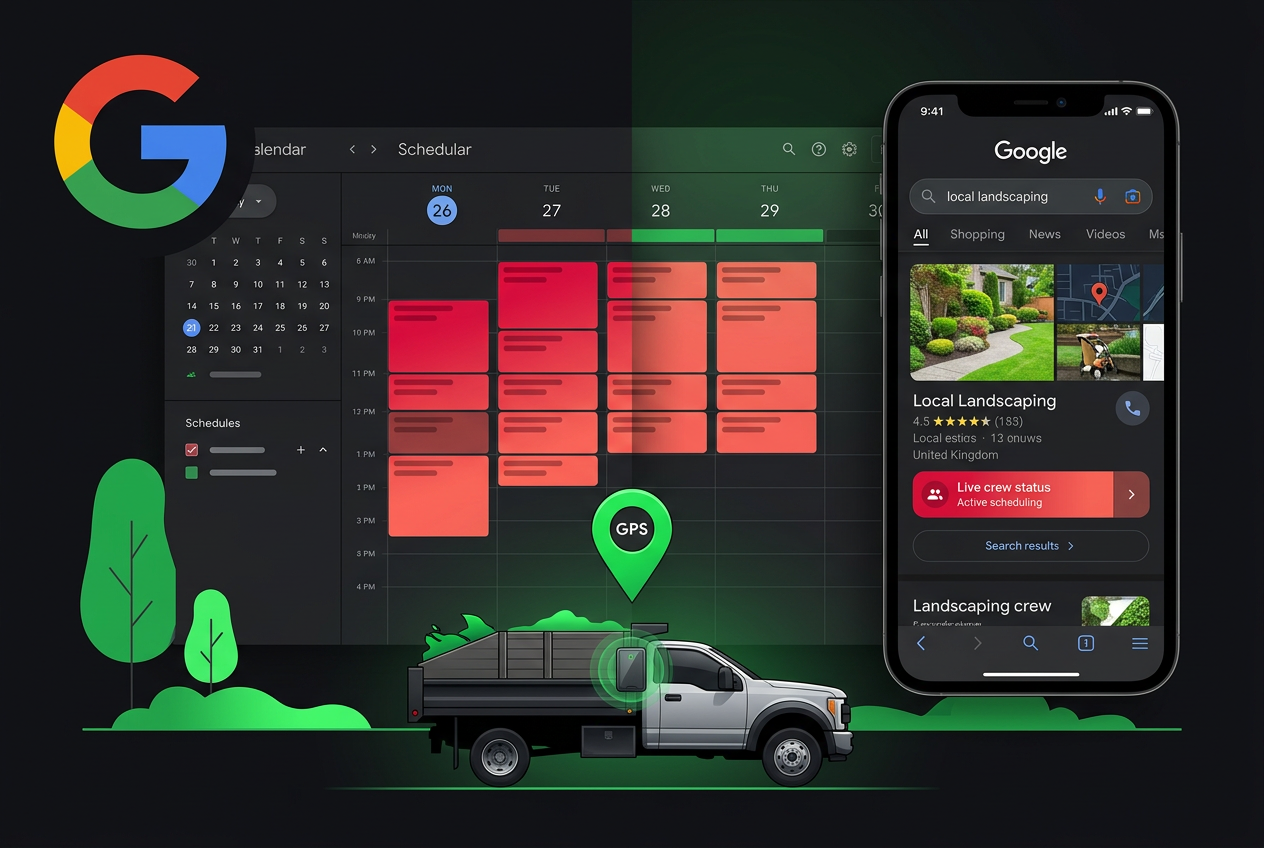
Google Now Ranks Landscapers by Schedule Density, Not Reviews
Google's September 2026 update surfaces real-time crew capacity in local search, rewarding landscapers whose systems expose operational tempo.
Google rolled out a significant Business Profile update in September 2026 that changes how landscaping and lawn care companies surface in local pack results. If a homeowner searches "lawn care near me" on a Tuesday morning, Google now visibly prioritizes companies whose calendars show available crew capacity that same day or week. Companies with sparse booking density get pushed down, regardless of review count or keyword optimization.
This is not speculative. The update integrates real-time scheduling data through GBP API feeds, embedded booking widgets, and dispatcher integrations. Google is indexing operational tempo—route density, same-week availability, multi-crew utilization—as a verified ranking signal.
For landscaping operators, local visibility now depends on whether your scheduling system exposes the right data to Google in a format Google can verify and reward.
The Ranking Signal Shift
Google has been moving toward "helpful content" signals for years, but this update marks the first time operational infrastructure directly influences local search rank for appointment-based services. The logic is straightforward: a landscaper with three crews running five days a week, visible open slots Tuesday through Thursday, and consistent booking velocity is more helpful to a searcher than a competitor with the same star rating but opaque availability.
Google can now distinguish between these two businesses because it ingests scheduling data in real time.
The update prioritizes three operational signals:
Same-week availability. If your calendar shows open slots within the next 5-7 days, Google interprets that as capacity to serve new demand. A landscaper with Thursday and Friday availability for a new lawn maintenance client ranks higher than one whose next opening is three weeks out—or whose calendar shows no availability at all because the system doesn't expose it.
Booking density. Google rewards businesses with consistent appointment velocity. A lawn care company running 40 jobs across two crews in a week signals operational maturity. A competitor with the same number of jobs but erratic scheduling—three jobs Monday, zero Tuesday, nine Wednesday—reads as less reliable. Google's algorithm interprets rhythm as reliability.
Multi-crew utilization. For landscapers operating multiple crews, Google now differentiates between companies that load-balance work across crews and those that run one crew hot while others sit idle. Route density and crew utilization are verified through calendar feeds, location pings, and booking widget data. A three-crew operation with balanced territory coverage and staggered availability ranks higher than a single-crew shop, even if the single crew has higher review velocity.
None of this is visible in the traditional "review count and keyword stuffing" playbook. It is entirely dependent on whether your scheduling infrastructure emits the right signals to Google's Business Profile API.
Why Landscaping First
Google chose landscaping and lawn care as the pilot vertical for schedule density indexing because the operational characteristics map cleanly to search intent.
Lawn care is high-frequency, local, and time-sensitive. A homeowner searching "lawn mowing service near me" wants someone this week, not next month. Unlike a remodeler managing six-week lead times or a pest control company running quarterly service intervals, landscaping operates on tight weekly cycles. Google can test the hypothesis that real-time availability predicts conversion—and then measure whether surfacing high-availability providers reduces search abandonment.
Landscaping also has clean crew-based operations. A two-person mowing crew runs a defined route. Start time, service duration, travel time between jobs, and end-of-day return are predictable. Google's algorithm can verify that a "Tuesday 1–3 PM" availability slot is real because it sees the surrounding job structure, route logic, and historical completion patterns. A fake availability block inserted to game the algorithm stands out against actual operational tempo.
The verticalization of this update matters. Google is not rolling out schedule density indexing across all service categories simultaneously. It is testing in landscapes where operational data is abundant, structured, and verifiable. Landscaping fits. HVAC emergency calls do not. Remodeling estimates do not. But lawn care, landscape maintenance, and seasonal cleanup services do.
If this works—if Google sees higher click-through rates, lower bounce rates, and more completed bookings—expect the same ranking logic to expand into cleaning, pest control, pool service, and other high-frequency appointment businesses within 12 months.
What Google Verifies
Google does not take your word for it. The algorithm cross-checks multiple data sources to confirm that calendar availability is real, not fabricated.
GBP API integration. If your scheduling software connects to Google Business Profile via API, it streams availability data directly. Google sees when a slot opens, when it books, and when it completes. A landscaper using a system that pushes real-time calendar updates to GBP emits a verified signal. A competitor manually updating "business hours" once a quarter does not.
Booking widget behavior. If you embed a booking tool on your website or in your GBP listing, Google tracks interaction patterns. How many searchers click through to check availability? How many complete a booking? A widget showing "next available: Thursday 9 AM" that converts 18% of clicks signals real capacity. A widget showing "call us for availability" that converts 3% does not.
Dispatcher data feeds. For landscapers running dispatch software—route optimization, crew tracking, job sequencing—Google can ingest location pings, job start/stop timestamps, and travel patterns. A crew completing eight jobs between 7 AM and 4 PM, each job geocoded and timestamped, verifies that the business operates at the density it claims. A calendar showing 12 jobs scheduled but no corresponding location data raises a flag.
Historical completion rates. Google compares scheduled appointments to completed appointments over time. A lawn care company that books 95% of its calendar slots and completes 92% earns trust. A competitor that books 60% and completes 45% does not. Completion rate becomes a proxy for operational reliability, and Google weights current availability signals accordingly.
The system is not gameable with fake slots or keyword-stuffed service descriptions. Google verifies operational tempo the same way it verifies review authenticity: by triangulating multiple data sources and penalizing inconsistencies.
The Infrastructure Gap
Most landscaping companies do not emit these signals because their scheduling systems were not built to expose operational data to third-party APIs.
A landscaper running jobs out of a spreadsheet has zero integration surface. Google cannot verify schedule density, crew utilization, or booking velocity because the data does not exist in a structured, accessible format.
A lawn care operator using basic scheduling software—something that tracks "who is doing what, when"—may have internal visibility but no outbound data feed. The system manages jobs but does not publish availability to GBP, does not power a booking widget, and does not stream completion events. From Google's perspective, this business is operationally invisible.
Even operators using mid-tier software often lack the API architecture required to expose real-time utilization. The platform tracks jobs, but it does not integrate with Google Business Profile. It manages crews, but it does not publish route density. It stores historical data, but it does not emit velocity signals.
The result: a capable operation with strong crew utilization and consistent job flow ranks below a competitor with worse operations but better infrastructure.
This is not a marketing problem. It is an infrastructure problem.
How 2getherPro Infrastructure Turns Operations Into Ranking Signals
2getherPro's Revenue & Operations Infrastructure was built to expose the exact signals Google now indexes. The system does not bolt SEO onto scheduling. It treats operational data as the foundation of demand generation.
Real-time GBP sync. Every time a job books, reschedules, or completes, 2getherPro pushes an update to Google Business Profile via API. If a landscaping crew finishes a spring cleanup job at 11:30 AM and the next scheduled job is not until 2 PM, that 90-minute window surfaces as available capacity within minutes. Google sees it. Searchers see it. The ranking algorithm rewards it.
Dynamic booking widgets. The widget embedded in a landscaper's GBP listing or website does not show static "call for availability" copy. It displays actual crew capacity: "Next available: Thursday, September 24, 9 AM or 1 PM." The widget pulls from the same dispatch calendar the crews use, so availability is always accurate. When a searcher books a slot, the system removes it from inventory in real time and adjusts route sequencing for the assigned crew.
Multi-crew load balancing. For operators running two, three, or five crews, 2getherPro distributes jobs across crews to maximize utilization and minimize idle time. If Crew A is at 90% capacity Tuesday and Crew B is at 60%, the next inbound job routes to Crew B. Google's algorithm sees balanced density across all crews, which signals operational maturity and scalability. A single-crew shop cannot emit the same signal, even with perfect execution.
Route density optimization. The system does not just fill calendars—it clusters jobs geographically to reduce drive time and increase jobs per crew per day. A lawn care company running eight jobs in a tight two-mile radius completes more work and emits higher density signals than a competitor running eight jobs scattered across 15 miles. Google's location data verifies the density. The ranking algorithm rewards it.
Completion event streaming. When a crew marks a job complete in the field, the system logs the timestamp, location, and service duration, then streams that event to Google. Over time, this builds a verified track record: scheduled jobs turn into completed jobs at a consistent rate. Google interprets this as operational reliability, which compounds into higher trust and better ranking.
None of this is manual. None of it depends on a marketer remembering to update business hours or a dispatcher copying calendar data into a spreadsheet. The infrastructure runs autonomously, turning daily operations into continuous ranking signal generation.
The Compounding Advantage
The operators who adapt early do not just rank higher this month. They compound the advantage over time because Google's algorithm rewards consistency.
A landscaping company that emits verified schedule density signals for six consecutive months builds trust that a competitor cannot replicate in six days. Google sees sustained operational tempo—weekly job counts, crew utilization rates, booking-to-completion ratios—and interprets that history as predictive of future reliability.
This creates a local SEO moat that is nearly impossible to breach with traditional tactics.
A new competitor can buy ads, solicit reviews, and optimize keywords. They cannot fabricate six months of verified operational data. They cannot fake route density or multi-crew utilization. They cannot generate booking widget conversion rates that match a business with real, consistent availability.
The businesses that win are the ones whose operations generate ranking signals as a byproduct of doing good work—because their infrastructure is built to expose that work to Google in real time.
What Operators Should Build Now
Landscapers who want to maintain or improve local visibility in the post-September 2026 environment need to close three infrastructure gaps.
Calendar systems that integrate with GBP. If your scheduling tool does not connect to Google Business Profile via API, it is invisible to the ranking algorithm. Migration is not optional. The system must push availability, bookings, and completions to Google in real time, not once a week when someone remembers to log in.
Booking widgets that convert searchers. A "call us" button is not a booking interface. The widget must display actual availability, allow same-day or same-week booking, and sync with dispatcher calendars so crews see new jobs immediately. Conversion rate is a verified signal. A high-converting widget tells Google the availability is real.
Dispatch infrastructure that optimizes density. The goal is not just to fill calendars—it is to fill them in a way that maximizes jobs per crew per day and minimizes idle time. Route optimization, geographic clustering, and load balancing across multiple crews generate the density signals Google rewards. A spreadsheet cannot do this. Basic scheduling software cannot do this. Purpose-built Revenue & Operations Infrastructure can.
These are not incremental improvements. They are foundational shifts in how local search works for appointment-based service businesses.
Why This Is Not Just Landscaping
Google piloted schedule density indexing in landscaping because the vertical has clean operational characteristics and abundant structured data. But the logic applies to any appointment-based service business where availability and operational tempo predict customer satisfaction.
A residential cleaning company running four teams five days a week can emit the same signals: real-time availability, booking density, multi-team utilization, route optimization. So can a pest control operator, a pool service company, or a mobile pet groomer.
The businesses that treat scheduling infrastructure as a competitive advantage—not a back-office cost center—will rank higher, convert more inbound demand, and operate with lower customer acquisition cost than competitors still optimizing meta descriptions and chasing review count.
The ones that do not adapt will watch their local pack visibility erode, not because they deliver bad service, but because their infrastructure is invisible to the algorithm that now controls demand distribution.
The New Moat
Revenue & Operations Infrastructure is no longer back-office. It is the surface area Google indexes to decide who gets the call when a homeowner searches for a landscaper, a cleaner, or a lawn care provider.
The businesses that win in this environment are the ones whose operations generate ranking signals autonomously—because their scheduling, dispatch, and booking systems were built to expose real-time utilization, route density, and completion velocity to the platforms that control demand.
This is not a hack. It is not a campaign. It is infrastructure that compounds advantage over time because the operational tempo you run today becomes the verified trust signal that drives visibility tomorrow.
Google's September 2026 update makes it explicit: the best marketing is good operations made visible.
Build systems that turn your daily work into the data layer that drives demand generation. That is the moat.