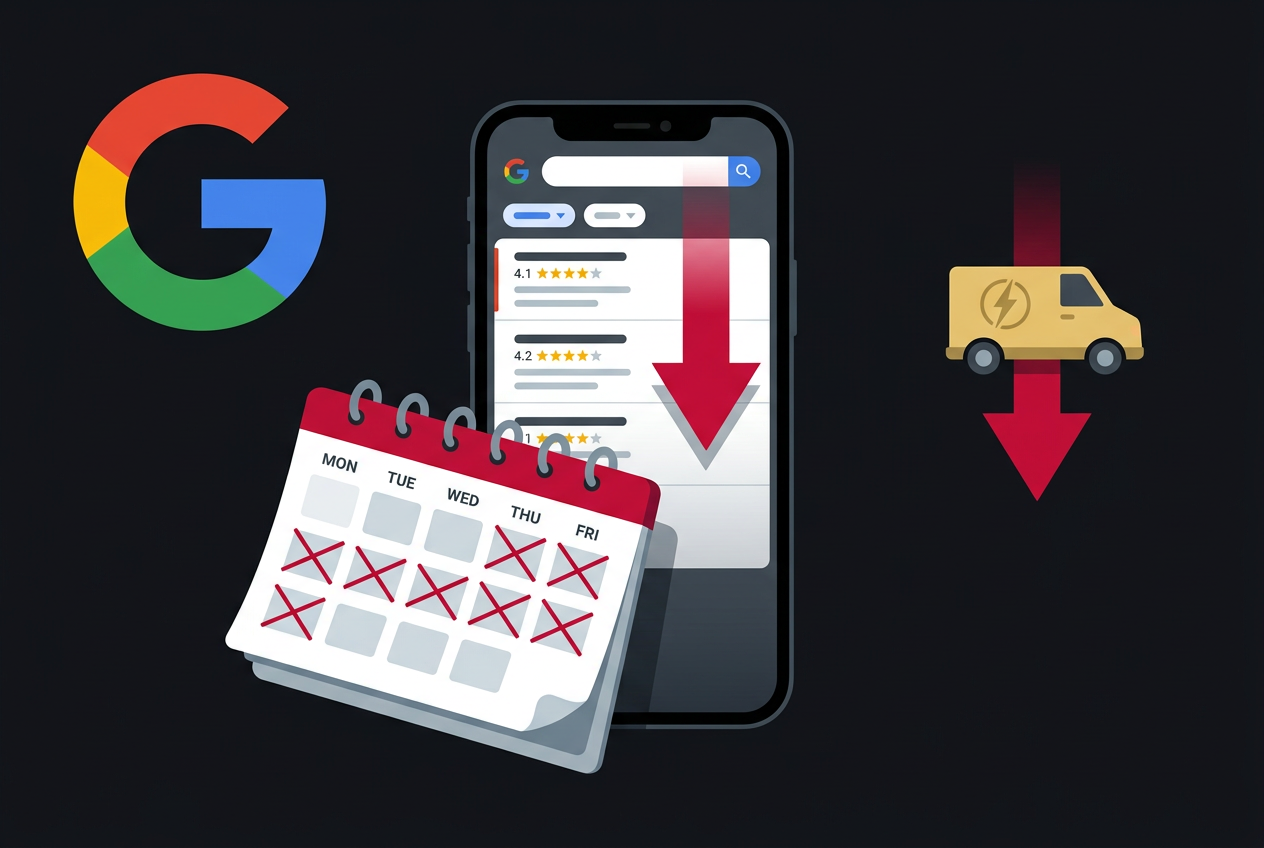
Google Now Penalizes Reschedule Rate in Electrician LSA Ranking
Google's October 2026 Local Services Ads update makes reschedule rate a ranking signal for electricians, tanking impression share for shops above 12%.
Google rolled out a Local Services Ads ranking change this month that fundamentally alters how electricians must think about scheduling. The platform now surfaces reschedule rate as a ranking signal, and early data shows shops with reschedule rates above 12% are seeing 30-40% drops in LSA impression share.
This is not cancellation tracking. Google is penalizing businesses when the customer requests to move the appointment, even if the job ultimately gets completed. A homeowner calls Monday to push their panel upgrade from Thursday to the following week because the permit cleared late. That counts against you. A commercial client asks to shift a tenant improvement walk-through by two days to align with their GC's schedule. That counts too.
The mechanic forces a hard look at how electrical contractors quote jobs, set arrival windows, communicate parts lead times, and make promises at the point of booking.
Why This Changes Everything
Local Services Ads have become the dominant acquisition channel for residential and light commercial electrical work in most metro markets. For many shops, LSA drives 40-60% of inbound lead volume. The cost structure is simple: you pay per lead, and your impression share determines lead volume.
Impression share is now directly coupled to operational precision.
A shop that books a service call with a four-hour arrival window and no real-time visibility into crew location will generate reschedules when the truck runs late on the prior job. A contractor who quotes a two-week lead time for a subpanel installation without checking supplier inventory will generate reschedules when the parts shipment delays. An estimator who schedules a site visit without knowing which technician is certified for the scope will generate reschedules when they realize the assigned tech isn't licensed for the work.
Each of these reschedules now erodes your acquisition cost efficiency. You pay the same per lead, but you receive fewer leads because your rank drops.
The math compounds quickly. A shop running 25 reschedules per month on 200 booked appointments sits at 12.5%. If that pushes impression share down 35%, lead volume drops from 180 inbound LSA leads per month to 117. At a 30% book rate and $4,200 average ticket, that's $79,380 in monthly revenue lost to scheduling mistakes.
And you're still paying Google the same amount per lead.
What Google Is Actually Measuring
The reschedule rate signal tracks any instance where the customer initiates a change to the scheduled appointment time after the booking is confirmed. It does not matter whether the reschedule happens one hour later or the following week. It does not matter whether the job completes successfully. It does not matter whether the reschedule was due to customer preference, parts delay, crew availability, or weather.
Google's system sees: booking confirmed for October 15 at 2:00 PM. Customer calls October 14 and moves it to October 17 at 10:00 AM. Reschedule event logged.
The distinction between customer-initiated reschedules and contractor-initiated reschedules does matter, but in the opposite direction most operators assume. Contractor-initiated reschedules—where your office calls the customer to move the appointment—hit harder. Google interprets these as operational failures. Customer-initiated reschedules carry weight too, because Google's hypothesis is that customers reschedule when the original booking didn't account for realistic lead times, parts availability, or scheduling constraints.
The signal is noisy, but the directionality is clear: businesses that force customers to reschedule because of internal operational gaps will lose rank.
The Root Cause Is Quote Precision
Most reschedules trace back to the moment the appointment is created. The customer asks when you can come out. Your CSR or dispatcher looks at a calendar, sees an open slot Thursday afternoon, and books it. The appointment is made without knowing:
- Whether the truck assigned to that slot has the tools required for the job scope described
- Whether the technician in that truck holds the license or certification required for the work
- Whether the parts necessary to complete the job in one visit are in stock or on order
- Whether the prior appointment in that truck's route has a history of running long
- Whether the job site has access constraints (gated community, commercial building, HOA rules) that require lead time to coordinate
The CSR is not withholding information. The information does not exist in an accessible form at the point of booking.
So the appointment gets made. Then reality asserts itself.
The parts aren't in stock. The lead time is seven days, not two. The technician on the Thursday route isn't certified for the panel work. The prior job runs two hours over because the customer added scope on-site. The job site requires 48-hour notice for vendor access, and no one logged that in the CRM.
The customer gets a call: "We need to move your appointment."
Or the customer calls first, because they realize the timing won't work and they'd rather reschedule than cancel.
Either way, Google logs it.
Scheduling Software Isn't the Fix
Most electrical contractors already use scheduling software. The tool shows a calendar. Dispatchers drag appointments into slots. Technicians see their routes on a mobile app. Customers get automated reminders.
This does not prevent reschedules.
Scheduling software organizes time. It does not make the data that determines whether a time slot is realistic visible at the point of booking. The system doesn't know that the 2:00 PM slot on Thursday is attached to a technician who isn't qualified for the job. It doesn't know that the part required for the job won't arrive until next Tuesday. It doesn't know that the previous appointment has a 60% chance of running over based on historical data for that job type and customer.
Reducing reschedule rate requires surfacing operational constraints at the point of quote, not just organizing appointments after they're made.
What to Build: Real-Time Availability Logic
The shops that will maintain LSA rank are building systems that surface three layers of constraint data before the appointment is confirmed:
Crew capability and certification matching. When a customer calls for a 200-amp service upgrade, the system must know which technicians are licensed and insured for that scope and show only their availability. Not "the next open slot." The next open slot with a qualified crew.
Parts inventory and lead time visibility. When the scope requires a transfer switch, a whole-home surge protector, or a specialty breaker, the system must check current inventory and supplier lead times before quoting a date. If the part is backordered for ten days, the earliest realistic appointment is ten days out, not tomorrow.
Route buffer and historical job duration. Electricians know that a "one-hour service call" for a tripping breaker can turn into a three-hour rewire if the panel is old. The system must apply historical data for job type, customer property age, and technician speed to calculate realistic appointment windows and buffer times. If the 2:00 PM slot follows a job that runs long 40% of the time, that slot is not actually available.
This is not hypothetical. Electrical contractors operating at scale already track certification matrices, parts inventory systems, and job costing data. The gap is that these datasets live in separate tools—licensing records in a spreadsheet, inventory in the supplier portal, job history in QuickBooks—and none of it is accessible to the person booking the appointment.
The Operations Layer: Parts and Promise Management
Reschedule rate is an acquisition metric, but the fix is operational.
Consider a residential electrical contractor in a second-tier metro market running eight trucks. Typical job mix: service calls (breaker replacements, outlet additions, ceiling fan installs), panel upgrades, EV charger installations, whole-home surge protection, and generator connections.
Service calls can usually be completed with truck stock. Panel upgrades, EV charger installs, and generator connections require parts procurement with variable lead times depending on the brand, the amperage, and the supplier. A 200-amp Siemens panel might ship same-day from the local distributor. A 400-amp Schneider panel with a specific bus configuration might take two weeks.
If the CSR booking the appointment can't see parts lead time, they will quote based on calendar availability. The customer books for next Thursday. The part doesn't arrive until the following Tuesday. The office calls Wednesday to reschedule.
Google logs it. Rank drops.
The fix requires integrating parts inventory and supplier lead time data into the booking workflow. When the customer describes the job and the CSR enters the scope, the system checks:
- Is the required equipment in stock in our warehouse?
- If not, what is the lead time from our primary distributor?
- What is the lead time from our secondary supplier?
- Should we order the part now to hold the appointment date, or quote the appointment based on confirmed delivery?
This does not require custom software. Most electrical distributors provide API access to inventory and lead time data. The gap is connecting that data to the system used to create appointments.
Arrival Windows and the Four-Hour Problem
The standard operating procedure for most service businesses is to quote a four-hour arrival window. "We'll be there between 8:00 AM and 12:00 PM."
This works when the truck has one appointment in the morning. It breaks when the route includes two or three jobs with variable scope.
Electricians face higher scope variability than many other trades. A service call for "a breaker that keeps tripping" could be a 20-minute reset and inspection, or it could be a two-hour circuit troubleshooting job if the wiring is damaged inside the walls. The technician does not know until they open the panel.
If the 8:00 AM appointment runs long, the 10:00 AM appointment gets delayed. The customer at 10:00 AM calls to ask where the truck is. The dispatcher says, "Running about an hour behind, can we push you to this afternoon?" The customer agrees or reschedules for another day.
Google logs it.
The fix is dynamic arrival windows based on real-time route progress. When the prior job closes out in the mobile app, the system recalculates estimated arrival time for the next appointment and sends an updated notification to the customer. "Your technician is finishing up the previous job and will arrive between 11:15 AM and 11:45 AM."
If the delay pushes the arrival outside the customer's available window, the dispatcher proactively offers alternatives before the customer calls. "We're running behind. We can get there by 1:30 PM today, or we have an opening tomorrow morning at 9:00 AM. Which works better?"
This still generates reschedules in some cases, but it reduces the volume and shifts the interaction from reactive to proactive. Customers reschedule less often when they receive accurate information early.
The Technician Feedback Loop
Reschedule rate drops when the data used to quote jobs reflects the actual conditions technicians encounter in the field.
A contractor books a panel upgrade with a four-hour labor estimate. The technician arrives and discovers the existing panel is surface-mounted on a brick wall with no accessible knockout paths for new conduit. The job requires core drilling and an additional six hours of labor. The technician does not have the core drill on the truck. The job gets rescheduled for when the right equipment and a two-person crew are available.
If this happens once, it's an edge case. If it happens regularly for a specific job type or property age bracket, it's a data problem.
The system must capture deviation data from completed jobs and feed it back into the quoting model. When a "standard 200-amp panel upgrade" consistently runs 50% longer in homes built before 1980, the system should flag pre-1980 jobs at the point of booking and quote longer labor windows or flag them for a pre-job site visit.
Most electrical contractors already track job costing data for estimating and invoicing. The gap is using that data to inform scheduling and quoting, not just accounting.
Commercial Jobs and Coordination Delays
The reschedule mechanic hits differently for commercial electrical work. Residential service calls reschedule because of parts delays and route overruns. Commercial tenant improvements, building retrofits, and new construction electrical work reschedule because of coordination failures with other trades, permitting delays, and site access issues.
An electrical contractor books a rough-in for a retail build-out on October 18. The framing crew runs two days behind. The electrical rough-in reschedules to October 20. Google logs it.
A service call to replace lighting in a corporate office building requires 48-hour advance notice to the property manager for vendor access. The CSR books the appointment for October 16 without coordinating access. The property manager denies entry. The appointment reschedules. Google logs it.
A data center electrical upgrade requires the client's IT team to schedule a maintenance window. The contractor books the work before the maintenance window is confirmed. The client pushes the window by a week. The contractor reschedules. Google logs it.
The fix is dependency tracking at the point of booking. When the CSR creates the appointment, the system must prompt:
- Does this job require coordination with another trade? Is their work confirmed complete?
- Does this site require advance notice for vendor access? Has that notice been submitted?
- Does this job require a customer-controlled maintenance window or shutdown? Is that window confirmed?
If any dependency is unresolved, the appointment is flagged as tentative and not confirmed until the dependency clears. This increases the time between initial customer contact and confirmed appointment, but it eliminates reschedules caused by predictable coordination gaps.
What This Means for Acquisition Cost
The feedback loop between operational precision and acquisition cost is not new. Shops with better answer rates, faster response times, and higher close rates have always generated better ROI from advertising spend.
What's new is that Google is now directly measuring an operational metric—reschedule rate—and using it to allocate impression share in Local Services Ads. The margin for operational sloppiness just compressed.
An electrical contractor running a 15% reschedule rate is now paying the same per-lead cost as a competitor running a 6% reschedule rate, but receiving 35% fewer leads. The competitor is not spending more on marketing. They are not running better ads. They are booking appointments that do not require rescheduling because they have real-time visibility into crew capability, parts availability, and route constraints at the point of quote.
The ROI gap compounds month over month.
Building the System
Reducing reschedule rate is not a scheduling problem. It is a data access problem.
The information required to book a realistic appointment already exists. Technician certifications live in an HR file or a licensing tracker. Parts inventory and lead times live in the supplier portal. Job duration data lives in invoicing and job costing records. Route delays and travel time variances live in GPS logs and mobile app timestamps.
None of this data is accessible to the person booking the appointment.
The fix is building infrastructure that surfaces these datasets at the point of quote:
-
Certification and capability routing. Tag each technician with certifications, tool access, and specialty skills. When a job is scoped, show only the availability of crews qualified for that scope.
-
Inventory and procurement integration. Connect parts distributors' APIs to the booking system. When a job requires materials, check stock and lead time before quoting a date. If lead time exceeds the customer's expected timeline, flag it immediately.
-
Route modeling and buffer logic. Use historical job duration data to calculate realistic appointment windows. Apply buffer time between appointments based on the variability of the prior job type. Update arrival windows dynamically as jobs close out in the field.
-
Dependency and site access tracking. Build a checklist that prompts for coordination dependencies, site access requirements, and customer-controlled scheduling constraints. Do not confirm the appointment until these are resolved.
None of this requires inventing new data. It requires connecting existing data to the booking workflow.
What Compounds
An electrical contractor who builds this infrastructure does not just reduce reschedule rate. They reduce truck roll waste, improve technician utilization, increase first-visit completion rates, and shorten the gap between quote and cash.
The same system that prevents reschedules also prevents dispatching the wrong crew, ordering parts twice, and running routes that stack high-variability jobs back-to-back.
The LSA ranking boost is the signal. The operational leverage is the system.
Google's October 2026 update makes reschedule rate visible because it correlates with operational discipline. Shops that can make realistic promises at the point of booking win on acquisition cost, conversion rate, and operational efficiency simultaneously.
The shops that ignore this will watch their impression share erode month by month, wondering why their cost per lead is rising while lead volume drops.
The shops that build systems will compound.