Google's Service Speed Badge Turns Infrastructure Into Moat
Google now reads your scheduling system to decide which cleaning companies win visibility, turning operational infrastructure into competitive advantage.
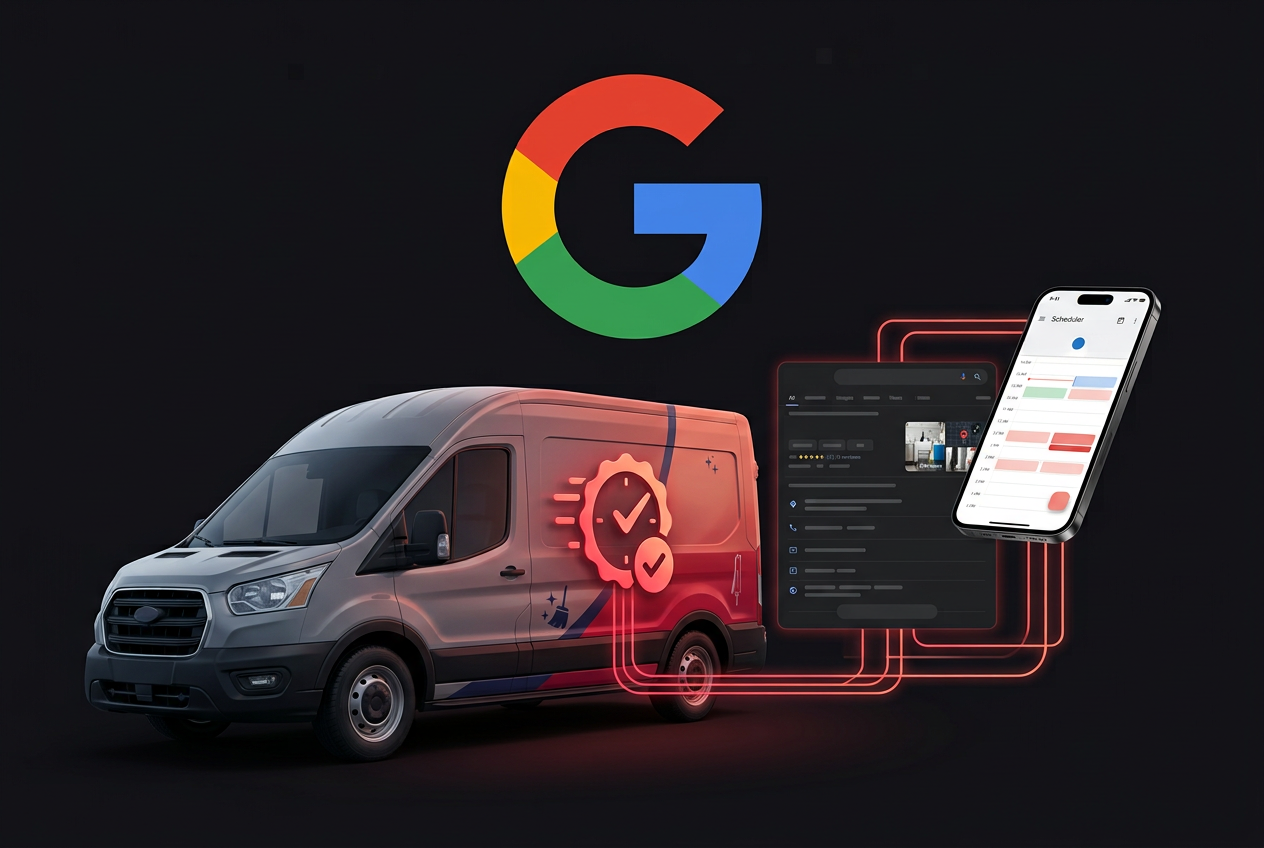
Google's September 2026 "Service Speed" badge went live for residential cleaning companies this month. It surfaces real-time booking availability and crew utilization directly in the knowledge panel—the box that appears when someone searches your business name or "house cleaning near me."
Cleaners with integrated scheduling systems are earning the badge. Those relying on manual spreadsheets, callback workflows, or disconnected calendar tools are being labeled "limited availability" even when they have open slots.
This is not a feature update. This is infrastructure becoming competitive moat.
What Changed
The Service Speed badge appears as a green checkmark next to your Google Business Profile listing with the label "Fast booking available." When a searcher clicks it, they see your next available slot, average response time, and whether you offer instant online booking.
Google is reading this data from three sources:
Structured appointment feeds. If your booking system integrates with Google's Reserve with Google API or pushes availability through schema markup, Google displays real-time open slots.
Booking velocity. Google tracks how quickly inquiries convert to confirmed appointments. A cleaning company that confirms a Tuesday inquiry for a Thursday clean signals capacity. One that calls back Friday and offers "maybe next week" signals constraint.
Crew schedule accuracy. Google cross-references appointment confirmations against actual service windows. If you book a 2-hour clean and your crew arrives 90 minutes late or stays 3.5 hours, Google infers scheduling uncertainty. That uncertainty degrades your speed score.
The badge is not awarded manually. It is calculated algorithmically from operational signals your business already emits—whether you know it or not.
Why This Matters
Residential cleaning is a local search business. Most customers find providers through Google Maps or local pack results. The knowledge panel is often the first detailed impression.
A "Fast booking available" badge is social proof of operational reliability. A "limited availability" tag is a warning label.
Google is effectively surfacing your scheduling infrastructure as a proxy for service quality. The assumption: a cleaning company that cannot manage its calendar in real time probably cannot manage its crews, its supply chain, or its customer communication.
That assumption is directionally correct.
Consider two residential cleaners in the same zip code:
Cleaner A uses a residential cleaning scheduling software that syncs availability to Google, sends automated confirmations, and tracks crew GPS to update job duration. When a searcher finds them on Google, they see "Next available: Tomorrow at 10 a.m." and a one-click booking button. Badge awarded.
Cleaner B runs a spreadsheet, takes calls, and manually confirms jobs by text. They have four crews and plenty of open capacity, but their Google profile shows no real-time availability. Searchers see "Call to book" and no badge. Google labels them "limited availability" because there is no data feed to prove otherwise.
Cleaner A converts 34% of profile views to booking clicks. Cleaner B converts 11%. Same market, same service area, same reviews. The difference is infrastructure.
The Mechanics Behind the Badge
Google is not guessing. It is measuring.
Availability feed integration. The cleanest path to the badge is integrating your cleaning company booking system with Google's Reserve API or embedding schema.org appointment markup on your website. This pushes real-time slot availability directly into the knowledge panel.
If you use a modern booking platform designed for service businesses, this integration often exists as a one-click toggle. If you built a custom solution or rely on generic calendar tools, you will need a developer to structure the data feed.
Response time tracking. Google measures the time between a customer inquiry (call, message, or form submission through Google) and your confirmation. The target threshold is under 15 minutes for instant confirmation or under 2 hours for human follow-up.
Manual callback workflows fail this test. If a customer submits a request Tuesday morning and you call back Wednesday afternoon to "check the schedule," you have already lost the speed signal.
Appointment adherence. Google uses location data from customer devices and publicly available check-in patterns to estimate whether you arrived on time and completed the job within the quoted window.
A residential cleaner who books 2-hour slots but routinely runs 3 hours creates uncertainty. Google does not penalize longer service—it penalizes unpredictability. If your average deep clean takes 3.5 hours, quote 3.5 hours. The system rewards accuracy, not speed.
Cancellation and reschedule rates. High cancellation rates—especially last-minute cancellations initiated by the business—signal capacity problems. If you frequently move customers because a crew called out or a prior job ran over, Google reads that as operational fragility.
The badge algorithm weights reliability over raw availability. A cleaner with two crews and airtight scheduling will outperform a cleaner with five crews and constant reshuffling.
What Operators Should Build
Earning the Service Speed badge is not a marketing project. It is an operations unlock that happens to surface in search.
Real-Time Availability
Your scheduling system must reflect actual crew capacity in real time. That means:
- Blocking out booked slots immediately when a job is confirmed.
- Accounting for drive time between jobs, not just service windows.
- Syncing PTO, vehicle maintenance, and supply delays into the availability feed.
A residential cleaner running three crews across two zip codes needs a system that knows Crew 1 finishes in Northside at 1 p.m., has a 22-minute drive to the next zone, and cannot start a new job before 1:30 p.m. If your system offers a 1:15 p.m. slot, you will miss the window and erode your speed score.
Manual scheduling cannot deliver this. Spreadsheet-based workflows require a human to calculate drive time, check crew assignments, and update availability—steps that introduce lag and error.
Integrated residential cleaning scheduling software calculates this automatically. It tracks GPS, knows your service areas, and updates Google's availability feed every time a job is booked or completed.
Instant Confirmation Workflows
Speed is measured from inquiry to confirmation, not inquiry to service delivery.
A customer who books online at 9 p.m. and receives automated confirmation in 90 seconds registers as instant. A customer who calls at 9 a.m. and waits for a callback at 3 p.m. registers as slow—even if you book them for the next morning.
Build workflows that confirm immediately:
- Online booking that pulls from live availability and auto-confirms without human review.
- SMS or email auto-replies that confirm receipt and provide expected response time if human review is required.
- CRM rules that route inquiries to the first available team member and escalate if unresponse after 15 minutes.
If you require a site visit or phone consultation before quoting, build a two-step confirmation: instant confirmation of the consultation appointment, followed by service booking. Google rewards the speed of the first confirmation.
Accurate Job Duration Models
Your system needs to predict job length based on service type, square footage, add-ons, and crew size.
A 1,200-square-foot standard clean with one cleaner averages 2 hours. The same home with deep clean, interior windows, and baseboards averages 3.5 hours. A two-person crew cuts that to 2 hours.
If your booking system does not model these variables, you will either overbook (causing delays) or underbook (leaving capacity unused). Both hurt the speed score.
Build job duration logic into your intake:
- Service type (standard, deep, move-out).
- Property size and room count.
- Add-on services (inside fridge, oven, windows).
- Crew size and experience level.
Feed this into your scheduling engine so every quote includes realistic start and end times. Track actual vs. estimated duration for every job and refine your models monthly.
Over six months, a residential cleaner using duration modeling will tighten their windows from ±45 minutes to ±10 minutes. That precision directly improves Google's confidence in your availability data.
Integrated Communication
Google tracks inquiry response time across all channels: phone, Google messages, website forms, and chat.
If a customer messages you through Google Business Profile and you respond via your business line two hours later, Google does not connect the dots. The message shows as unresponded.
Integrate all inquiry channels into one system:
- Route Google messages into your CRM or booking platform.
- Use a unified phone number that logs calls and ties them to customer records.
- Sync form submissions from your website directly into your scheduling tool.
When every inquiry hits the same system, you can set response SLAs, automate acknowledgments, and track performance in one dashboard.
The Compound Effect
The Service Speed badge is not the end state. It is the leading edge of a broader shift: operational data becoming discovery data.
Google already uses review velocity, photo recency, and Q&A engagement to rank local listings. Now it is adding scheduling performance, crew utilization, and booking conversion.
The next logical steps:
- Pricing transparency signals. Cleaners who publish real-time quotes will earn "upfront pricing" badges.
- Crew certification display. Cleaners who track and verify employee background checks, training, and insurance will surface credentials in the knowledge panel.
- Service guarantee integration. Cleaners who offer money-back guarantees or rescheduling credits through a structured system will display those terms in search.
Each of these requires infrastructure. You cannot fake a pricing feed or crew certification display with marketing copy. Google will pull directly from your operational systems—or penalize you for not having them.
Residential cleaners who build this infrastructure now will compound advantage over 18 to 24 months. Those who treat it as a "nice to have" will lose share to competitors whose operations are natively legible to Google.
Infrastructure as Moat
The Service Speed badge reveals a structural truth about local service businesses: your operations are now your marketing.
A decade ago, you could run a cleaning company on paper schedules and a good phone manner, then buy your way to visibility with ads and SEO. That model still works, but it is losing efficiency.
Today, the businesses that win local search are the ones whose systems feed real-time operational signals to Google. Availability, pricing, crew location, job adherence, customer communication—all of it is being measured and surfaced.
This is not a temporary algorithm tweak. This is Google systematically reducing information asymmetry in local services by making operational performance visible before the transaction.
For residential cleaners, the implication is clear: invest in scheduling infrastructure or accept that your competitors will earn the visibility you are paying to rent.
The badge is the signal. The moat is the system behind it.
What to Build Now
If you operate a residential cleaning company and do not yet have the Service Speed badge, the shortest path is:
Week 1: Audit your current scheduling workflow. Document the time between inquiry and confirmation, your no-show and reschedule rates, and how often jobs run over the quoted window.
Week 2: Implement or upgrade to a residential cleaning scheduling software that integrates with Google Business Profile, tracks crew GPS, and models job duration. Prioritize platforms with Reserve with Google API support or structured schema output.
Week 3: Build instant confirmation workflows for online bookings and auto-response templates for phone and message inquiries. Set internal SLAs: confirm within 15 minutes or auto-confirm.
Week 4: Refine job duration models. Compare estimated vs. actual times for your last 50 jobs, identify the variables causing variance (property size, service type, crew experience), and encode those into your booking logic.
Month 2: Monitor your Google Business Profile insights. Track the appearance of the badge, profile-to-booking conversion rate, and inquiry response times. Adjust crew capacity and availability windows based on what converts.
This is not a marketing initiative. It is operational hygiene that happens to unlock search visibility.
The residential cleaners earning the Service Speed badge today are not running better ad campaigns. They are running tighter operations—and Google is rewarding them with distribution.
That is the new game. Build systems that generate legible operational signals, or lose share to operators who do.