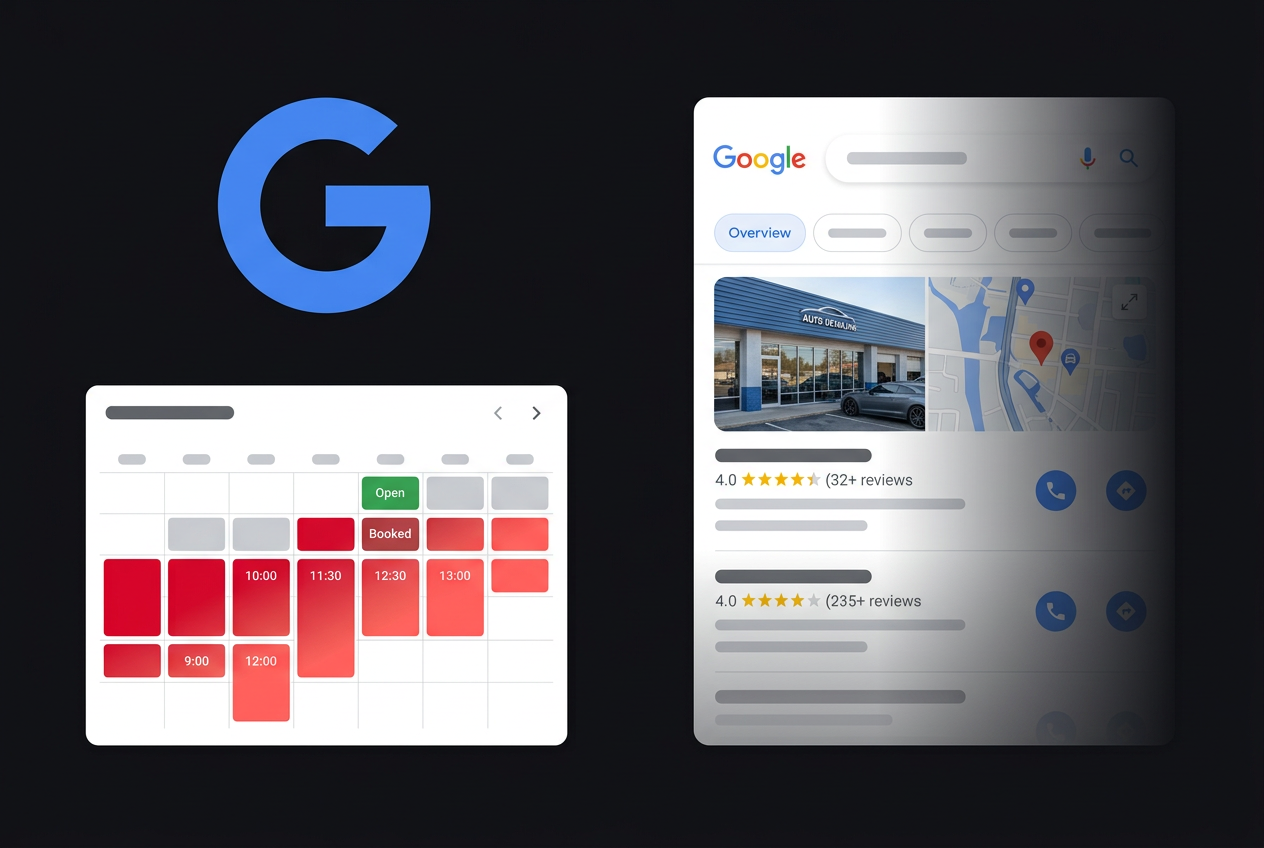
Google's Service Transparency Update Makes Scheduling a Ranking Signal
Google's October 2026 update treats calendar availability as an SEO signal—auto detailing shops with manual scheduling are losing 30–40% of their Map Pack impressions.
Google rolled out its "Service Transparency" update in October 2026, and auto detailing operators are seeing the impact immediately. Shops that manage availability manually or block off large chunks of "admin time" in their Google Business Profile are losing 30–40% of their Map Pack impressions. Shops that sync real-time calendars and show open, bookable slots are gaining preference in local search results.
This is not a content play or a review strategy. Google is now treating calendar hygiene as a direct ranking signal.
The mechanic is simple: if your Google Business Profile shows limited availability or if you manually toggle hours without reflecting actual open slots, the algorithm assumes you cannot serve new customers and deprioritizes your listing. If your profile displays real-time openings synchronized from a live booking system, Google interprets that as capacity and rewards you with visibility.
This shift exposes the gap between shops that built Revenue & Operations Infrastructure and those still running phone-only, manual scheduling. Work quality no longer drives discovery if your calendar says you are unavailable.
What Changed in October
Google's Service Transparency update introduces a new ranking factor for service-based businesses: displayed availability.
Before this update, a detailing shop could rank well with strong reviews, accurate NAP data, and a keyword-optimized profile. Calendar management was invisible to the algorithm. You could block off half your week for personal projects, leave your GBP availability settings untouched for months, or ignore appointment requests in the booking interface with no ranking penalty.
That changed on October 1st.
Now, Google scans your Business Profile for real-time slot availability. If you have enabled booking through Google Reserve or integrated a scheduling API that publishes open slots, the algorithm reads those slots as available capacity. If your profile shows no bookable times, blocks recurring "unavailable" windows, or displays outdated availability, Google treats your business as unable to serve demand.
The result: shops with live calendars move up in the Map Pack. Shops with static or manually managed availability drop.
This is not speculation. Early reports from auto detailing operators show a 30–40% decline in Map Pack impressions within two weeks of the update for shops that do not sync live calendars. Shops that integrated real-time booking APIs saw a 15–25% increase in profile views and a measurable lift in "Request Appointment" clicks.
Google is optimizing for user intent. If a searcher looks for "mobile detailing near me" at 2 PM on a Tuesday, Google wants to surface shops that can book that customer now—not shops that might answer the phone tomorrow.
Why Detailers Are Vulnerable
Auto detailing has historically been a phone-heavy, manual scheduling business. Most operators run one of three workflows:
-
Customer calls. Operator checks a paper calendar or mental schedule. Operator proposes a time. Customer agrees or negotiates. Operator writes it down.
-
Customer calls. Operator is on a job. Customer leaves a voicemail. Operator calls back hours later. Slot may already be filled in the operator's head.
-
Customer submits a contact form or DMs on Instagram. Operator responds when they see it. Back-and-forth via text to land on a time.
None of these workflows publish availability to Google in real time.
A detailing shop might have six open slots on Thursday, but if those slots are not reflected in the Google Business Profile as bookable times, the algorithm sees zero availability. The shop appears full even when it is empty.
Compare that to a competitor who integrated auto detailing scheduling software that syncs with Google Reserve. Every time a job is booked or a tech marks a slot unavailable, the calendar updates in real time. Google sees live capacity and routes search traffic accordingly.
The competitor is not doing better work. They are not running better ads. They built a system that makes availability machine-readable, and Google's algorithm rewards that.
This is the operational tax of manual scheduling. You lose visibility because your infrastructure cannot communicate capacity to the platforms that control discovery.
The Admin Time Problem
One of the most common patterns in auto detailing is blocking off large chunks of "admin time" or "shop time" on the calendar. This makes sense operationally—you need time to restock supplies, detail equipment, handle invoicing, return calls.
But if that blocked time appears in your Google Business Profile as "unavailable," the Service Transparency update treats it as lost capacity.
A shop that blocks Monday and Friday for admin and only shows Tuesday through Thursday as available now signals to Google that it operates three days a week. Even if the owner is willing to book a high-ticket job on Monday, the algorithm does not know that. It sees a 60% reduction in displayed availability and adjusts rankings accordingly.
The solution is not to eliminate admin time. The solution is to separate bookable availability from internal workflow.
A well-architected detailing shop calendar management system allows you to block internal time without publishing those blocks to Google. You maintain control over when jobs can be booked while still displaying maximum capacity to the algorithm.
Manual operators cannot make this distinction. If they block Friday in Google Business Profile settings, it affects both customer-facing availability and internal scheduling. The system lacks the granularity to differentiate.
This is why infrastructure matters. The shops that built API-connected calendars can tune what Google sees without sacrificing operational flexibility. The shops that still manage GBP availability by hand are forced to choose between ranking visibility and internal workflow—and most choose wrong without realizing it.
Real-Time Sync as Infrastructure
The core mechanic that determines whether a detailing shop benefits or suffers from this update is whether availability is pushed or pulled.
Manual operators pull availability. A customer calls, the operator checks the calendar, the operator communicates what is open. Google never sees the data. The profile remains static.
Integrated operators push availability. Every booking, cancellation, or schedule change writes to a central system. That system publishes open slots to Google via API. The profile reflects current capacity in real time.
This is not about adopting "auto detailing appointment booking" as a feature. It is about building a system where scheduling, CRM, and discovery are synchronized through a single source of truth.
Here is what that looks like in practice for a mobile detailing operation:
- A customer books a full exterior detail for Wednesday at 10 AM through the online scheduler.
- The booking writes to the CRM, creating a customer record and job ticket.
- The calendar updates, marking Wednesday 10 AM – 12:30 PM as unavailable (assumes a 2.5-hour service window).
- The Google Business Profile API reads the updated calendar and removes that slot from displayed availability.
- Google's algorithm sees that the shop still has six other open slots that week and maintains or improves Map Pack ranking.
Compare that to the manual version:
- A customer calls and books Wednesday at 10 AM.
- The operator writes it in a planner or adds it to a Google Calendar that is not synced to GBP.
- The Google Business Profile still shows Wednesday as "available" because no API updated it.
- Google's algorithm sees availability, but when another customer tries to book that slot through Google Reserve (if enabled), they hit a conflict or get no response.
- Google interprets this as poor service quality or unresponsive booking behavior and reduces ranking.
Or worse:
- The operator blocks the entire week as "unavailable" in GBP settings because they are tired of fielding spam calls.
- Google sees zero capacity.
- Map Pack impressions drop 40% in ten days.
The shops that treat scheduling as infrastructure—integrated, automated, machine-readable—are now being rewarded algorithmically. The shops that treat it as a manual workflow are being penalized regardless of their service quality or customer satisfaction.
What Operators Should Build Now
If you run an auto detailing operation and have seen a drop in Google Map Pack impressions since early October, the diagnosis is straightforward: your calendar is not speaking to Google in real time.
The fix requires three layers of infrastructure.
Layer One: Unified Calendar
You need a single calendar that captures all bookable availability, reflects all confirmed jobs, and updates instantly when anything changes.
This cannot be a paper planner. It cannot be a personal Google Calendar that you manually edit. It must be a system designed for service business scheduling, with API access and multi-user support.
For mobile detailing, this means accounting for travel time, service duration, buffer windows, and technician assignment. For a multi-bay shop, it means managing bay availability, equipment conflicts, and staggered start times.
The calendar must be the source of truth. If a job is booked, it is in the calendar. If a slot is open, it is in the calendar. No mental math, no "I will add it later," no double-booking because someone forgot to update.
Layer Two: Google Business Profile Integration
Once you have a unified calendar, you connect it to your Google Business Profile via an API that supports Google Reserve or a similar real-time booking protocol.
This integration does two things:
- It publishes your open slots to Google, making them visible in search results and the booking interface.
- It writes inbound bookings back to your calendar, ensuring that when a customer books through Google, the appointment is captured in your system without manual entry.
This is a two-way sync. Availability flows out, bookings flow in.
Most detailing operators do not build this themselves. They use auto detailing operations software that includes GBP integration as a core feature. The software handles the API handshake, manages slot formatting, and ensures compliance with Google's booking policies.
The key is that the integration runs automatically. You do not manually update GBP when a job is booked. The system does it.
Layer Three: CRM and Job Workflow
Real-time availability is only valuable if you can actually service the bookings that flow from it. This is where CRM and operational workflow matter.
When a customer books through Google, your system should:
- Create a customer record with contact info, vehicle details, and service history.
- Generate a job ticket with service type, duration, pricing, and technician assignment.
- Trigger pre-appointment messaging (confirmation SMS, reminder 24 hours out, prep instructions).
- Update job status as the work progresses (en route, in progress, completed).
- Capture payment and log it against the customer record.
- Prompt for review requests post-service.
This is the operational backend that allows you to scale availability without sacrificing service quality. If you open more slots on Google but cannot manage the workflow, you create bottlenecks, no-shows, and missed revenue.
The shops that benefit from the Service Transparency update are not just syncing calendars—they are running integrated Revenue & Operations Infrastructure that handles acquisition, conversion, and delivery in one system.
The Ranking Advantage is Compounding
Here is why this matters beyond short-term traffic.
Google's local search algorithm is moving toward real-time signals. Service Transparency is one update, but the direction is clear: businesses that provide machine-readable, up-to-date information about their capacity, availability, and responsiveness will rank higher than businesses that do not.
This is a compounding advantage.
A detailing shop that integrates scheduling and GBP sees a 20% lift in Map Pack impressions. More impressions generate more bookings. More bookings generate more reviews (if the post-service workflow is automated). More reviews improve ranking further. Higher ranking drives more impressions.
The manual operator sees a 35% drop in impressions. Fewer impressions mean fewer bookings. Fewer bookings mean less cash flow to invest in systems. The ranking slide continues.
Within six months, the gap is not 20% versus -35%. It is 3x versus 0.5x. The operator with infrastructure has compounded visibility, revenue, and reviews. The manual operator is spending money on Google Local Service Ads to compensate for lost organic traffic.
This is not a temporary algorithm tweak. This is a structural shift in how discovery works for service businesses. The platforms that control customer access—Google, Yelp, Nextdoor—are prioritizing businesses that operate like software: responsive, real-time, machine-readable.
You cannot fake this with SEO tricks. You cannot buy your way out with ads indefinitely. You build infrastructure, or you lose access.
Why Most Detailers Will Ignore This
Despite the clear ranking penalty and the measurable revenue impact, most auto detailing operators will not integrate real-time scheduling within the next twelve months.
The reasons are predictable:
- "I have always done it this way." Manual scheduling feels safer because it is familiar.
- "I do not want random people booking online." Fear of low-quality leads or time-wasters who book and cancel.
- "I am too busy to set up new software." The day-to-day operation leaves no time for infrastructure projects.
- "My customers prefer to call." A belief that phone-based service is higher touch and builds better relationships.
These objections are not irrational. They reflect real concerns. But they ignore the fact that Google has made calendar integration a ranking requirement, not an optional enhancement.
You can prefer phone-only scheduling. Google will still deprioritize your profile if it shows no live availability.
You can be too busy to implement new software. Your competitors will implement it, gain ranking preference, and take your search traffic.
You can believe your customers prefer to call. The customers who search on mobile at 8 PM and want to book now will choose the shop that shows open slots, not the one that says "call during business hours."
The shops that thrive after this update are the ones that treat infrastructure as non-negotiable. Scheduling is not a "nice to have." It is the mechanism that connects your capacity to algorithmic discovery. If you do not engineer that connection, you are invisible.
Infrastructure Beats Craft
The uncomfortable truth of the Service Transparency update is that a mediocre detailing shop with integrated scheduling now outranks an excellent shop with manual operations.
Google does not measure the quality of your paint correction. It does not see your five-star craftsmanship or your decades of experience. It sees data: availability, responsiveness, booking completion rate.
A two-year-old mobile detailing operation running modern auto detailing operations software, syncing calendars in real time, and displaying live availability will appear higher in the Map Pack than a ten-year veteran who still uses a paper planner and returns calls when he gets around to it.
This feels unfair. It is also irrelevant.
The algorithm does not care about fairness. It optimizes for user intent. A searcher looking for "car detailing appointment booking" wants to see who can serve them now. The business that can answer that question in real time wins the click.
This is the same dynamic that has played out in every service category Google has touched. Restaurants that integrated OpenTable outranked better kitchens with phone-only reservations. Hotels that synced room availability through booking APIs outranked boutique properties with email-only inquiries.
Service Transparency brings that dynamic to auto detailing, and eventually to every appointment-based service business.
The operators who recognize this early and build accordingly will compound an advantage that becomes unassailable. The operators who resist will spend years wondering why their traffic dried up despite doing great work.
What This Means for the Category
Google's October 2026 update is not an isolated event. It is part of a broader shift in how service businesses are discovered, evaluated, and booked.
The next twelve months will separate detailing operators into two groups:
-
Infrastructure operators who run integrated systems where scheduling, CRM, GBP, and operations are synchronized in real time. These shops will gain algorithmic preference, capture more inbound demand, and scale revenue with lower marginal cost per booking.
-
Manual operators who continue to manage availability by hand, treat scheduling as a phone-only process, and ignore the ranking signals Google is broadcasting. These shops will see traffic decline, cost-per-acquisition rise, and margin compress as they shift budget to paid ads to compensate for lost organic visibility.
The gap between these two groups will widen every quarter. The infrastructure operators will reinvest revenue into better workflows, faster response times, and deeper integration. The manual operators will cut prices, work longer hours, and blame the algorithm.
This is not a prediction. This is how infrastructure advantages compound in every category where software meets service delivery.
The detailing shops that treat scheduling as a system—machine-readable, API-connected, real-time—are building the foundation for predictable revenue growth. The ones that treat it as a manual task are engineering their own irrelevance.
Google's Service Transparency update makes this dynamic visible and measurable. Calendar hygiene is now a ranking signal. Availability is algorithmic currency.
The operators who build accordingly will own the next decade. The ones who ignore it will wonder where their customers went.