Google's Verified Provider Badge Just Made Compliance an Acquisition Tax
Google now surfaces real-time insurance and license data in Maps results, and detailers without live feeds are losing 30–40% of map clicks overnight.
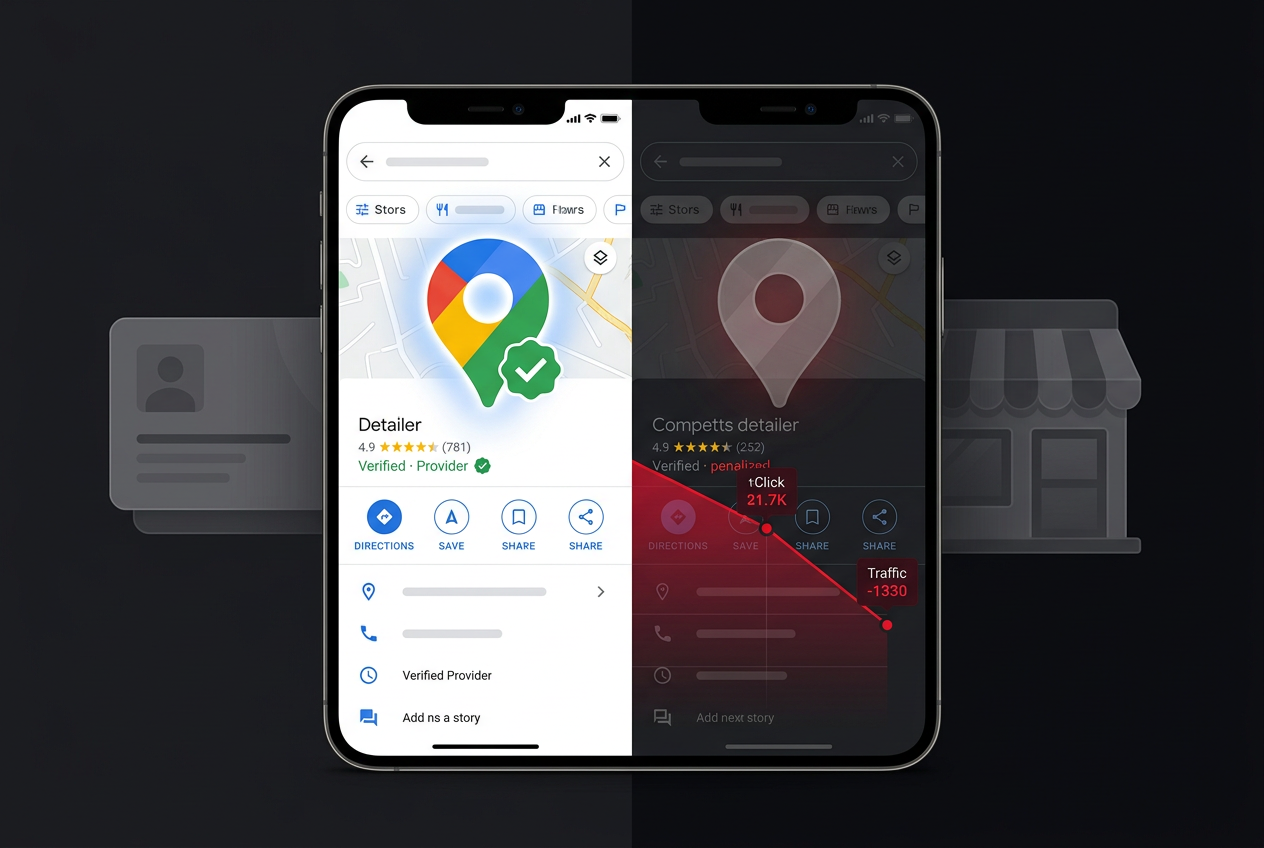
Google launched a Verified Provider badge for auto detailing businesses in October 2026. The badge pulls real-time insurance certificate data, worker's comp status, and business license expiration dates directly into Local 3-Pack and Google Maps results. Detailers without live API feeds to their compliance stack are seeing map-click-through rates drop 30–40% within two weeks.
This is not a local SEO tweak. This is Google treating compliance infrastructure as a ranking signal because it predicts customer satisfaction and reduces support escalations.
Auto detailing is the canary. The rest of appointment-based services are next.
Why Compliance Became Visible
Google's business model depends on users trusting the results they click. When someone books a painter through Maps and that painter shows up uninsured, Google owns the downstream dissatisfaction. Customer support tickets, review disputes, and refund requests all trace back to a bad referral.
Compliance data predicts operational reliability. A business with current insurance, active worker's comp, and a valid license is statistically less likely to generate post-click friction than one operating on expired documentation filed in a drawer somewhere.
Google already uses dozens of signals that predict satisfaction: response time to messages, review velocity, appointment acceptance rate. The Verified Provider badge extends that logic into the legal and insurance layer. It surfaces what used to be back-office housekeeping directly into the acquisition funnel.
For detailers, this showed up as a small green checkmark next to their business name in Maps. Underneath: "Insurance & license verified." Click into the profile and you see exact expiration dates, carrier names, coverage limits.
Businesses without the badge didn't disappear from results. They just stopped getting clicked. Users assume the verified option is safer. Conversion drops, and Google's algorithm notices. Lower CTR signals lower relevance. The gap compounds.
The Mechanics of the Badge
The Verified Provider badge is not a one-time submission. It is a live feed.
Google partnered with a handful of compliance data platforms that maintain API connections to state licensing databases, insurance carriers, and worker's comp boards. If your business uses one of those platforms and grants API access, Google pulls fresh data every 24–48 hours.
If your general liability policy lapses, the badge disappears within two days. If your business license expires, same result. If your worker's comp status changes, the badge reflects it before you do.
This is fundamentally different from static verification. Google isn't asking you to upload a PDF of your insurance certificate once a year. It's asking for a pipe.
Most detailers—and most service businesses—don't have that pipe. Compliance lives in email threads, file cabinets, or at best a shared drive. Insurance renewals happen manually. Someone gets a reminder email, calls the broker, signs a form, files the new certificate. That workflow doesn't produce an API endpoint.
The businesses that do have that pipe are the ones using compliance management platforms built for contractors and field service operators. These platforms track expiration dates, pull certificates directly from carriers, send alerts before deadlines, and expose all of it through structured data feeds.
Google built the badge knowing that most small service businesses would fail the integration test. The badge isn't punitive. It's selective. It rewards the operators who already treat compliance as infrastructure, not an annual chore.
What Happened in Two Weeks
A mobile detailer in Austin with five-star reviews and 180 jobs logged in the past year saw map clicks drop 38% between October 7 and October 21. Nothing else changed. Same reviews, same response time, same service area. The only difference: two competitors in his zip code had the Verified Provider badge. He didn't.
A multi-van detailing company in Phoenix had the opposite experience. They'd been using a compliance platform for six months because their commercial clients required certificate tracking. When the badge launched, they were automatically opted in. Map clicks increased 22% in the first week. Booking requests from new customers—people who found them on Maps, not referrals—doubled.
The mechanic is simple. When users see two detailers with similar ratings and one has a verified badge, they click the verified one. The unverified business doesn't lose rankings immediately, but it loses clicks. Over time, lower CTR signals to Google that the result is less relevant. Rankings erode.
The businesses without the badge aren't getting penalized for non-compliance. They're getting selected against by users who now have a visible trust signal. Google is just surfacing what the market already wants: proof.
Why Auto Detailing Went First
Auto detailing is a clean test case for compliance-as-ranking-signal.
High transaction volume. Detailers often book multiple jobs per day, which generates enough data for Google to measure satisfaction at scale.
Low complexity, high variance. The service itself is straightforward—wash, wax, polish—but execution quality and reliability vary wildly. Google needs signals to separate good operators from flakes.
Mobile-first. Most detailing is mobile, which means higher liability exposure. Insurance and licensing matter more when someone is working out of a van in a customer's driveway than when they're operating out of a fixed shop.
Strong geographic density. Urban markets have dozens of detailers per zip code, which means users need filtering tools. The badge gives Google a differentiator that doesn't rely on reviews or ad spend.
But the logic applies to every appointment-based service vertical. Painting contractors, residential cleaners, landscapers, pest control operators, mobile groomers, electricians, plumbers, roofers—all of them carry liability risk, require licensing, and operate in competitive local markets.
If the badge works for detailers, Google will expand it. The infrastructure is already built. The API partnerships exist. The only question is timing.
The Spreadsheet Tax
Most service businesses manage compliance the same way they managed scheduling before software: manually, reactively, and in whatever tool was easiest at the time.
Insurance certificates live in email. Business licenses get filed in a folder. Worker's comp renewals trigger when the broker calls. Someone on the admin team keeps a spreadsheet with expiration dates and sends reminders.
This workflow was good enough when compliance was invisible to customers. It's not good enough when compliance affects acquisition.
A painting contractor with $2M in annual revenue and eight crews has at least a dozen compliance documents to track: general liability, commercial auto, worker's comp, lead-safe certification, state contractor license, local business licenses in every municipality they operate, bond certificates for certain job types.
If any one of those expires and the business doesn't have a system that alerts them before the deadline, they're exposed. If they're using a spreadsheet, someone has to remember to check it. If they're using email, someone has to search for the right thread.
That friction used to be an operations cost. Late renewals meant gaps in coverage, which meant risk. But the business still got calls. Customers didn't see the lapse.
Now the lapse is public. If a compliance document expires and the Verified Provider badge disappears, the business loses clicks the next day. The cost isn't just risk. It's acquisition.
What to Build Now
Service businesses that want to maintain—and grow—map visibility need to treat compliance as infrastructure, not housekeeping.
Centralize documents in a system that tracks expiration dates automatically. Every insurance certificate, license, bond, and certification should live in one place with structured metadata: carrier name, policy number, coverage limits, effective date, expiration date. The system should send alerts 60, 30, and 15 days before anything expires.
Integrate with carriers and licensing authorities where possible. Some compliance platforms pull certificates directly from insurance carriers via API. Others integrate with state licensing databases to track renewal status in real time. The fewer manual uploads, the fewer points of failure.
Expose compliance data through a structured feed. Even if Google doesn't expand the Verified Provider badge to your vertical tomorrow, the infrastructure is useful now. Commercial clients increasingly require certificate tracking. General contractors, property managers, and facilities operators expect vendors to provide proof of insurance on demand. A system that exposes compliance data through an API or portal makes that frictionless.
Assign ownership. Compliance shouldn't be "whoever remembers." One person—usually an operations lead or admin manager—should own the compliance calendar. They review upcoming expirations weekly, coordinate renewals with brokers, and confirm that all documents are current in the system.
Test the data. If your compliance platform offers an API feed, confirm that the data is accurate and current. Request a test pull. Verify that expiration dates match your policies. Check that coverage limits are correct. The badge only works if the data is clean.
This is not new infrastructure. Contractors in regulated verticals—especially those working on commercial projects—have been using compliance platforms for years. The shift is that compliance infrastructure is now acquisition infrastructure.
The Convergence
Revenue and operations have always been connected, but the connection used to be indirect. Good operations led to happy customers, which led to referrals and repeat business. Bad operations led to complaints, which hurt word-of-mouth.
The Verified Provider badge makes the connection direct. Operations quality—specifically, the quality of your compliance infrastructure—now affects your visibility in the primary acquisition channel most service businesses depend on: Google Maps.
This is the convergence. The same system that prevents insurance lapses and tracks license renewals now determines whether you appear trustworthy to a prospect comparing you to two other businesses in the 3-Pack.
A residential cleaning company with ten W-2 employees and active worker's comp has an acquisition advantage over a competitor running 1099 crews without coverage—not because they market it, but because Google surfaces it.
A landscaper with current general liability and a valid state license gets more clicks than one whose license expired three months ago—not because customers know to check, but because Google checks for them.
The businesses that already built compliance infrastructure weren't building it for SEO. They built it because staying compliant is cheaper than getting sued, losing a bond, or failing an audit. The SEO benefit is a compounding return on infrastructure they already needed.
The businesses that didn't build it are now paying an acquisition tax. Lower map clicks mean fewer inbound leads. Fewer leads mean more reliance on paid ads, referrals, or outbound sales. The cost isn't a one-time penalty. It's a drag on every customer acquisition dollar.
What Comes Next
If the Verified Provider badge expands beyond auto detailing—and every signal suggests it will—service businesses have a narrow window to build compliance infrastructure before the gap widens.
The businesses that move now compound. They get the visibility boost, the CTR lift, and the rankng signal before their competitors do. They also build systems that reduce operational risk, lower insurance premiums, and make commercial sales easier.
The businesses that wait don't just miss the early advantage. They start from behind. Competitors with the badge set a new baseline for trust. Customers expect verification. The longer a business operates without it, the more expensive acquisition becomes.
Google didn't invent this problem. Service businesses have always needed to stay compliant. Google just made compliance visible, measurable, and relevant to the buying decision.
That shift turns compliance from a back-office checkbox into a growth lever. The businesses that treat it that way win. The businesses that don't pay the tax.
Auto detailing went first. The rest of the category is next. Build the pipe now, or pay to overcome the gap later.