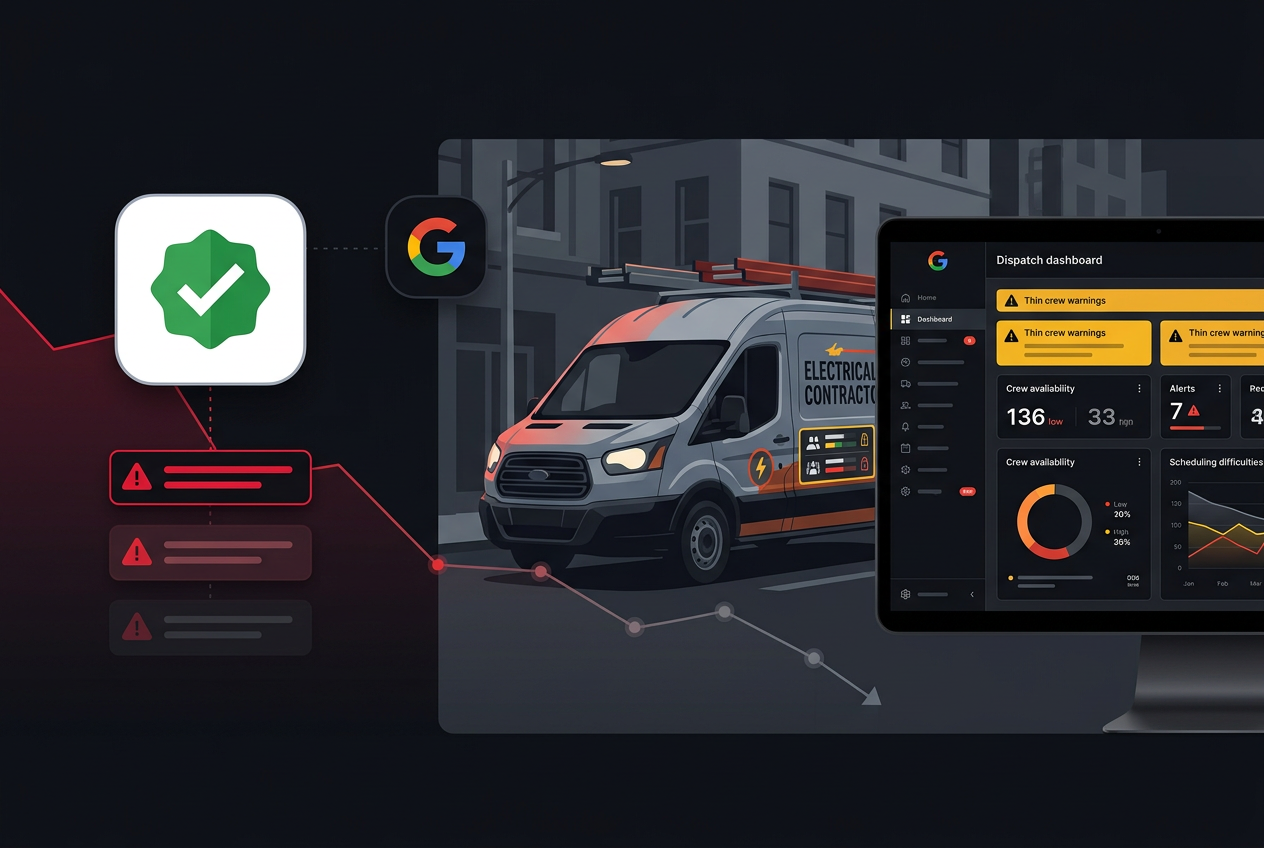
Google LSA Now Punishes Thin Crew Capacity in Electrical
When labor shortages meet algorithmic enforcement, electrical contractors face a new reality: operations infrastructure is now a prerequisite for LSA budget efficiency.
The Bureau of Labor Statistics confirmed it in September 2026: skilled trade labor shortages hit a ten-year high. Electricians report a 23% vacancy rate. At the same moment, Google rolled out an LSA algorithm update that penalizes electrical contractors who show inconsistent availability or long lead times in their profiles.
This is not a coincidence of bad timing. It's a structural collision.
Electrical contractors now face a double bind. They can't hire fast enough to meet inbound demand. Yet Google's Local Services Ads platform—the primary acquisition channel for most residential and light commercial electrical work—now throttles budgets and suspends profiles when availability signals weaken. Miss too many calls, push lead times past five days, or show inconsistent booking windows, and the algorithm interprets it as low service quality.
The contractors who survive this aren't the ones with the best recruiting pipelines or the biggest LSA budgets. They're the ones who engineer their scheduling, dispatch, and capacity management as a single integrated system.
The New Penalty
Google's September LSA update introduced three new signals into profile ranking and budget allocation:
Availability consistency. If your booking calendar shows open slots on Monday but is dark by Wednesday—without corresponding job volume to explain it—the algorithm flags profile instability.
Lead time creep. If your average quoted lead time drifts beyond five business days and stays there for more than two weeks, your impression share drops and cost-per-lead climbs.
Inbound responsiveness. Miss more than 18% of LSA calls in a rolling seven-day window, and you trigger a review flag. Miss 30%, and you risk suspension.
These aren't subjective quality complaints. They're automated enforcement mechanisms tied to operational metrics that most electrical contractors don't actively manage.
The old LSA playbook—buy more budget, answer the phone faster, get more reviews—assumed infinite capacity. The new reality assumes you can prove operational readiness in real time, across multiple surfaces, to an algorithm that checks your availability posture every few hours.
When electrician vacancy rates sit at 23%, that posture becomes nearly impossible to maintain without systems.
Why Electrical Contractors Hit This First
Electricians aren't the only trade facing labor shortages in 2026. Plumbers report a 19% vacancy rate. HVAC techs sit at 21%. But electricians got hit with the LSA update first because of the shape of their demand.
Electrical work skews urgent and unplannable. A tripped breaker, a failed outlet, a panel upgrade required for a permit—these jobs don't wait. Customers expect a quote within two hours and a truck within three days. That expectation is baked into LSA's ranking algorithm, because Google knows electrical search intent trends higher-urgency than, say, exterior painting or landscaping projects.
The algorithm learned that electricians who can't offer near-term availability usually can't deliver quality service. It's not wrong. But it also doesn't account for the fact that every electrical contractor in a metro market is fishing from the same shallow labor pool.
So when vacancy rates spiked in Q3 2026, Google's LSA algorithm started suspending profiles that were simply reflecting labor market reality. The contractors who maintained their LSA position weren't the ones who magically hired faster. They were the ones who made better use of the crews they had.
That means dispatch efficiency, job sequencing, and real-time capacity visibility.
The Operations Breakdown
Most electrical contractors run scheduling the same way they did in 2016. A dispatcher—sometimes the owner—takes inbound calls, checks a whiteboard or a shared Google Calendar, and slots jobs based on memory, gut feel, and whoever complains the loudest.
Crews finish jobs early or run late. Customer callbacks create same-day emergencies. No-shows burn half a day. Lead time estimates are aspirational.
This works fine when you have slack capacity. It falls apart when every crew is spoken for and every job is pre-sold two weeks out.
Here's what breaks:
Lead time inflation. When you don't know your true available capacity in real time, you pad estimates to avoid over-promising. A job that could fit in three days gets quoted at seven. Your LSA lead time metric drifts, your impression share drops, and your cost-per-lead climbs 40% before you notice.
Callback chaos. Warranty work, change orders, and "while you're here" requests create unplanned demand that eats into scheduled capacity. Without a dispatch system that models crew availability dynamically, these requests either bump paying jobs or push your lead time further out. Either way, the algorithm sees inconsistency.
Inbound misalignment. Your LSA profile says you're available for residential panel upgrades in ZIP codes 30301–30308. But your dispatcher doesn't know that your only crew qualified for panel work is booked solid until next Thursday. So you take the call, quote a lead time, and either lose the job or make a promise you can't keep. Both outcomes hurt your LSA standing.
No-show invisibility. A 15% no-show rate costs you 6–9 crew hours per week. In a tight labor market, that's the difference between a five-day lead time and a three-day lead time. But most contractors don't measure no-show rates by crew, by job type, or by lead source, so they can't improve them. The lost capacity just evaporates.
None of these are new problems. What's new is that an algorithm now measures the downstream consequences in real time and adjusts your customer acquisition costs accordingly.
Capacity as a Function
The electrical contractors who maintain LSA efficiency in 2026 treat capacity as a function, not a feeling.
They know, at any moment:
- How many crew hours are billable this week and next week.
- Which crews are qualified for which job types.
- Average job duration by service category, not just a flat "half-day" estimate.
- No-show rate and late-start rate by lead source and customer segment.
- Real-time drive time and geographic distribution of committed jobs.
This isn't ERP-level complexity. It's operational literacy. And it's the foundation for three leverage points that directly improve LSA performance under labor constraints.
Dynamic lead time quoting
When a new LSA call comes in, your dispatcher should see available capacity segmented by crew, service type, and geography. Not a shared calendar with color-coded blocks. A dispatch board that models job duration, travel time, and scheduling rules.
If you have a residential service call in 30315 that needs a two-person crew and your southeast crew has a four-hour opening on Thursday afternoon, your lead time for that job is three days—not the seven-day average you're quoting because you don't have visibility.
Contractors who quote lead times dynamically based on real capacity data keep their LSA lead time metric under five days even when overall crew utilization hits 88%. Contractors who quote conservatively because they don't trust their scheduling data watch their impression share collapse.
Callback and warranty routing
Unplanned work doesn't have to destroy scheduled capacity if you route it intentionally. A callback for a dimmer switch issue doesn't require the same crew as a new 200-amp service install.
Electrical contractors who separate callback routing from new job dispatch can absorb 12–15% unplanned volume without extending lead times for new LSA-sourced jobs. That separation requires tagging jobs by type and qualification level in your dispatch system, and it requires dispatchers who understand crew skill matrices.
It also requires measuring callback rate by job type and by technician. If one crew generates callbacks at twice the rate of another, that's a training issue or a QC issue—but it's invisible until you instrument it.
No-show recovery and confirmation
A 15% no-show rate in a market with 23% electrician vacancies is the same as walking away from one full-time equivalent crew. Reducing that rate to 6% adds capacity without hiring.
Confirmation systems—automated SMS 24 and 48 hours before the appointment, with a one-tap reschedule option—cut no-show rates by 40–60% in appointment-based service businesses. But only if the confirmation is tied to your dispatch system so reschedules automatically surface available slots and update lead time visibility.
Most electrical contractors send confirmation texts. Few tie the response back into scheduling logic. So a customer who cancels 18 hours before an appointment creates a hole that the dispatcher doesn't see until the crew arrives and calls it in.
Contractors who close that loop recover 70% of would-be no-show slots and redeploy them as same-day or next-day availability—which directly improves their LSA availability signal.
What the Algorithm Sees
Google's LSA algorithm doesn't know you're short two journeyman electricians. It doesn't care that you're competing with three national chains and a dozen owner-operators for the same talent pool. It measures signals:
- Time from LSA call to first available slot.
- Consistency of booking availability over rolling seven-day windows.
- Percentage of inbound calls converted to booked appointments.
- Rate of appointment cancellations initiated by the contractor.
Every one of those signals improves when you move from static scheduling to dynamic dispatch.
A contractor running a shared calendar with manual dispatch might have 320 billable crew hours available next week but quote a six-day lead time because they don't have real-time visibility into job sequencing, travel time, or qualification requirements. They lose impression share, their cost-per-lead climbs, and they start believing LSA "doesn't work anymore."
A contractor running integrated dispatch can see the same 320 hours, model job duration and routing, and quote a three-day lead time with confidence. Their LSA cost-per-lead stays flat or drops, even as market competition intensifies.
The difference isn't marketing budget. It's operational infrastructure.
The Compounding System
Here's how this connects to 2getherPro's three-layer thesis: acquisition, conversion, and operations must function as one system.
Acquisition is LSA spend and impression share. You control cost-per-lead by maintaining availability signals and lead time competitiveness.
Conversion is the call or form that becomes a booked appointment. You control conversion rate by offering near-term availability that matches customer urgency and by reducing friction in the booking process.
Operations is dispatch, routing, confirmation, and crew utilization. You control lead time, availability consistency, and cost-per-job by treating capacity as a managed resource, not a static constraint.
When these three layers integrate, you get a compounding loop:
Better dispatch visibility → shorter quoted lead times → higher LSA impression share → more inbound volume → higher crew utilization → better unit economics → budget headroom to raise wages and recruit → lower vacancy impact.
When they don't integrate, you get a death spiral:
Poor capacity visibility → padded lead time quotes → lower LSA impression share → higher cost-per-lead → thinner margin per job → no budget to recruit → worsening vacancy impact → longer lead times.
Electrical contractors in September 2026 are living both loops simultaneously. The operators who built integrated systems before the labor shortage hit are compounding. The ones who treated scheduling as an admin task are compounding in reverse.
Building the System Now
You don't need a custom-built ERP or a six-month implementation to start improving these metrics.
You need dispatch software that models crew availability by skill, service type, and geography. You need automated confirmation workflows that feed cancellations and reschedules back into scheduling logic. You need weekly reporting on lead time by lead source, no-show rate by customer segment, and callback rate by crew.
Most importantly, you need to stop treating LSA performance as a marketing problem. It's not a bidding problem or a review problem or a competitor problem.
It's a capacity management problem. And in a labor market with 23% vacancy rates, capacity management is existential.
The electrical contractors who recognize this in Q3 2026 will compound through Q4 and into 2027. The ones who keep troubleshooting their LSA campaigns without fixing their dispatch operations will watch their cost-per-lead double while their calendar stays half-empty.
Google's algorithm doesn't negotiate. It measures, ranks, and allocates budget based on operational readiness. If you can't prove availability, you don't get the impression share.
The fix isn't hiring faster. It's using the crews you have with precision, visibility, and system discipline. That's the infrastructure play. And it's the only sustainable answer to the double bind of labor shortages and algorithmic enforcement.