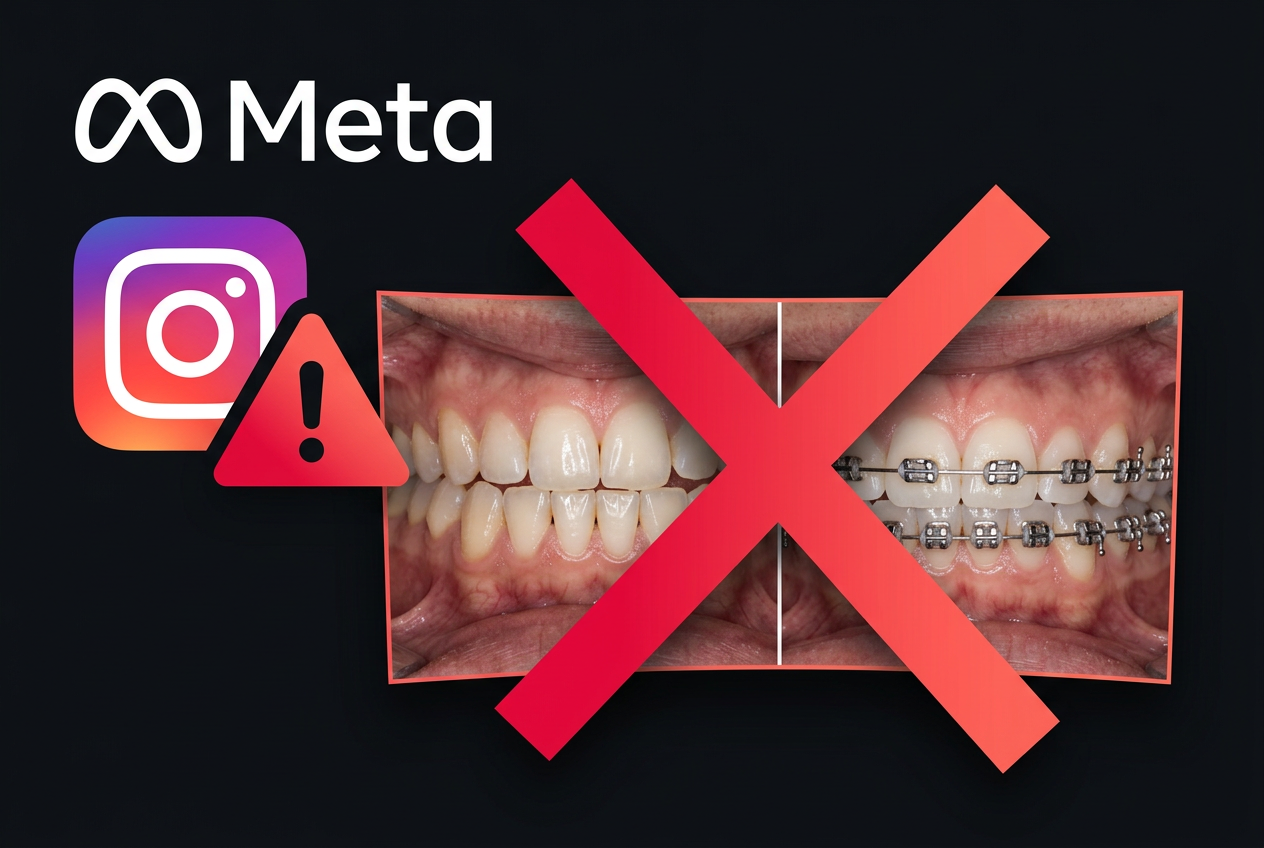
Meta Just Broke Orthodontic Acquisition at Scale
Instagram's stricter enforcement of before-and-after imagery is hitting dental and orthodontic practices with mass rejections in September 2026.
Instagram rolled out stricter enforcement of "before and after" transformation imagery in paid ads this month. Dental and orthodontic practices are seeing ad rejections and account warnings at scale across September 2026.
The impact is surgical. Orthodontic practice marketing campaigns that were running profitably for months—delivering $80–$140 cost per consultation booking—are now disabled within hours of launch. Creative that generated 400+ consultation requests per month is flagged before it clears review.
This is not a bug. Meta updated its enforcement logic for health and cosmetic transformation claims, and the algorithm now treats smile transformations, braces-off reveals, and whitening comparisons as violations of its "before and after" imagery policy under the Medical, Health & Pharmaceutical Products category.
The policy itself is not new. The enforcement is.
Policy Mechanics
Meta's advertising policies prohibit before-and-after imagery that depicts results of health treatments or cosmetic procedures. The language has existed since 2018. Enforcement was historically inconsistent—ads would run for months, then suddenly trigger a manual review.
In September 2026, Meta appears to have deployed automated detection at the creative upload stage. Accounts are seeing rejections within minutes, not days. The shift suggests computer vision models now flag transformation imagery during the initial review queue, before human moderators assess context.
Here's what specifically triggers rejection for orthodontic practices right now:
Side-by-side smile images with visible dental change. This includes braces on/off, clear aligner progress, whitening results, or veneer transformations. Even if the practice does not label them "before" and "after," the visual structure triggers the flag.
Single-image carousels that show progression. A three-slide carousel showing Week 0, Week 12, Week 24 of aligner treatment is treated identically to a split-screen before/after.
Video testimonials with smile reveals. Patient testimonials that show the subject smiling at the beginning and end of the video—even if unscripted and documentary-style—are being flagged when the difference is pronounced.
Text overlays referencing transformation. Phrases like "6 months later," "my smile now," or "final result" paired with smile imagery increase rejection rates, even on single images without comparison structure.
The enforcement does not appear to assess clinical vs. cosmetic intent. Orthodontic treatment is medical. Invisalign, braces, retainers, and functional appliances correct bite issues, jaw alignment, and oral health problems. Meta's policy does not distinguish between medically necessary orthodontics and elective cosmetic dentistry. Both trigger the same rejection.
Why This Hits Ortho
Orthodontic practices depend on visual proof more than almost any other appointment-based service vertical.
A painting contractor can show a transformed living room. A landscaper can display a redesigned backyard. A med spa can describe treatment protocols without showing a client's face. But an orthodontic practice sells an outcome that is inseparable from the patient's physical appearance—and that outcome is the smile.
Before-and-after creative is not supplementary. It is the acquisition engine.
Internal data from practices running lead generation campaigns in 2025 showed before-and-after creative converting at 2.1× to 3.4× the rate of testimonial-only or service description ads. Cost per consultation dropped 35–50% when transformation imagery was the lead creative asset.
Patients booking orthodontic consultations are making a decision that involves:
- $3,000–$8,000 in out-of-pocket cost
- 12–24 months of treatment time
- Weekly or biweekly adjustment appointments
- Visible appliances (for traditional braces)
- High perceived risk of poor outcomes
The decision threshold is high. Proof lowers it.
When Meta removes the ability to show that proof in paid ads, the friction returns. Click-through rates drop. Cost per lead climbs. Practices that were acquiring 60 qualified consultations per month at $95 each now see volume fall to 30 at $160 each.
The math breaks. Patient acquisition cost approaches or exceeds lifetime value, especially for aligner-only practices with lower average case fees.
What Still Runs
Not all creative is blocked. Practices that moved quickly in early September identified patterns in what clears review.
Single-image smile photos without comparison context. A patient smiling after treatment, with no reference to a "before" state, typically clears. The image must not imply transformation through text, framing, or visual cues like arrows or progress indicators.
Office and team imagery. Photos of the practice, the orthodontist, the treatment chair, and staff perform poorly compared to transformation creative, but they run without issue. Conversion rates are 40–60% lower.
Illustration or 3D renders of treatment mechanics. Graphics showing how braces move teeth, or animations of aligner staging, do not trigger the policy. Engagement is weak. These assets work better as mid-funnel retargeting creative than cold acquisition.
Patient testimonials without visual smile transformation. Video testimonials where the patient discusses their experience but does not show a pronounced smile change at beginning vs. end often clear review. The challenge is directing patients to avoid smiling on camera—unnatural and low-performing.
Process and education content. Posts explaining consultation structure, payment plans, insurance acceptance, or appointment availability run without friction. These do not generate cold lead volume at scale.
Practices are testing hybrid approaches: leading with compliant creative to drive traffic, then using landing pages and email sequences to display transformation galleries outside Meta's ad environment. Early results show this introduces a conversion gap. Traffic that does not see proof in the ad has lower intent and higher drop-off before booking.
Account Risk Compounding
The immediate problem is creative rejection. The compounding problem is account health.
Meta's ad account infrastructure operates on a violation-and-penalty system. Repeated policy violations—even on different ads within the same account—trigger escalating restrictions:
- First violation: Ad disabled, account warned
- Second violation within 90 days: Temporary ad creation limits
- Third violation: Account restricted from running ads in certain categories (health, finance, housing)
- Fourth violation: Permanent account suspension
Orthodontic practices running multiple campaigns with before-and-after creative in August saw 8–15 ad rejections in the first week of September. Each rejection contributes to the account's violation count.
Practices that appeal rejections and receive approval do not reverse the violation flag. The appeal process reviews whether the ad violated policy, not whether the account should be penalized. A successful appeal reinstates the ad but leaves the account health score degraded.
Some practices are seeing account restrictions after five total rejections, even when three were appealed and approved. Meta's internal account quality scoring is opaque, but the pattern suggests that flagged creative submissions degrade the score regardless of outcome.
This creates a compliance death spiral. Practices that continue testing transformation creative—hoping to find compliant formats—burn through violation thresholds faster than they find working assets. Accounts that have run profitably for two years are permanently suspended in three weeks.
Restructuring Acquisition Flow
Orthodontic practices cannot wait for Meta to clarify or relax enforcement. The alternative is not "pause ads until this blows over." The alternative is restructuring acquisition infrastructure to route lead flow under tighter creative constraints.
This requires separating three functions that most practices conflate:
- Traffic generation (getting attention)
- Proof delivery (showing transformation evidence)
- Conversion capture (booking the consultation)
Before September 2026, orthodontic practices collapsed all three into a single ad unit: a before-and-after image that linked directly to a consultation booking page. Traffic, proof, and conversion happened in one click.
That model is now non-compliant. The new structure distributes the three functions across different environments with different compliance rules.
Traffic Layer
Meta ads now serve as the top-of-funnel traffic source, but not the proof layer. The creative must clear review, which means removing transformation imagery entirely.
Practices that rebuilt campaigns in early September used:
Patient story hooks without visual transformation. Video testimonials where the patient discusses the decision to start treatment, the consultation experience, or the first few weeks wearing aligners. Smile transformation is not shown. The hook is relatability, not proof.
Orthodontist-led education content. The treating doctor explains common treatment questions: "How long does Invisalign take?" or "Do braces hurt?" Shot in the office, using the orthodontist's authority as the engagement driver.
Consultation-offer creative focused on process, not outcome. Ads that lead with "$99 new patient consultation—includes 3D scan and treatment plan" or "Book your complimentary smile assessment this week." The offer is the hook. Outcome proof is deferred.
These assets convert at 50–65% of the rate that before-and-after creative achieved. Cost per click rises from $1.10–$1.60 to $1.90–$2.80. But they run without rejection.
The goal of the traffic layer is no longer direct conversion. It is qualified attention.
Proof Layer
Transformation proof moves off Meta's ad platform and into owned environments where the practice controls compliance.
Landing pages with compliant transformation galleries. After clicking the ad, the prospect lands on a page that hosts before-and-after imagery. Meta's ad policy governs what appears in the ad unit itself—not what happens on the destination URL. The landing page is outside Meta's enforcement scope.
Email sequences triggered by lead magnet opt-in. Practices offer a free guide ("The Complete Guide to Adult Orthodontics" or "What to Expect During Invisalign Treatment") in exchange for an email address. The first email contains transformation case studies. Subsequent emails show patient video testimonials with visible smile change. The nurture sequence delivers proof over 5–7 days.
Retargeting creative with transformation imagery—sometimes. Practices are testing whether before-and-after imagery runs in retargeting campaigns aimed at users who visited the landing page but did not book. Early data is mixed. Some retargeting ads with transformation creative clear review; others are rejected. The pattern suggests Meta applies looser enforcement to warm audiences, but this is not consistent.
The proof layer operates under the assumption that prospects need to see transformation evidence before booking, but that evidence does not need to appear in the first touchpoint.
Conversion Layer
Booking infrastructure must handle lower-intent traffic and longer consideration cycles.
Practices that previously converted cold traffic into consultations within 24 hours now see a 3–6 day lag between first ad click and booking. This introduces drop-off risk at every step.
Automated follow-up sequences. When a prospect submits a consultation request or downloads a lead magnet, an automated SMS and email sequence begins immediately. The sequence includes transformation proof, answers common objections, and prompts booking. Practices using automated follow-up saw 22–30% of prospects who did not book on the landing page convert within 72 hours.
Live chat and speed-to-lead infrastructure. Prospects who land on the booking page but do not complete the form are prompted by live chat or chatbot. The system captures partial lead data (name, phone, question) and routes it to the front desk for immediate outreach. Speed-to-lead remains the highest predictor of conversion—every hour of delay reduces booking likelihood by 8–12%.
Consultation offer clarity and low friction. Practices that simplified the booking path—removing multi-step forms, offering single-click calendar integration, confirming via SMS within 60 seconds—offset some of the conversion loss from weaker ad creative. The path from landing page to confirmed appointment must be nearly frictionless to compensate for lower initial intent.
The conversion layer assumes that a smaller percentage of traffic will book immediately, so the infrastructure must recover intent through speed, automation, and proof sequencing.
The Compliance Arbitrage
Some practices are exploring creative arbitrage: running compliant ads through the main account while testing higher-risk transformation creative through secondary accounts or partner profiles.
This is high-risk. Meta's account enforcement extends to the Business Manager level and tracks account ownership through IP address, payment method, and page admin associations. If a secondary account is suspended for before-and-after violations, Meta can disable all associated accounts, including the main practice ad account and the Facebook Business Page.
Practices that run multi-account strategies must structure them with full legal and operational separation:
- Different Business Manager entities with no overlapping admins
- Separate payment methods (different credit cards, different billing addresses)
- Different Facebook Pages (not linking to the same practice website or Google My Business profile)
- Different creative libraries (no shared assets between accounts)
Even with full separation, Meta's detection systems flag patterns. If two accounts run nearly identical campaigns targeting the same geography and age/gender demo, and both link to orthodontic practice landing pages, the system can associate them.
The arbitrage window is short. Practices that deploy it see secondary accounts suspended within 3–6 weeks. It is a stopgap, not a solution.
Systemic Resilience
Meta's enforcement shift exposes a structural weakness in orthodontic practice acquisition: single-channel dependency.
Practices that derived 70–85% of consultation bookings from Meta ads in August are now facing 40–50% volume declines in September. There is no fast replacement. Google Local Services Ads do not offer the same targeting precision. SEO takes months to build. Direct mail and traditional media are cost-prohibitive at the consultation volumes most practices need to sustain growth.
The solution is not to find a compliant hack. The solution is to build acquisition infrastructure that distributes lead generation across multiple channels and separates proof delivery from ad platform compliance.
Practices that run Google Ads, optimize Google Business Profile for local search, invest in content that ranks organically, collect and display online reviews, and maintain an owned email and SMS database are not immune to Meta's policy shifts—but they do not collapse when one platform tightens enforcement.
This is not diversification for diversification's sake. It is systems thinking.
An orthodontic practice that generates 60 consultation bookings per month from a single source has a fragile acquisition engine. A practice that generates 20 from Meta ads, 18 from Google Local Services, 12 from organic search, and 10 from referral and email reactivation has a resilient one.
When Meta changes its rules, the resilient practice adjusts one input without losing pipeline velocity.
Infrastructure Over Creative
The broader lesson is not "how do I get before-and-after ads approved again." The broader lesson is that acquisition performance in appointment-based service businesses cannot depend on any single creative format or platform policy remaining stable.
Meta will continue adjusting enforcement. Google will continue changing Local Services eligibility. iOS privacy updates will continue degrading attribution. Practices that build acquisition systems around a single creative hook or traffic source will face recurring collapse.
2getherPro's infrastructure is designed to route lead flow under changing platform constraints. When creative restrictions tighten, the system shifts traffic allocation to compliant channels, sequences proof delivery through owned environments, and accelerates conversion through speed-to-lead automation and intelligent follow-up.
The consultation booking pipeline stays intact because the system does not rely on any single creative format or platform behavior. It operates on mechanics: traffic routing, proof sequencing, conversion capture, and appointment confirmation.
Orthodontic practices running campaigns in September 2026 are learning this in real time. The ones that rebuild acquisition infrastructure around systems thinking—not around a single high-performing ad—will stabilize faster and grow more predictably once enforcement settles.
The ones that keep trying to sneak before-and-after creative past Meta's algorithm will burn through account health and lose the ability to advertise entirely.
Meta did not break orthodontic acquisition. It exposed the brittleness of acquisition systems that depended on creative formats instead of operational infrastructure.
The practices that survive this shift are the ones that stop asking "how do I get my ads approved" and start asking "how do I build a lead generation system that performs regardless of what any single platform allows."
That is the infrastructure problem. And infrastructure problems have engineering solutions.