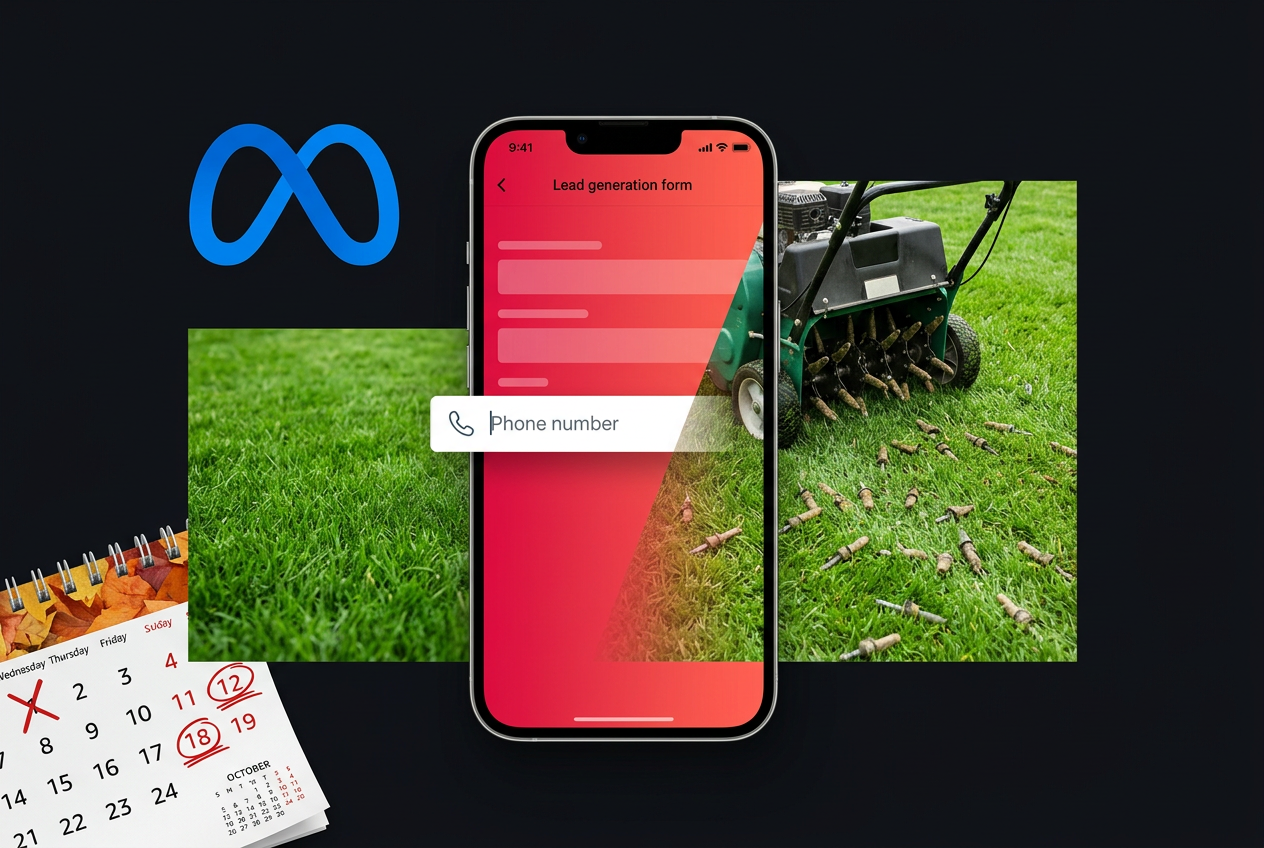
Meta's New Lead-Form Rules Hit Landscapers Mid-Season
Meta now requires phone validation and same-day follow-up tracking for home service advertisers—just as fall aeration season peaks.
On September 3, 2026, Meta announced stricter lead-form verification requirements for home service advertisers. Phone number validation and same-day follow-up tracking are now mandatory. The policy lands in the middle of fall aeration and cleanup season, when landscaping and lawn care companies depend on Facebook lead ads to fill October and November schedules.
If you run Meta lead ads for landscaping services, your ad account now depends on operational infrastructure you may not have built yet. Phone validation, instant lead routing, and documented response times are no longer CRM features—they are compliance requirements that determine whether your acquisition channel stays online.
This is not a platform policy shift you can ignore or work around. It is a forcing function that separates operators with revenue infrastructure from those running ads into a spreadsheet.
What Changed
Meta's updated lead-form policy for home services advertisers includes three new requirements:
Phone number validation at capture. Every lead form must verify that the phone number submitted is valid and reachable before the lead is recorded. Meta does not specify the validation method, but the number must pass real-time format and carrier checks.
Same-day follow-up tracking. Advertisers must demonstrate that leads receive outbound contact within 24 hours of form submission. Meta will audit accounts by requesting timestamped records of first contact attempts.
Response documentation. Advertisers must retain logs showing call attempts, connection status, and lead disposition for at least 90 days. Meta reserves the right to request these logs during account review.
The policy applies immediately to all active campaigns in the home services category. Meta has not provided a grace period. Accounts that cannot produce validation and follow-up records during review face suspension.
For landscaping and lawn care businesses running fall campaigns—aeration packages, leaf cleanup, winterization—this creates an operational deadline that has nothing to do with creative or targeting.
Why Now
Meta has been tightening lead-quality enforcement since late 2024, but this is the first policy that explicitly mandates operational infrastructure on the advertiser side.
The driver is lead quality, not privacy. Meta's lead forms convert at high volume because the friction is low—name, phone, zip, submit. That low friction also generates leads that are incomplete, unverified, or abandoned before a business can make contact.
When follow-up rates are slow or inconsistent, leads report the form as spam or claim they never opted in. Meta's support queues fill with disputes. Advertisers blame the platform for bad leads. Homeowners blame the platform for unwanted calls.
Meta's solution is to push verification and follow-up accountability onto the advertiser. If you cannot prove you validated the number and contacted the lead within 24 hours, the platform assumes the problem is your operation, not the lead.
This is not unique to Meta. Google Local Services Ads already require response-time SLAs and call recording. Angi and Thumbtack track first-response speed as a ranking signal. Platforms are converging on the same thesis: advertisers who cannot operate at speed and document compliance are liabilities.
For landscaping businesses, this shift arrives at the worst possible time. September and October are peak months for aeration and overseeding lead volume. Schedules fill fast. Crews are deployed. The operational tempo is high.
Adding phone validation, lead routing, and response tracking mid-season is not a software configuration—it is an infrastructure project.
The Landscaping Context
Fall aeration and cleanup campaigns have specific characteristics that make Meta's new requirements especially difficult to meet without automation.
High lead volume in narrow windows. Aeration season runs six to eight weeks in most climates. A mid-sized lawn care company might capture 200 to 400 aeration leads in that span. At 10 to 15 leads per day, manual validation and same-day follow-up become bottlenecks fast.
Price-sensitive leads with short consideration windows. Aeration jobs range from $80 to $300 depending on lot size. These are not high-ticket remodeling projects where a lead will wait 48 hours for a callback. If a homeowner submits a form on Tuesday morning and does not hear from you by Tuesday evening, they have already called two other companies.
Routing complexity. Landscaping businesses often run multiple service lines—mowing, aeration, leaf cleanup, hardscaping—and each service has different routing logic. An aeration lead in zip code 43220 might route to crew A, while a leaf cleanup lead in the same zip routes to crew B. Manual routing introduces delay and error, both of which now trigger compliance risk.
Seasonal hiring and dispatch variability. Fall is a high-turnover period for landscaping crews. The person responsible for following up on leads in September may not be employed in October. If follow-up workflows depend on individual discipline rather than automated assignment, response rates degrade as staffing changes.
Without infrastructure that validates numbers at capture, routes leads instantly by service and geography, and logs every contact attempt, a landscaping company cannot meet Meta's same-day follow-up requirement at scale.
What Breaks First
When Meta audits an account, they request proof of follow-up for a sample of leads. The request arrives without warning, and the advertiser has 48 hours to produce timestamped records.
If your operation looks like this, you will not pass:
- Leads export to a spreadsheet or email inbox, and someone manually copies them into a CRM.
- Follow-up depends on a sales rep remembering to check the lead list each morning.
- Call logs are stored in individual phones or not stored at all.
- Lead assignments happen in a group chat or whiteboard.
Even if your team is disciplined and fast, you cannot produce the timestamped, aggregated records Meta requires. The infrastructure does not exist.
The account gets suspended. Ads stop running. It is October 10, you have six trucks on the road, and your primary acquisition channel is offline.
This is not a hypothetical. In the first 72 hours after Meta's September 3 announcement, multiple landscaping operators in contractor communities reported ad account suspensions tied to inability to produce follow-up documentation.
Meta is not issuing warnings. The policy is live, and enforcement is immediate.
The Infrastructure Answer
Compliant operation under Meta's new lead-form policy requires four infrastructure components:
Real-Time Phone Validation
Every lead form submission must trigger a validation check before the lead enters your system. The validator checks format, carrier type, and line status. Invalid or disconnected numbers are flagged immediately.
This prevents fake or mistyped numbers from entering your pipeline, and it gives you a clean record to present during audit: every lead that passed validation was reachable at the time of capture.
Phone validation services integrate with Meta's lead forms via webhook. The validation happens in milliseconds, before the thank-you page loads. The homeowner never sees the check, but your system knows whether the number is real.
Instant Lead Routing
Same-day follow-up requires that leads reach the right person instantly. That means automated routing based on service type, geography, and availability.
A validated aeration lead in your northern territory routes to the crew lead responsible for that zone. A leaf cleanup lead in your southern territory routes to a different contact. The routing logic lives in your system, not in someone's head.
Routing rules can be simple—zip code plus service type—or complex, incorporating crew capacity, schedule density, or customer LTV. The requirement is that assignment happens automatically within minutes of capture, not hours.
Automated Follow-Up Tracking
Every outbound call, text, or email to a new lead must be logged with a timestamp, outcome, and next action. This is not optional. It is the record you produce when Meta audits your account.
If you use a CRM, it must log every contact attempt automatically. If your team makes calls from mobile phones, those calls must sync to a central log. If you send SMS confirmations, the send timestamp must be recorded.
Manual logging does not scale and does not survive staff turnover. The system must capture this data as a byproduct of normal operation, not as an additional task someone remembers to complete.
Response SLA Enforcement
Same-day follow-up is a commitment, not a goal. Your system must enforce it.
That means leads older than X hours without contact attempt trigger an alert. Managers see which leads are aging. Routing escalates to a backup contact if the primary assignee does not respond.
This is not micromanagement. It is the operational discipline that keeps ad accounts online.
A landscaping company running 15 aeration leads per day cannot rely on individual hustle to hit same-day follow-up. The workflow must guarantee it.
What This Means for Paid Acquisition
Meta's lead-form policy is a preview of where all paid acquisition channels are headed. Platforms are offloading lead-quality risk onto advertisers by requiring proof of operational speed and follow-up discipline.
For landscaping and lawn care businesses, this changes the cost structure of customer acquisition. The price of a lead is no longer just CPL. It is CPL plus the infrastructure required to keep the channel compliant.
If your operation cannot validate, route, log, and follow up at the speed the platform demands, your effective cost per acquired customer is infinite—because the channel shuts down.
This is not a Facebook-specific problem. Google Local Services Ads already penalize slow responders by suppressing their placement. Angi ranks providers partly on response speed. Thumbtack shows average response time on provider profiles.
The operators who treat follow-up speed and documentation as infrastructure investments—automated, measured, enforced—are the ones who compound paid acquisition over years. The operators who treat it as a discipline problem depending on individual effort lose access to channels when enforcement tightens.
Building for Compliance
If you run Meta lead ads for landscaping services and cannot currently prove same-day follow-up with timestamped records, you have two choices.
Pause campaigns until the infrastructure is in place. This protects your ad account but kills October and November revenue.
Or build the validation, routing, tracking, and SLA enforcement layer now, before Meta audits your account.
The build does not require custom software. It requires connecting the pieces you likely already have—lead forms, phone validation API, CRM, call tracking, SMS platform—and adding the routing and logging rules that turn activity into documentation.
The companies that survive platform policy shifts are the ones who build operational infrastructure before it becomes mandatory. By the time enforcement is universal, the laggards are locked out and the operators with compliant systems are buying volume at scale with no competition.
Meta's September 3 policy is not an inconvenience. It is a forcing function that separates revenue infrastructure from lead-gen theater.
If your landscaping business depends on paid acquisition to fill fall schedules, compliance is not a CRM project. It is the system that keeps the revenue engine online.
Systems Over Speed
Platform compliance requirements will only tighten. Meta's lead-form policy is one signal in a broader shift: acquisition channels now require operational proof, not just ad spend.
For appointment-based service businesses—landscaping, cleaning, pest control, remodeling—the implication is clear. Revenue infrastructure is not a back-office concern. It is the layer that keeps acquisition channels open, follow-up consistent, and operations auditable.
The landscapers who treat this as a temporary annoyance will spend the next two years fighting ad account suspensions and hunting for new lead sources. The ones who build phone validation, instant routing, and response SLA enforcement into their core operation will run paid acquisition at scale while competitors churn through platforms.
This is not about moving faster. It is about building systems that document speed, enforce follow-up, and produce the records platforms now require.
The fall aeration season is six weeks long. The infrastructure you build to stay compliant this October compounds for every campaign you run after.