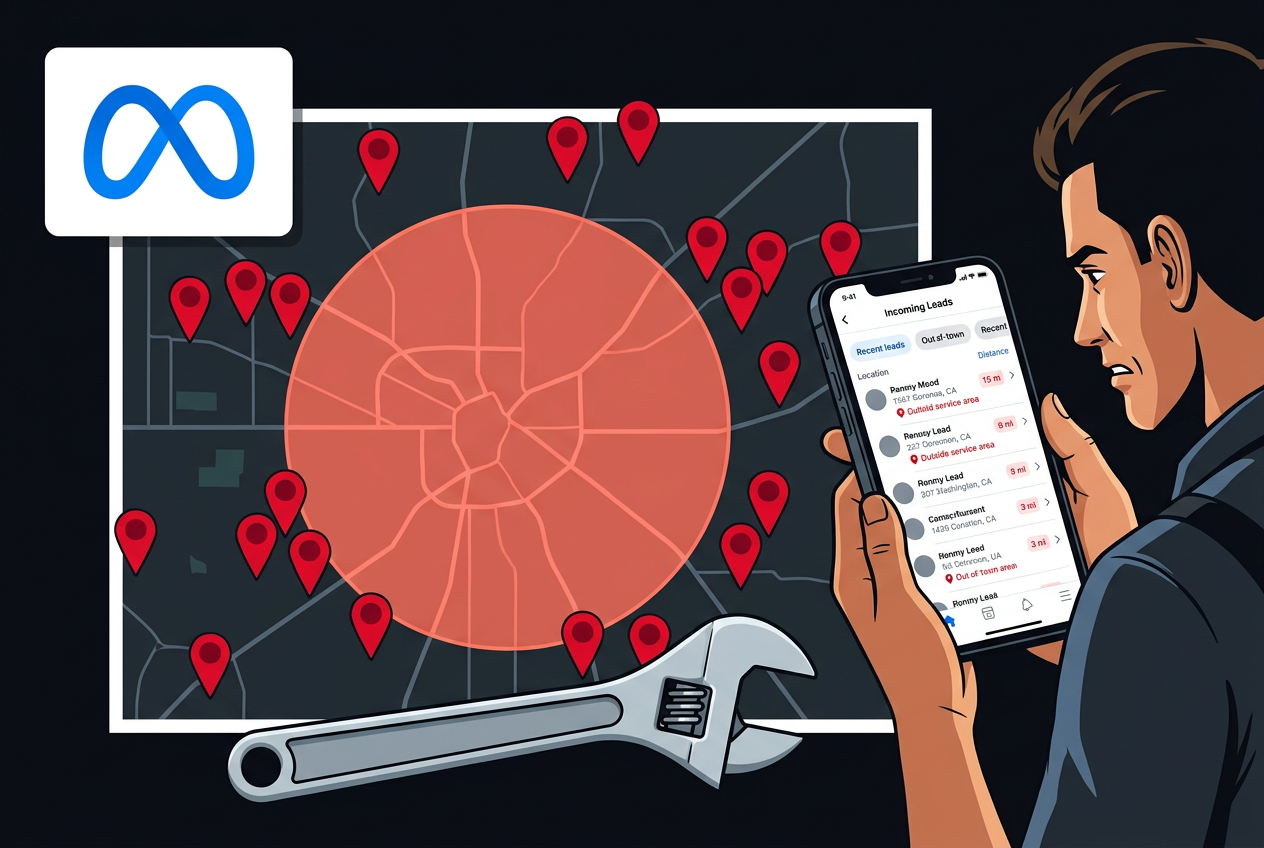
Meta Broke Service-Area Targeting for Plumbers. Here's the Fix
Meta's September 2026 Advantage+ update optimizes for engagement over geography, flooding plumbing contractors with leads 40+ miles outside service zones.
Meta's September 2026 Advantage+ audience update changed how the platform interprets service-area targeting. Plumbing contractors who relied on 15-mile radius targeting are now receiving leads from 40, 50, even 60 miles outside their serviceable zones. The algorithm prioritizes engagement signals—clicks, form completions, time on page—over geographic precision.
This isn't a bug. It's a deliberate shift in how Meta defines optimization.
For plumbers, the damage is immediate. A residential plumber in Naperville, Illinois sets a 20-mile service radius and starts receiving leads from Joliet, Aurora, even Rockford. The CSR answers, qualifies, realizes the address is 45 miles out, and declines the job. The homeowner is annoyed. The dispatcher wasted six minutes. The ad spend is gone. And Meta's algorithm just learned that this lead converted—someone filled out the form—so it sends more like it.
The operators getting destroyed are those running high-volume lead gen with loose qualification on the front end. The operators who survive are those who connect Meta's conversion events to actual serviceable jobs, not form submissions.
Why Geographic Precision Collapsed
Meta's Advantage+ suite uses machine learning to expand audience definitions beyond manual constraints. In earlier versions, you could set a 15-mile radius around a zip code and trust the platform to respect it. The algorithm optimized within that boundary.
The September update loosened that contract. Now, if the algorithm detects that users 30 miles outside your radius are more likely to engage with your ad creative, it will serve impressions there. The platform treats your radius as a suggestion, not a rule.
Three factors make plumbing contractors especially vulnerable.
High-intent creative triggers broad engagement. Plumbing ads work because they speak to acute pain. Burst pipe, no hot water, sewer backup. That creative gets clicks everywhere, not just inside your service area. A homeowner in a neighboring county sees "Emergency Plumber – 60 Min Response" and clicks. They want help. They don't check your service map first.
Form friction is low. Most plumbing lead forms ask for name, phone, zip, and problem description. Takes 30 seconds. The homeowner outside your area completes it because the friction is negligible and the need is urgent. Meta sees a conversion. It doesn't see the CSR declining the job two minutes later.
The pixel fires on the wrong event. Most plumbers fire the conversion pixel on form submission. That's the event Meta optimizes toward. If 40% of your form submissions come from outside your service area, and you're still firing the pixel, you're teaching the algorithm that out-of-area leads are successful conversions.
The result: your cost per lead stays flat or even drops, but your cost per booked job doubles.
Who Gets Hit Hardest
Not all plumbing operations feel this equally. The severity depends on market density, service radius, and conversion infrastructure.
Suburban operators with 15-mile radiuses in dense metro areas. A plumber in Marietta, Georgia serves a tight 15-mile zone. Twenty miles north is Alpharetta. Twenty miles south is Atlanta proper. Meta's algorithm sees engagement across all three zones and serves ads accordingly. The operator gets leads from Buckhead, Roswell, even Duluth—all outside the service area. In a dense metro, a 20-mile radius difference can mean 40+ minutes of drive time.
Operators using lead forms instead of booking flows. If your conversion point is "submit this form and we'll call you back," you have no way to filter geography before the pixel fires. The lead enters your CRM, the pixel fires, Meta counts it as a win. If your conversion point is "book an available time slot," you can hide slots for out-of-area zips before the conversion event.
High-volume shops running Advantage+ campaign budget optimization. The more you let Meta control, the harder it optimizes for engagement over geography. If you're running manual campaigns with strict radius controls and custom audiences, you retain more influence. If you're running Advantage+ with open targeting and letting the platform allocate budget, you lose geographic precision fast.
Operators in low-density markets near population centers. A plumber in Woodstock, Georgia serves a 20-mile radius that includes exurban and semi-rural areas. Thirty miles south is metro Atlanta—higher population density, more engagement, more clicks. Meta's algorithm drifts toward Atlanta because the engagement metrics are better, even though the jobs are unbookable.
The operators who survive this are those with tight service areas and the infrastructure to teach Meta what a good lead actually looks like.
The Wrong Fix
Most plumbers try to solve this with tighter radius settings, more granular zip code targeting, or increased manual bid controls. These slow the bleeding but don't stop it.
Tighter radius controls only work if Meta respects them. Under the current Advantage+ logic, a 10-mile radius is still treated as a suggestion. You'll see fewer out-of-area leads, but you'll also see lower impression volume and higher CPMs because you're fighting the algorithm's preference.
Zip code exclusion lists help, but they're reactive. You're playing whack-a-mole, adding zip codes to your exclusion list every time you notice a cluster of bad leads. Meanwhile, the algorithm is already testing new areas.
Lowering your budget or pausing Advantage+ features gives you more control but kills scale. You're back to manual targeting, smaller audiences, and higher cost per result.
The correct fix is to change what you're telling Meta a "result" is.
Fix One: Fire Conversion Events on Booking, Not Form Submission
The first infrastructure change is to move your Meta conversion pixel from the form submission confirmation page to the booking confirmation page.
Here's the mechanic.
A homeowner clicks your ad, lands on your page, and sees a lead form. They fill it out: name, phone, zip, issue description. When they hit submit, the form does not fire the Meta pixel. Instead, it sends the data to your CRM or booking engine, which checks the zip code against your service area polygon.
If the zip is outside your area, the system shows an apology message: "We don't service [zip] yet. Here are three plumbers near you." No pixel fire. No conversion event. Meta gets no signal.
If the zip is inside your area, the system shows available time slots. The homeowner picks a slot and confirms. Now the pixel fires. Meta registers a conversion. You've just taught the algorithm that this geography, this creative, this audience segment leads to a bookable job.
This requires three components.
A service area lookup table. Your CRM or booking software needs a list of serviceable zips or a polygon map of your service boundary. When a zip code comes in, the system checks it in real time.
Conditional pixel logic. Your pixel integration must be conditional, not static. Most operators paste the Meta pixel code on a "thank you" page that fires regardless of service area. You need server-side logic or a tag manager rule that only fires the pixel if the zip passes validation.
A fallback for out-of-area leads. If you decline a lead, you still need to handle the user experience. An apology message with referral links keeps the interaction professional and avoids angry users who then trash your ad in comments.
The result: Meta stops optimizing toward out-of-area engagement because those interactions never register as conversions.
Fix Two: Send Offline Conversion Events for Completed Jobs
Firing the pixel on booking is better than firing on form submission, but it's still incomplete. A booking is not a completed job. No-shows, cancellations, and reschedules all register as conversions even though they don't generate revenue.
The second infrastructure change is to send offline conversion events back to Meta when a job is completed and paid.
Here's how it works.
When a homeowner books a slot, your system captures their fbclid or fbc parameter—the unique identifier Meta uses to track conversions back to specific ad clicks. Your CRM stores that identifier alongside the job record.
When your plumber completes the job and marks it closed in your dispatch software, the system triggers an API call to Meta's Conversions API. That call includes the fbclid, the event name (e.g., "Job Completed"), the revenue amount, and the timestamp.
Meta receives the signal and attributes the completed job back to the original ad, campaign, and audience. Now the algorithm optimizes toward users who not only book but also complete and pay.
This creates a feedback loop that teaches Meta the difference between a qualified lead and a waste.
A homeowner in Marietta books a water heater repair, your plumber shows up, completes the job, collects $680. The offline event fires. Meta attributes it. The algorithm learns that this zip code, this creative, this time of day produces closed revenue.
A homeowner 40 miles outside your area books a slot but cancels two hours later because they realize you're too far. No offline event fires. Meta sees the booking conversion but not the completion. Over time, the algorithm down-weights that audience segment.
This requires four components.
Integration between dispatch software and Meta's Conversions API. Most modern dispatch platforms—ServiceTitan, Housecall Pro, Jobber—support webhook triggers or API exports when a job status changes. You route that data to a middleware layer (Zapier, Make, or custom code) that formats and sends it to Meta.
Persistent storage of fbclid or fbc. When a user lands on your site from a Meta ad, the URL contains a fbclid parameter. Your booking form must capture and store it alongside the customer record. If they book, that parameter travels with the job through dispatch and invoicing.
Event mapping that mirrors your funnel. Meta allows you to define custom conversion events. You might send "Lead," "Booking Scheduled," "Technician Dispatched," "Job Completed," and "Invoice Paid" as separate events. The algorithm then optimizes toward the event you designate as your primary conversion goal.
Match quality for offline events. When you send an offline conversion, Meta matches it back to a user using the fbclid or hashed customer email/phone. Poor match rates weaken the signal. Clean data—consistent phone formatting, valid emails—improves attribution and algorithm performance.
The result: your campaigns optimize toward jobs that actually happen, in areas you actually service, with customers who actually pay.
Fix Three: Use Booking Data to Build Custom Audiences
The third infrastructure change is to feed your closed job data back into Meta as a custom audience, then use that audience as a seed for lookalike expansion.
Here's the play.
Export a list of every customer who booked and completed a job in the last 90 days. Include phone number, email, zip code, and revenue. Upload that list to Meta as a custom audience.
Create a lookalike audience from that seed, starting at 1% and testing up to 3-5% depending on your market density. Meta analyzes the attributes of your best customers—demographics, interests, behaviors, device usage, geography—and finds users who match that profile.
Now your Advantage+ campaigns use the lookalike as a starting audience instead of open targeting. The algorithm still expands beyond the lookalike, but it uses high-quality conversions as the anchor.
This approach works because you're training the algorithm on completed jobs, not form fills. Meta's lookalike model identifies patterns that correlate with service-area fit, job urgency, willingness to pay, and booking completion—not just ad engagement.
A residential plumber in Marietta uploads 320 completed jobs from July and August 2026. Meta builds a 2% lookalike. The new audience skews toward homeowners in Cobb and Cherokee counties, age 35-60, homeowners, higher income. When the plumber launches an Advantage+ campaign using that lookalike as the seed, the algorithm expands intelligently. It tests adjacent zips, similar income bands, similar homeowner profiles—not random engagement 50 miles away.
You refresh the custom audience monthly. As you close more jobs, the seed improves. The lookalike gets smarter.
Three implementation notes.
Segment by job type if volume allows. If you run 100+ jobs per month, build separate custom audiences for emergency calls, water heater installs, and drain cleaning. The customer profiles differ. A homeowner who needs a 2 a.m. emergency visit behaves differently than one scheduling a water heater replacement. Separate lookalikes let you match creative and offer to intent.
Weight by revenue or margin. Meta's custom audience upload supports a "value" field. You can assign higher weight to customers who spent more or generated higher margin. The lookalike model will bias toward attributes that correlate with higher-value jobs.
Combine with geographic overlays. You can layer a radius or zip code inclusion filter on top of a lookalike audience. This gives you the best of both: algorithmic intelligence from closed jobs, plus manual geographic guardrails.
The result: your targeting stays broad enough to feed Advantage+ scale, but it's anchored to real customer profiles instead of abstract engagement signals.
How This Changes Lead Economics
These three changes don't just reduce out-of-area leads. They restructure how you measure and manage lead generation performance.
Cost per lead becomes irrelevant. If you're firing the pixel on form submission, you track cost per lead. If you're firing on booking confirmation, you track cost per booking. If you're sending offline events, you track cost per completed job. The metric shifts from vanity (lead volume) to reality (revenue per dollar spent).
Ad creative can get more specific. When you're optimizing for engagement, you write broad creative that appeals to everyone. "Need a plumber? Call now." When you're optimizing for completed jobs in your service area, you can write creative that pre-qualifies geography and urgency. "Marietta's 60-minute emergency plumber. Serving Cobb & Cherokee only." The algorithm rewards specificity because it correlates with higher completion rates.
You can increase spend without killing margin. Most plumbers hit a wall where increasing Meta spend drives cost per lead up and lead quality down. When you're teaching the algorithm to optimize for closed jobs, spend scales more cleanly. You're feeding it better data, so it finds better inventory.
A residential and commercial plumber in Marietta ran $8,000/month in Meta spend from April to August 2026, firing the pixel on form submission. Cost per lead: $42. Booking rate: 38%. Cost per booked job: $110. Jobs completed: 62%. Cost per completed job: $177. Revenue per job: $520. ROAS: 2.9x.
In September, after Meta's Advantage+ update, out-of-area leads jumped to 41% of volume. Cost per lead held at $44, but booking rate dropped to 22% (because CSRs were declining out-of-area calls). Cost per booked job: $200. Completed jobs: 59%. Cost per completed job: $339. ROAS: 1.5x.
The operator implemented all three fixes: pixel on booking confirmation, offline events for completed jobs, and a 90-day lookalike from closed customers. By mid-October, the algorithm had retrained.
October results: cost per booking: $94. Booking rate became irrelevant because the pixel only fired on bookings. Completed jobs: 71%. Cost per completed job: $132. Revenue per job: $548. ROAS: 4.1x. The operator increased spend to $11,000 in November and maintained a 3.8x ROAS.
The difference wasn't creative, offer, or audience size. It was data infrastructure.
Why Most Plumbers Won't Do This
The fixes above are not complicated, but they require integration work that most plumbing contractors don't prioritize.
Firing the pixel on booking confirmation requires either a booking plugin with conditional pixel logic or a developer who can write the integration. Most plumbers use static lead forms that dump into email or a basic CRM. No validation layer. No conditional logic.
Sending offline conversion events requires a dispatch platform with API access, a middleware layer to format and route the data, and someone who understands how to map events and pass parameters. Most plumbers use dispatch software but never connect it to their ad platforms. The data sits in silos.
Building lookalike audiences from closed jobs requires exporting customer data, cleaning it, uploading it to Meta, and refreshing it monthly. Most plumbers don't have a process for this. They rely on saved audiences built two years ago or let Advantage+ run with no seed.
The result: the operators with revenue operations infrastructure—integrated CRM, booking, dispatch, and ad platform—pull further ahead. The operators running disconnected tools fall further behind.
This isn't about having a bigger ad budget. It's about connecting the systems that already exist.
The Broader Shift
Meta's September 2026 update is not an isolated event. It's part of a longer trend toward black-box optimization where platforms prioritize their own engagement and conversion metrics over advertiser-defined goals.
Google's Performance Max works the same way. TikTok's Smart+ campaigns follow similar logic. The platforms want control because their algorithms are better at finding conversions than manual targeting—if they have good data to learn from.
For plumbing contractors, the lesson is that campaign-level tactics matter less than infrastructure-level data flow. You can't out-optimize a platform that controls targeting, creative testing, and bid strategy. But you can teach it what success looks like by controlling what events you send and when.
The operators who win in this environment are those who treat their ad platforms as learning systems, not vending machines. You don't "run a campaign." You feed the algorithm data from your operations—bookings, completions, payments, service areas—and let it optimize toward the outcomes you actually care about.
That requires systems that connect acquisition, conversion, and operations into a single feedback loop. It requires treating marketing as infrastructure, not a service you outsource to an agency that only sees the front half of the funnel.
The plumbers who rebuild their lead gen around this logic won't just survive Meta's targeting changes. They'll exploit them. Because while everyone else is fighting the algorithm, they'll be training it.