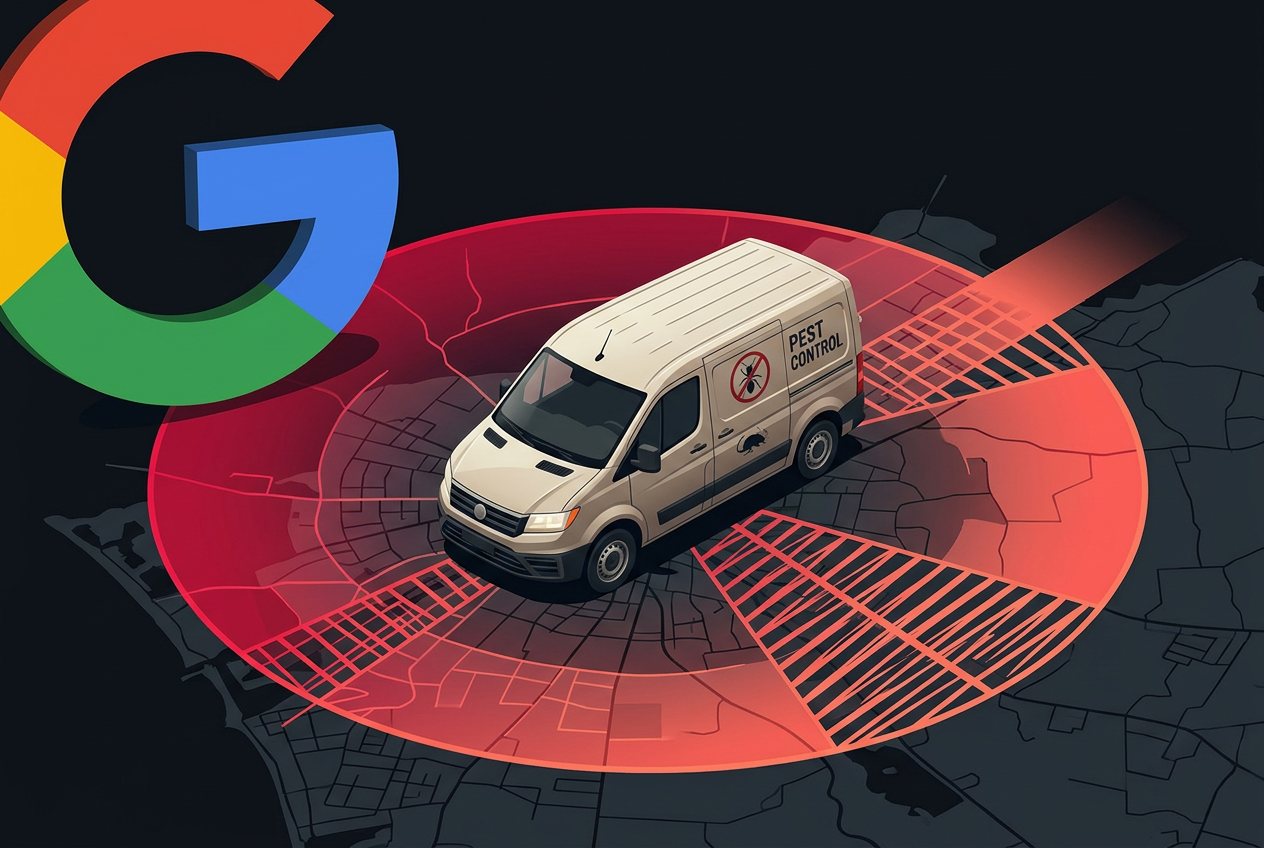
Google's Service Radius Update Is Punishing Pest Control Operators
Google now cross-checks your claimed service area against your operational capacity, and pest control companies that overpromised territory are losing 30–50% of local visibility.
Google rolled out a local search algorithm update in October 2026 that introduced a "service radius consistency" metric. The change is hitting pest control operators harder than almost any other vertical.
The update cross-references the service areas you claim in your Google Business Profile, your Local Services Ads settings, and the territory language on your website. When those don't match—or when Google determines you can't actually service the area you claim within acceptable response windows—your local pack ranking drops and your LSA impression share disappears.
Pest control companies that expanded their claimed radius to capture seasonal demand spikes without adding dispatch capacity are seeing 30–50% visibility drops. The ones claiming a 40-mile radius with two techs and no routing logic are getting hammered.
This is not a local SEO problem. This is an operations problem that now surfaces as a visibility problem.
What Changed
Google has always penalized obvious spam—fake addresses, keyword-stuffed business names, P.O. boxes. This update is different.
It evaluates operational plausibility.
The algorithm now asks: Can this business actually deliver the service it claims, in the geography it claims, within the timeframe customers expect?
For appointment-based service businesses, that question has three inputs:
- The service area boundaries you set in Google Business Profile and LSA
- The geographic coverage reflected in your website content (city pages, service area copy, structured data)
- Behavioral signals that suggest whether you actually fulfill jobs in the claimed territory—review density by ZIP code, response time to LSA leads, appointment density patterns
When those inputs conflict, or when the claimed area looks implausible given your operational footprint, Google suppresses you.
Pest control is getting hit first and hardest because the industry has a long history of claiming the widest possible service radius as standard practice. A single-truck operator in suburban Atlanta claims a 50-mile radius. A two-tech outfit in Phoenix lists 30 ZIP codes. Everyone stretches.
That worked when Google treated service area as a self-reported field. It doesn't work now that Google treats it as an operational commitment.
Why Pest Control
Pest control operates in a uniquely volatile local demand environment.
Termite swarms are hyperlocal and last 48 hours. Fall rodent pressure hits specific neighborhoods as temperatures drop. Bed bug calls spike in multifamily corridors. Mosquito season varies by microclimate.
Operators respond by stretching their claimed territory to capture every possible inbound lead during peak windows. The logic: "I'll figure out how to service it if the call comes in."
But pest control also has some of the tightest service-window expectations in the trades. A homeowner who sees termites swarming wants someone on-site today. A restaurant with a rodent sighting needs service before the health inspector arrives. Same-day and next-day response isn't a differentiator—it's table stakes.
Google's algorithm now knows this.
When a pest control company claims a 40-mile service radius but has review density clustered in a 12-mile core, the algorithm infers a mismatch. When LSA leads from the outer ZIP codes convert at half the rate of core-territory leads, the algorithm infers you can't actually cover the area. When your average response time to outer-zone inquiries is 18 hours while competitors in that zone respond in 4, you get suppressed.
The service radius consistency metric is Google's way of enforcing truth in advertising at the operational layer.
The Old Playbook
For years, the pest control service area playbook looked like this:
- Set your Google Business Profile service area to the maximum radius Google allows or the widest area you'd theoretically drive to.
- Build city pages for every town within 50 miles.
- Run LSA campaigns across the broadest possible geography.
- When a lead comes in from the edge of your territory, decide in the moment whether to take it based on schedule, ticket size, and desperation.
This worked because Google had no way to verify operational follow-through. Your claimed area was your claimed area. The algorithm rewarded coverage, not accuracy.
The October 2026 update flips that. Now, overclaiming is worse than underclaiming.
A pest control operator who accurately claims a tight 15-mile radius and consistently services that zone will outrank a competitor claiming 40 miles who can only reliably cover 20.
What Google Sees
The service radius consistency metric synthesizes multiple signals. Google doesn't publish the exact formula, but reverse-engineering from operator reports and visibility drops reveals the likely inputs.
Service area declaration consistency. Google Business Profile lets you define your service area as a radius or a list of ZIP codes. LSA has its own geographic targeting. Your website has city pages and service area copy. If those don't align—if GBP says 25 miles, LSA targets 40 miles, and your site lists 60 towns—you trigger a consistency flag.
Review geography. If you claim to serve 30 ZIP codes but 80% of your reviews come from six of them, Google infers that your operational center of gravity is much smaller than your claimed area. Sparse or absent reviews in the outer zones signal you're not actually fulfilling work there.
Lead response behavior. For LSA, Google tracks how fast you respond to leads and whether you convert them into booked jobs. If you respond to core-territory leads in 90 seconds and outer-territory leads in 8 hours, the algorithm learns that you deprioritize the edge. If you ghost leads from certain ZIP codes, Google stops showing you there.
Appointment density. If your booking system integrates with Google (via Reserve with Google, schema markup, or LSA's booking flow), Google can see where your appointments cluster. A claimed 40-mile radius with zero booked appointments in the outer 15 miles is a red flag.
Routing plausibility. Google owns Waze and has access to real-time traffic and drive-time data. It knows that a pest control operator based in Alpharetta, Georgia can't reliably promise same-day service in Newnan (45 miles south) during rush hour. If your GBP address is in the northern suburbs and you claim territory that would require 90-minute drive times, the algorithm discounts you.
The throughline: Google is now treating your service area as a capacity constraint, not a marketing variable.
The Dispatch Problem
Most pest control operators do not plan dispatch capacity around their claimed service radius. They do the opposite—they claim the widest possible radius and then manage dispatch reactively.
When a lead comes in, the dispatcher checks the board, looks at drive time, weighs the ticket size, and decides whether to squeeze it in. If the schedule is light, they'll drive an hour. If it's packed, they'll push the outer-territory job to next week or ghost it entirely.
This approach optimized for maximum inbound lead volume. Cast the widest net, filter later.
Google's update punishes that model because the filtering behavior creates a revealed preference that contradicts your claimed area. You say you serve 40 miles. Your response patterns say you reliably serve 18.
To rank well under the new metric, pest control operators need to flip the logic:
Claim only the territory you can service with consistency, then build dispatch capacity to match seasonal peaks within that territory.
That requires three operational shifts.
Operational Shift One: Service Area as a Capacity Decision
Your claimed service area should be a function of how many techs you run, your average jobs per day per tech, your geographic density, and your target response window.
A pest control company running two techs in a metro market should not claim a 40-mile radius. If each tech completes six stops per day and you want same-day or next-day response, your serviceable radius is probably 12–18 miles, depending on density.
You calculate it backward from capacity:
- Two techs × six stops per day = 12 appointments per day
- Average drive time between stops in your area = 15 minutes
- Target response window = same-day for emergencies, next-day for standard service
- Maximum drive time from base to job site you can absorb without blowing the schedule = 25 minutes
That math gives you a realistic radius. Claim that in Google Business Profile. Claim that in LSA. Build your website city pages around that core.
When you add a third tech, you expand the radius. When you add routing software that cuts drive time by 20%, you expand again. But you expand after you build the capacity, not before.
Operational Shift Two: Routing and Scheduling as an SEO Input
Google's service radius consistency metric makes pest control routing software a direct input to local search visibility.
If your dispatch process is a whiteboard and a dispatcher's mental map, you can't prove you cover your claimed area efficiently. You'll miss the outer zones, stack jobs inefficiently, and blow response windows.
If you run routing software that optimizes daily schedules by drive time and clusters jobs geographically, you can pack more stops into the same radius, reduce windshield time, and maintain consistent response windows across your territory.
That operational improvement shows up in the signals Google tracks: faster lead response, higher review density across the service area, more appointment completions in every zone.
Pest control operators who deploy routing logic can claim a 20–25% larger service radius than competitors with the same tech count—because they can actually cover it.
The tool isn't the point. The operational truth is the point. But the tool makes the truth legible to the algorithm.
Operational Shift Three: Seasonal Capacity Planning
Pest control demand is seasonal and episodic. Termite swarms in spring. Mosquito pressure in summer. Rodent intrusion in fall. Bed bugs year-round in hospitality zones.
The old playbook was to claim a huge service radius year-round and hope to capture the seasonal spikes when they hit.
The new playbook is to add temporary capacity during peak windows so you can maintain your claimed service area without degrading response times.
That means:
- Hiring seasonal techs for termite season or mosquito season
- Partnering with adjacent operators to share overflow during demand spikes
- Offering time-shifted pricing (next-day discount, same-day premium) to smooth demand within your claimed radius
- Using your CRM to predict seasonal peaks by ZIP code and pre-position capacity
When you plan capacity around your claimed territory instead of planning territory around your capacity, you maintain consistency. Google's algorithm rewards that.
The Visibility Collapse
Operators who ignore this are seeing sharp drops in the metrics that drive pest control lead volume.
Local pack rankings. Companies that used to appear in the three-pack for "pest control near me" searches across 20 ZIP codes now appear in six. The ones still ranking consistently are the ones whose operational footprint matches their claimed area.
LSA impression share. Google Local Services Ads for pest control used to show to anyone searching within your claimed radius. Now, if Google detects that you don't reliably service the outer zones, your impressions drop even if you're paying for that geography. You're still charged for the narrower area, but you've lost half your reach.
Review velocity. Pest control companies depend on fresh reviews to stay competitive in local search. When your visibility drops in the outer zones, you stop winning jobs there. When you stop winning jobs, you stop earning reviews. The review density gap widens, which reinforces the algorithmic suppression.
One operator in Florida reported a 40% drop in LSA impressions and a 30% drop in local pack visibility within three weeks of the update. Their claimed service area hadn't changed. Their Google Business Profile was compliant. But their two-tech operation couldn't cover the 35-mile radius they'd been claiming for years, and Google's algorithm figured it out.
The Rebuild
Pest control operators who want to recover—or avoid the drop in the first place—need to audit the gap between claimed territory and operational capacity, then close it.
Step one: Pull your lead and job data by ZIP code. Map where your inbound leads come from and where your completed jobs cluster. If you claim 40 ZIP codes but do 70% of your work in 12, you've found the gap.
Step two: Calculate your realistic service radius. Use tech count, average stops per day, and drive time to model the area you can cover with consistent response windows. Be honest. If you can't reliably promise next-day service beyond 15 miles, don't claim 25.
Step three: Align your claimed area across platforms. Make your Google Business Profile service area, your LSA targeting, and your website service area copy match. If you serve 18 ZIP codes, claim 18 everywhere. Delete the orphan city pages for towns you don't actually cover.
Step four: Improve routing and dispatch. Implement scheduling software that optimizes routes and reduces drive time. The efficiency gain lets you cover more area with the same team—or cover the same area with better response times, which strengthens the consistency signals Google tracks.
Step five: Build seasonal capacity. Identify your demand peaks by service line and geography. Add temporary techs, adjust pricing, or partner with other operators to maintain response windows during high-volume periods. Consistency during peak season matters more than consistency in January.
Step six: Monitor the signals Google monitors. Track your lead response time by ZIP code. Track your review distribution. Track your appointment density. If you see gaps opening up in the outer zones, either add capacity or contract your claimed area before Google does it for you.
The Larger Shift
Google's service radius consistency metric is the leading edge of a larger trend: platforms are starting to enforce operational truth.
For years, digital marketing in appointment-based services was about claiming things—claiming territory, claiming capabilities, claiming availability. The platforms had no way to verify, so the game rewarded aggressive claims.
That's ending.
Google can now cross-reference your claimed service area with your actual service patterns. Yelp tracks whether you respond to leads and convert them. Angi scores you on completion rate. Thumbtack measures response speed. The platforms have enough behavioral data to separate operators who deliver from operators who overpromise.
This shifts the locus of competitive advantage. It's no longer enough to optimize your Google Business Profile or bid aggressively on LSA. You have to operationalize every claim you make.
If you claim a 25-mile service radius, your dispatch scheduling has to support it. If you claim same-day availability, your calendar and routing have to prove it. If you claim coverage in 30 ZIP codes, your review density and appointment data have to reflect it.
Marketing and operations are converging. The companies that treat them as one system will compound visibility. The ones that treat marketing as aspiration and operations as a back-office function will get suppressed.
Pest control is the canary. But every appointment-based service vertical is heading in the same direction.
Systems Over Claims
The pest control operators recovering fastest from the October update are the ones who stopped thinking about service area as a marketing decision and started thinking about it as a system.
They model capacity. They route efficiently. They plan for seasonal peaks. They claim only what they can cover, and they build the infrastructure to expand coverage before they expand claims.
Their local pack rankings are rebounding. Their LSA impression share is stabilizing. And they're compounding a new advantage: when the next algorithm shift rewards operational consistency—and it will—they'll already be aligned.
The operators still trying to game the radius, hoping Google won't notice the gap between claimed territory and actual coverage, are in a visibility death spiral.
Google's service radius consistency metric isn't a penalty for bad SEO. It's a penalty for bad operations. The fix isn't an audit of your Google Business Profile. The fix is an audit of your dispatch capacity, your routing efficiency, and your service area planning.
Claim what you can cover. Build systems to expand what you can cover. Let your operational truth drive your platform presence, not the other way around.
That's the new game.