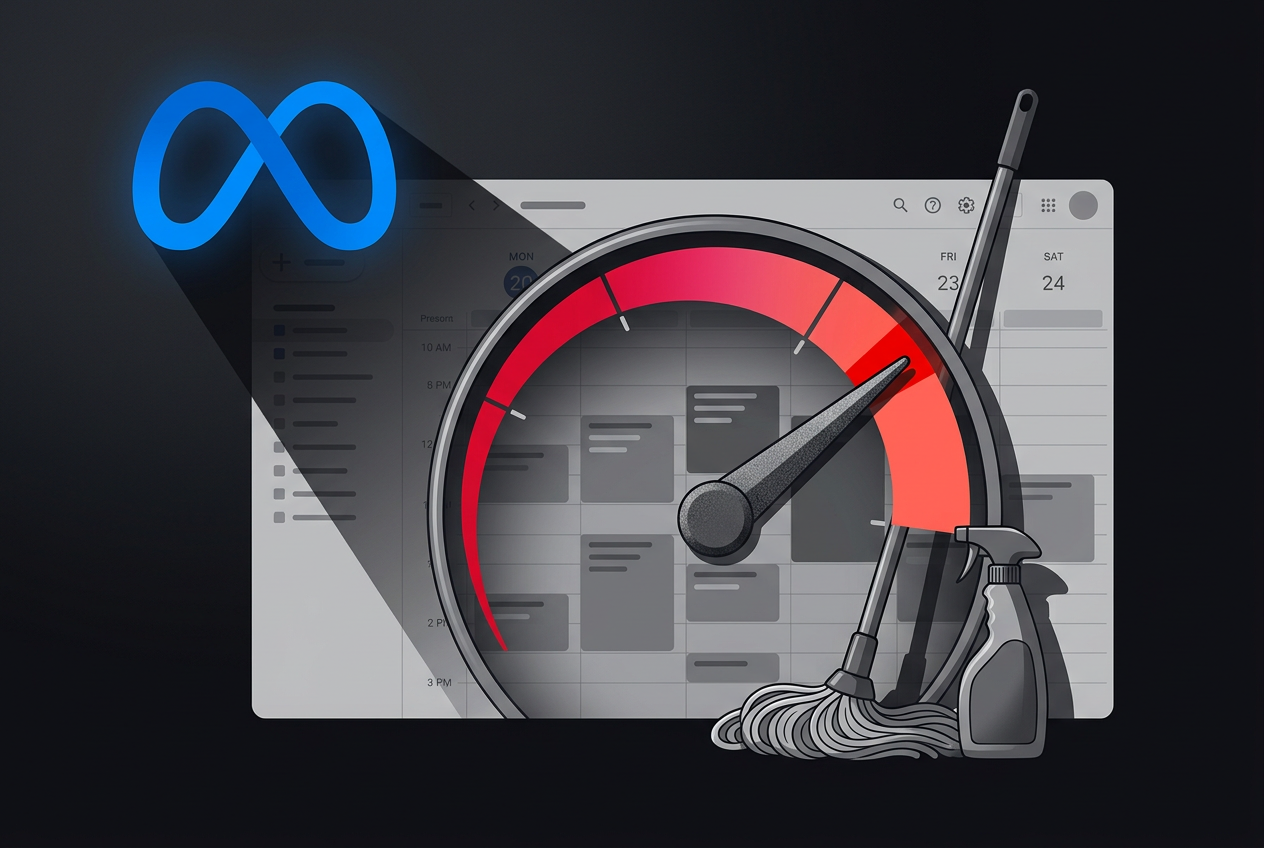
Meta's Service Delivery Windows Just Made Your CRM a Revenue Gate
Meta's new Creative Quality signal throttles ads that promise tight service windows but can't prove delivery—and cleaning operators are feeling it first.
Meta rolled out "Service Delivery Windows" as a Creative Quality signal this month, and residential cleaning operators woke up to CPMs 30–60% higher or delivery volume cut in half. The mechanic is simple: if your ad creative promises same-day service, next-day availability, or "flexible scheduling" but your booking flow offers four-hour arrival windows or vague "morning/afternoon" slots, Meta now reads that as a mismatch between promise and capability. Your ads get deprioritized. Your cost per click climbs. Your volume craters.
This is not a creative problem. This is not a targeting tweak. This is an infrastructure audit disguised as an ad policy change.
And cleaning businesses—residential and commercial—are the canary in the coal mine because they've built entire acquisition strategies on speed and convenience promises they can't operationally prove at the point of booking.
The Signal Mechanic
Meta's Service Delivery Windows signal works by scraping your booking flow after a user clicks your ad. If you advertise same-day service, Meta expects your calendar to offer arrival windows of 90 minutes or less, available within the timeframe you advertised. If you promote "book online in 60 seconds," Meta checks whether your form actually allows scheduling without a phone call or email handoff.
The system doesn't parse your ad copy for intent. It measures the delta between what you say and what your infrastructure can deliver.
If the gap is too wide, you get tagged. Your Creative Quality score drops. Your CPM rises or your delivery throttles. You don't get a warning email. You just see your cost per lead double over a week and your ad account rep shrugs and suggests "testing new creative."
Residential cleaning companies are hit hardest because the category has spent three years optimizing for one conversion message: we're fast, we're flexible, we fit your schedule. Same-day deep cleans. Next-day move-outs. Online booking with no phone tag.
But behind that front door, most operators are still running on:
- CRMs that don't sync real-time crew availability
- Scheduling tools that default to four-hour windows because tighter routing breaks utilization
- Dispatch workflows that require manual confirmation before a slot is "real"
- Booking forms that say "we'll call you to confirm your time"
Meta's new signal just turned that ops debt into an acquisition tax.
Why Cleaning Got Tagged First
Cleaning businesses live in the highest-promise, lowest-margin part of the service economy. A residential deep clean runs $150–$400. A move-out clean might hit $600. Commercial post-construction cleanup can push higher, but the median job size is small and the conversion cycle is short.
That means the entire growth model depends on fast-turn, low-friction acquisition. You can't afford a 14-day nurture sequence. You can't absorb a $90 cost per booked job when your average ticket is $220 and your margin is 18%.
So cleaning operators leaned into speed positioning. Same-day availability. Instant online booking. No estimates, just transparent pricing and a calendar link.
And it worked—until the ops stack couldn't keep up.
The problem isn't the promise. The problem is that most cleaning businesses are still using scheduling tools built for a different growth era. Tools that:
- Let customers "request" a time but require dispatch approval before confirmation
- Show availability based on static crew capacity, not real-time job duration and drive time
- Offer four-hour windows because the algorithm can't optimize tighter routes without breaking technician utilization
- Don't account for job-specific variables—square footage, add-ons, access issues—that change arrival precision
You told Meta you offer tight windows. Your booking page told Meta you offer requests.
Meta chose to believe your booking page.
The Ops Litmus Test
Here's the test every cleaning operator should run today:
Open an incognito browser. Click one of your own Meta ads. Go through your booking flow as if you're a customer who just saw your "same-day service" or "book online now" promise.
What does your calendar actually offer?
If the answer is "select morning or afternoon and we'll call you," you're getting tagged.
If the answer is "choose a four-hour window and we'll narrow it down the day before," you're getting tagged.
If the answer is "submit your info and we'll send you available times," you're getting tagged.
Meta's signal doesn't care about your intent. It measures the gap between the promise in the ad and the precision in the booking flow.
And here's the second-order problem: you can't fix this with better ad copy. If you pull back your promises—drop the "same-day" claim, remove the "instant booking" language—you lose the conversion edge that made Meta ads work in the first place.
Cleaning is a convenience purchase. The decision cycle is measured in hours, not days. If your ad says "request a quote" instead of "book now," your competitor who can offer tight windows just took your volume.
The only fix is infrastructure.
What Tight Windows Require
Offering 90-minute arrival windows at scale—and proving it to Meta's scraper—requires four operational components that most cleaning businesses don't have integrated:
Real-time crew availability. Your booking calendar has to know where every crew is, when they'll finish their current job, and how long it takes to drive to the next one. Not static shifts. Not manual dispatch. Live state.
Dynamic job duration estimation. A 1,200-square-foot apartment deep clean takes 2.5 hours with a two-person crew. A 3,000-square-foot house with add-ons takes 5. Your calendar has to calculate duration based on the inputs the customer provides before they book, or your windows are fiction.
Route-aware scheduling. If a customer in zip code 30308 wants a 2 PM slot, your system has to know whether you have a crew finishing a job in 30309 at 1 PM or whether the nearest available team is 40 minutes away in 30318. Tight windows require routing logic baked into availability, not bolted on after booking.
Instant confirmation with no human gate. If your workflow requires a dispatcher to approve the booking, you're not offering online scheduling—you're offering a lead form with extra steps. Meta's signal measures whether the customer gets a confirmed time in the booking session, not whether you call them back in three hours.
Most residential cleaning operators have one or two of these pieces. Almost none have all four connected in a way that the booking page can expose to a cold Meta click.
And that's the new cost of acquisition.
The Infrastructure Wedge
The operators who solve this first don't just get their CPMs back. They open a wedge.
Because once you build the ops stack that can offer 90-minute windows and prove it at the point of booking, you're not just compliant with Meta's signal—you've built a conversion moat.
Think about the customer experience delta:
Competitor A (95% of the market): Ad says "same-day service." Booking page says "choose morning or afternoon, we'll call to confirm."
Competitor B (you, post-fix): Ad says "same-day service." Booking page says "2:00–3:30 PM today, crew confirmed, $240."
You're not competing on price. You're not competing on reviews. You're competing on proof.
The customer doesn't have to trust that you'll call back. They don't have to wonder if "morning" means 8 AM or 11 AM. They see the crew, the window, the price, and the confirmation—in the session.
That's not a 10% conversion lift. That's a different customer decision path.
And it compounds: tighter windows mean fewer no-shows, because the customer picked a specific time that works for them instead of a vague range. Fewer no-shows mean better crew utilization. Better utilization means you can actually afford to run tighter routes. Tighter routes mean lower drive time and higher daily revenue per technician.
The ops infrastructure that fixes your Meta ads also fixes your unit economics.
What This Looks Like in Production
A residential cleaning company in Atlanta was running 12–15 jobs per day per crew, four-hour arrival windows, 18% no-show rate, $62 CPM on Meta, and a 4.2% click-to-book conversion rate.
They rebuilt their scheduling stack:
- Integrated real-time GPS and job status from their field teams
- Added dynamic duration logic based on square footage, room count, and selected add-ons
- Built route-aware availability so the booking calendar only showed windows the system could actually hit
- Removed the "we'll call to confirm" step—booking meant confirmation
Three weeks after go-live:
- CPM dropped to $41
- Click-to-book conversion jumped to 11.8%
- Average arrival window tightened to 90 minutes
- No-show rate fell to 6%
- Jobs per crew per day rose to 16–18 because tighter routing reduced drive time
They didn't change their ad creative. They didn't add budget. They didn't hire a new agency.
They built the ops layer that their marketing had been promising for two years.
And Meta's new signal rewarded them for it.
The Commercial Cleaning Parallel
This isn't just a resi play. Commercial cleaning operators face the same gap, just with different variables.
A janitorial company running post-construction cleanup advertises "next-day service for contractors" and "schedule online." But their booking flow requires a site walk, a custom quote, and a two-day confirmation cycle.
Meta's signal sees that delta and tags it.
The fix isn't faster sales calls. The fix is productizing enough of the quoting logic—square footage, scope checklist, access requirements, crew size—that you can offer confirmed windows for standard jobs without human intervention.
You keep the site walk for complex builds. But the 80% of jobs that fit your standard parameters? Those book instantly, with tight windows, with confirmed crews.
That's what Meta's signal is measuring. Not your sales process. Your infrastructure's ability to convert intent into commitment in the session.
Why This Is Permanent
Some operators are treating this like a temporary algo shake-up. Wait it out. Test new creatives. Shift budget to Google.
That's a misread.
Service Delivery Windows isn't a bug or a beta test. It's Meta formalizing what consumers already expect: if you promise speed and convenience, your systems need to prove it before the click converts.
This signal will only get stricter. Meta has spent three years trying to close the loop between ad promise and real-world delivery—lead quality scores, conversion API, offline event matching. Service Delivery Windows is the next layer: measuring whether your infrastructure can fulfill what your creative advertises.
And it's working. Early data from Meta's Q3 2026 earnings showed that advertisers who passed the Service Delivery Window check saw 22% higher conversion rates and 19% lower cost per acquisition than those who didn't.
Meta is training the algorithm to favor operators who can prove their promises.
If your ops stack can't keep up, your CPMs will keep climbing until your unit economics break or your volume disappears.
The Compounding System
Here's the deeper point:
The operators who fix this aren't just solving for a Meta policy change. They're building the scheduling and routing and confirmation infrastructure that compounds across the entire revenue engine.
Tighter windows improve conversion—not just on Meta, but on your Google LSAs, your organic landing pages, your referral links.
Lower no-shows improve crew utilization and technician retention.
Faster booking cycles shorten your cash conversion window.
Real-time availability reduces dispatch overhead and manual coordination.
You're not optimizing for an ad signal. You're engineering a system where acquisition, conversion, and operations pull in the same direction.
That's what separates operators who grow predictably from operators who keep hitting acquisition ceilings they can't explain.
Meta's Service Delivery Windows signal just made the gap visible.
The question is whether you treat it like a creative problem to hack around or an infrastructure problem to solve.
Because the operators who solve it don't just get their CPMs back.
They build a moat that makes every other cleaning company's four-hour windows look like a request form from 2019.